

The Best Water Temperature for Brewing Coffee
Last Updated: November 4, 2026
Quick Summary
The best water temperature for brewing coffee is 195°F to 205°F, based on the Specialty Coffee Association's Golden Cup Standard of 200°F ± 5°F. Water below 195°F under-extracts and tastes flat, while water above 205°F scorches the grounds and turns the cup bitter.
- Lighter roasts reward the hotter end at around 200°F to 205°F, while darker roasts do better near 195°F to 200°F.
- French press brewing works best at 195°F to 200°F because immersion lets heat and time stack up.
- Pour-over needs 200°F to 205°F since its thin bed of grounds loses heat fast during a 3-4 minute brew.
- Bitter coffee usually means over-extraction, so drop your water temperature by 5°F before changing anything else.
- Water boils about 1.9°F lower for every 500 feet of elevation, so at 5,000 feet it boils near 203°F.
Table of Contents
- Why 195°F to 205°F Is the Best Water Temperature for Brewing Coffee
- Coffee Brew Temperature Chart by Method and Roast
- The Best Temperature to Brew Coffee French Press
- The Best Temperature for Coffee Pour Over
- How to Measure Water Temperature Without Guessing
- How to Fix Bitter Coffee by Adjusting Temperature
- Altitude, Water Chemistry, and Other Variables That Shift Your Target
- Pick a Roast and Start Dialing In Your Brew Temperature
- Frequently Asked Questions
Why 195°F to 205°F Is the Best Water Temperature for Brewing Coffee
The best water temperature for brewing coffee is 195°F to 205°F. It comes from the Specialty Coffee Association's Golden Cup Standard, which sets a target of 200°F ± 5°F for hot coffee brewing. The National Coffee Association publishes the same 195°F to 205°F band as standard guidance, and Consumer Reports still uses it to lab-test drip machines in 2026.
Roasting to order keeps beans fresh, and the water you pour over them is the last variable you control. Get it wrong and even a great bean tastes flat or harsh.
Here is the short version: water below 195°F under-extracts, water above 205°F scorches, and the sweet spot moves a little depending on your roast.
What the Golden Cup Standard Actually Says
The Golden Cup Standard is the Specialty Coffee Association's benchmark for a balanced cup, and it fixes water at 200°F ± 5°F. That gives you 195°F as the floor and 205°F as the ceiling.
Water boils at 212°F at sea level, so brewing temperature sits just below the boil. You are never pouring boiling water straight onto grounds. The Coffee Chronicler's brewing guidance notes that anything under 195°F reads as flat, because the water cannot pull enough flavor out of the grounds.
How Temperature Drives Extraction, Solubility, and Flavor
Temperature controls how fast water dissolves the flavor compounds in coffee. Hotter water pulls more out, faster. Cooler water pulls less, slower.
That matters because coffee holds hundreds of flavor compounds, and they do not all dissolve at the same rate:
- Acids and fruit notes come out first, which is why weak coffee tastes sour.
- Sugars and caramel sweetness follow in the middle.
- Bitter compounds and dry tannins come out last.
Your grind size and contact time also shape extraction, not just heat. If you want to understand how the filter medium changes what reaches the cup, read our guide to alternatives to paper coffee filters for better flavor.
Coffee Brew Temperature Chart by Method and Roast
Here is how we set temperature across the common brew methods and roast levels.
| Method | Target Temp | Grind | Contact Time | Watch For |
|---|---|---|---|---|
| Pour-over (V60, Chemex) | 200°F-205°F | Medium-fine | 3-4 min | Slurry dropping too fast |
| French press | 195°F-200°F | Coarse | 4 min | Over-extraction from fine sediment |
| Drip machine | 195°F-205°F | Medium | 5-6 min | Machine running cool |
| AeroPress | 185°F-205°F | Fine to medium | 1-2 min | Bitter finish at full heat |
| Cold brew | Below 77°F | Coarse | 12-18 hr | Weak concentrate |
Roast level shifts where you sit inside that band. Lighter roasts are denser and give up flavor slowly, so they reward the hotter end, around 200°F to 205°F. Darker roasts are more porous and extract fast, so they do better near 195°F to 200°F. If you want to understand how roast level changes the target before dialing in your own beans, our breakdown of dark roast vs medium roast coffee blends covers the trade-offs.
The Best Temperature to Brew Coffee French Press
The best temperature to brew coffee in a French press is 195°F to 200°F. Immersion brewing keeps grounds in contact with water for the full four minutes, so heat and time stack up.
Two things make the French press different. First, the glass or steel carafe has real thermal mass, so it pulls heat out of the water the moment you pour. Second, the metal mesh lets fine particles through, and those keep extracting in the cup.
A medium-dark immersion-friendly roast holds up well here. Our Sumatra Single Origin has a syrupy body and brown spice, and it is a strong choice for the French press. Grind coarse, pour at 197°F, stir once, and press slowly at four minutes.
The Best Temperature for Coffee Pour Over
The best temperature for coffee pour over is 200°F to 205°F. Pour-over is a fast, high-agitation method with a thin bed of grounds, so it needs more heat to reach full extraction in three to four minutes.
Water loses heat as it travels. It leaves the kettle, crosses the air, and hits a room-temperature dripper and carafe. A preheated cone and rinsed filter cut that loss. So does keeping the kettle on heat between pours.
Lighter, fruit-forward coffees generally respond best to the top of the range. Our Ethiopia Single Origin lists pour-over as an ideal method for its floral and berry notes. Our Colombia Single Origin is a medium roast with dark chocolate and peach notes.

How to Measure Water Temperature Without Guessing
Measuring water temperature means using a digital instant-read thermometer, not eyeballing steam. Kettle dials drift, and "just off boil" is a guess that swings 10°F or more. An instant-read digital thermometer is enough for brewing; you do not need a lab-grade instrument.
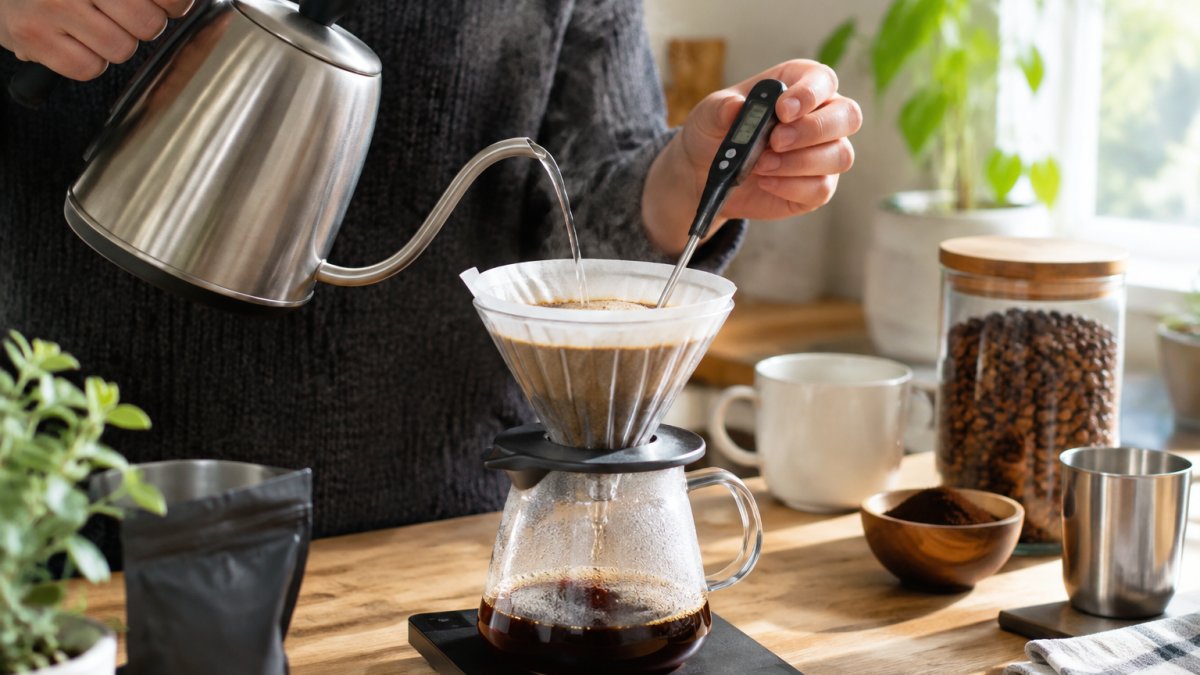
Here is the routine we use:
Best Sellers Coffee Tasting Flight - 6 Curated Roasts (2 oz Bags) →
- Boil fresh water, then let it rest. Two minutes off the boil lands near 205°F in a standard thin-walled kettle, but check with your probe rather than trusting the clock.
- Stick the probe in the kettle, not the stream. You want the water body, not a splash.
- Wait for the reading to settle, usually 3 to 5 seconds.
- Recheck mid-brew on long pours. Kettles shed heat fast.
- Log the number next to your grind setting so you can repeat a good cup.
Off-Boil Timing and Temperature Decay
Off-boil timing is the gap between boiling and pouring, and it is the cheapest temperature control you own. At sea level, water boils at 212°F. How fast it drops depends heavily on the kettle material and mass:
| Kettle Type | Approx. Loss in First 60 sec | Approx. Loss in Next 60 sec |
|---|---|---|
| Thin stainless, 1 L | 8°F-10°F | 5°F-7°F |
| Heavy stainless or copper, 1 L | 5°F-7°F | 3°F-5°F |
| Ceramic-lined or cast iron | 3°F-5°F | 2°F-4°F |
| Glass (poor insulator) | 10°F-12°F | 6°F-8°F |
That decay is not linear. It is steep at first, then flattens as the water approaches room temperature. A heavy kettle with more thermal mass holds heat longer than a thin one.
The same principle applies to your brewing vessel. A room-temperature ceramic dripper pulls 5°F to 8°F out of the slurry in the first 30 seconds, while a preheated glass or plastic cone pulls far less.
This is why a thermometer beats a stopwatch. Time tells you what you did. Temperature tells you what the coffee got. If you want another method where precise water temperature control matters in practice, our Turkish coffee brewing guide walks through it step by step.
How to Fix Bitter Coffee by Adjusting Temperature
Bitter coffee usually means over-extraction, and the fastest fix is dropping your water temperature by 5°F. Bitter, drying, ashy notes come from compounds that dissolve late, so cooler water stops pulling them out.
Try this order of adjustments:
- Drop 5°F and brew again before changing anything else.
- Coarsen the grind one step if bitterness persists.
- Shorten contact time by 15 to 30 seconds.
- Check your ratio at 1:16 coffee to water as a starting point.
Watch out: if the cup tastes sour and thin instead, you have the opposite problem. Under-extracted coffee needs more heat, not less. A 5°F bump and a finer grind will fix it.
One caveat worth knowing. A 2020 study in Scientific Reports found that when extraction and strength are held constant, brew temperature has little effect on the sensory profile. Translation: temperature is a lever for extraction, not a flavor dial on its own. Fix the temperature, then fix the grind.
Altitude, Water Chemistry, and Other Variables That Shift Your Target
Altitude changes your boiling point, and most guides ignore it. Water boils at 212°F at sea level, but the boiling point drops roughly 1.9°F for every 500 feet of elevation gain.
The fix is to stop treating off-boil timing as a fixed rule and treat it as an altitude adjustment. Here is how the target shifts:
| Elevation | Approx. Boiling Point | Off-Boil Rest | Effective Brew Temp |
|---|---|---|---|
| Sea level to 1,000 ft | 212°F | 60-90 sec | 200°F-205°F |
| 2,000-3,000 ft | 208°F-209°F | 30-45 sec | 198°F-203°F |
| 4,000-5,000 ft | 203°F-205°F | 0-15 sec | 200°F-203°F |
| 6,000-7,000 ft | 199°F-201°F | Pour immediately | 197°F-200°F |
| Above 7,000 ft | Below 199°F | Pour immediately, extend contact | 195°F-198°F |
At high altitude, grind slightly finer and extend contact time by 15 to 30 seconds to compensate for the lower ceiling on heat.
Water chemistry matters too, and it interacts with temperature in ways most guides skip. Pure distilled water is a poor solvent for coffee because it lacks the mineral ions that help pull flavor compounds into solution.
Then there is temperature stability during the brew cycle. Cheap drip machines heat water, then let it cool as it cycles.
Pick a Roast and Start Dialing In Your Brew Temperature
The best water temperature for brewing coffee is a starting point, not a finish line. Set your kettle to 200°F, brew, taste, and adjust by 5°F until the cup lands where you want it. That is the whole method.
At LGBrewTeaQ, we roast to order in small batches, so the beans arrive fresh enough to reward that kind of tuning. Our Best Sellers Coffee Tasting Flight gives you six 2 oz roasts for $24.99, a convenient way to compare roast levels side by side.
Best for: brewers who want to compare roast levels side by side. Skip if: you already have a favorite and just need one bag.
Frequently Asked Questions
What's the best water temperature to brew coffee?
The industry range is 195°F to 205°F, and the Specialty Coffee Association's Golden Cup Standard targets 200°F plus or minus 5°F. Below 195°F, extraction slows and the cup tastes flat and sour. Above 205°F, you risk scorching the grounds and pulling out harsh bitterness. Within that band, lighter roasts tend to do better near the top and darker roasts near the bottom, so adjust your coffee brewing temperature to the bean rather than treating 200°F as a fixed rule.
Does the roast level of the coffee bean change the ideal brewing temperature?
Yes. Lighter roasts are denser and less soluble, so they often need water closer to 205°F to extract fully. Darker roasts are more porous and give up flavor compounds faster, so 195°F to 198°F keeps them from turning bitter. A medium roast like LGBrewTeaQ's Colombia Single Origin sits comfortably around 200°F. If a dark roast tastes ashy at 202°F, drop 5 degrees before you change your grind.
How does water temperature affect the bitterness of coffee?
Heat increases solubility, so hotter water pulls more compounds out of the grounds in the same contact time, including the bitter ones. If your coffee tastes harsh or drying, drop the water temperature by 5°F and keep everything else the same. If it tastes weak and sour, go up 5°F. Research published in Scientific Reports in 2020 found temperature matters little when extraction and strength are held constant, which means temperature is a lever for extraction, not a flavor dial on its own.
Can I brew good coffee without a thermometer?
You can get close. Boil water, then let it sit off the boil for about 30 to 45 seconds before pouring. That rest usually lands you near 200°F in a standard kettle. The catch is that kettles, room temperature, and altitude all change the cooling rate, so a $10 instant-read thermometer removes the guesswork. Once you know what 200°F feels like on your kettle, you can repeat it.
Your kettle is probably running 10°F off what you think, and your coffee is telling you so. LGBrewTeaQ roasts every bag to order, ships it fresh, and gives you the roast range to test your temperature against. Shop coffee with LGBrewTeaQ and start dialing in a cup that tastes the way it should.
