

Gay Coffee Shop Culture: LGBTQ+ Cafes & Roasters
Table of Contents
- What Makes a Coffee Shop a Gay Coffee Shop
- LGBTQ+ Owned Coffee Roasters Worth Knowing
- How to Support LGBTQ+ Businesses in Coffee
- Accessibility and Neurodiversity in Queer Cafe Spaces
- Community Hubs and Gathering Spots: The Third Place
- Supporting POC-Owned Queer Spaces and Intersectionality
- Bringing the Gay Coffee Shop Home: Gear That Shows Pride
- Frequently Asked Questions
Last Updated: September 28, 2026
What Makes a Coffee Shop a Gay Coffee Shop
A gay coffee shop actively welcomes LGBTQ+ patrons through visible signals, inclusive hiring, and community programming, not just a rainbow sticker. Staff use correct pronouns, and nobody stares when you hold your partner's hand.
Inclusivity Verification Criteria: What Actually Counts
Most lists of queer-friendly cafes rely on self-identification, a weak standard. Use this checklist to verify a cafe genuinely serves the queer community:
- Visible signals beyond June: year-round Pride flag, pronoun pins, or queer-affirming signage
- Inclusive hiring: job postings that mention LGBTQ+ candidates and nondiscrimination policies
- Gender-neutral restrooms: or clearly marked all-gender options
- Community programming: drag brunches, queer book clubs, trans meetups, or open mics
- Ownership transparency: the cafe publicly identifies as queer-owned or LGBTQ+ owned
- Staff training: evidence that baristas understand pronoun use and de-escalation
- Local partnerships: collaborations with LGBTQ+ nonprofits, artists, or organizers
LGBTQ+ Owned Coffee Roasters Worth Knowing
LGBTQ+ owned coffee roasters are businesses where the people who source, roast, and sell the beans are openly queer. Supporting them puts money directly into LGBTQ+ hands rather than a corporation's Pride campaign.
- Transparent sourcing: named farms, regions, and processing methods
- Fresh roasting: beans roasted to order rather than sitting on shelves
- Community ties: roasters who host queer events or donate to LGBTQ+ causes
- Direct-to-door delivery: convenient access whether or not you live near a queer hub
How to Support LGBTQ+ Businesses in Coffee
Supporting LGBTQ+ businesses in coffee means changing where your money goes the other eleven months of the year, not just buying a latte in June.
Start with these habits:
- Switch one recurring purchase. Make your weekly beans or tea order come from a queer-owned roaster.
- Buy gift cards for friends. A digital gift card introduces someone new to the brand without any risk.
- Leave reviews that mention the vibe. Reviews help queer-friendly cafes rank higher and get discovered.
- Attend community events. Showing up matters more than posting about it.
- Ask businesses about their practices. Questions push owners to be transparent.
National Directory vs. Local Lists: Where to Look
National directories and local lists serve different purposes; using both gives the most reliable picture of queer-friendly cafes near you.

Accessibility and Neurodiversity in Queer Cafe Spaces
Accessibility and neurodiversity are the most overlooked parts of the queer cafe conversation. A space is not truly safe if disabled and neurodivergent patrons cannot use it comfortably.
What genuine accessibility looks like:
- Step-free entry and wide aisles between tables
- Clear, non-flickering lighting for patrons sensitive to sensory overload
- Quiet hours or low-volume music periods
- Menus in plain language with allergen details
- Staff trained to communicate without pressure or rush
Community Hubs and Gathering Spots: The Third Place
Community hubs are the heart of gay coffee shop culture, sociologists call this the "third place," neither home nor work, where people build real relationships. But a third place is engineered through operational choices most cafes never make.
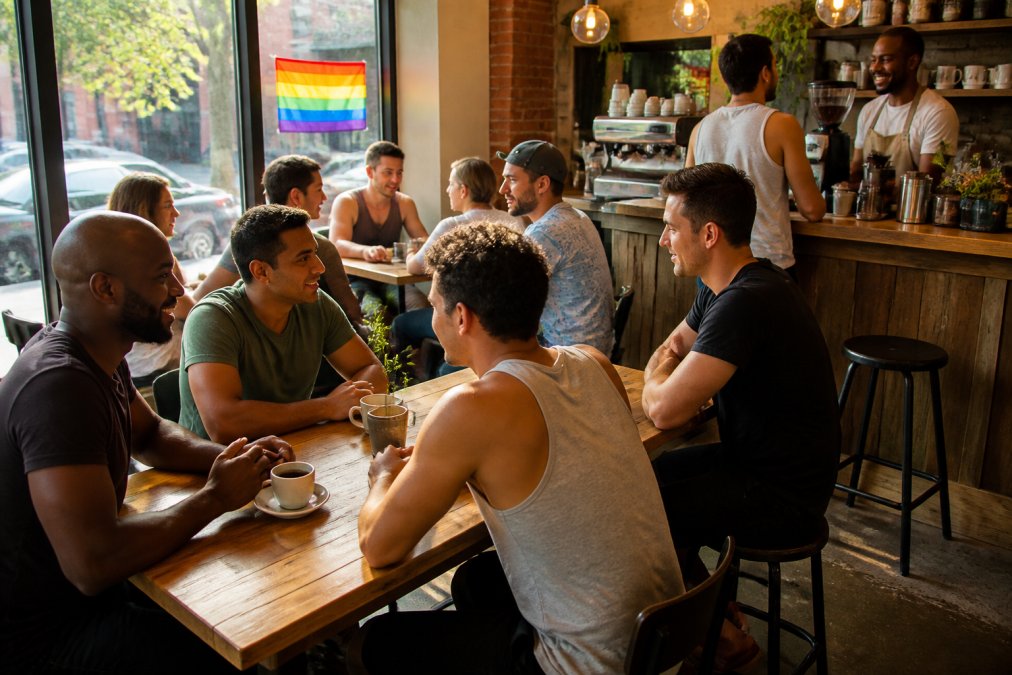
The Operational Mechanics of a Real Hub
What separates a genuine gathering spot from a cafe that just has a rainbow sticker comes down to repeatable systems. Here is what to look for, and what to ask about:
- A named recurring event calendar. Not "we do drag sometimes" but a posted schedule: first Thursday queer book club, second Saturday trans meetup, monthly open mic. Predictability is what turns strangers into regulars.
- A community bulletin board or zine rack. Physical infrastructure signals that the cafe expects the community to use the space, not just consume in it.
- Seating zoned for different needs. Communal tables for groups, two-tops for pairs, and a quieter corner for solo patrons. A single open floor plan forces everyone into the same social mode.
- Staff who introduce regulars to each other. This is the invisible labor that builds scenes. Ask a barista if they know the names of the people who come in weekly.
- A posted conflict policy. A hub that markets itself as safe but has no de-escalation protocol is a liability, not a refuge.
What a Hub Actually Costs to Run
Community programming often runs at a loss, the drag brunch sells tickets, the Tuesday book club does not. Owners cross-subsidize: the high-margin weekend rush pays for low-margin weeknight events, so spending at peak hours funds the quieter programming that makes it a hub.
The Accessibility Layer Competitors Skip
Most guides stop at the social dimension, but the deeper question is whether the space works for disabled and neurodivergent patrons. A hub accessible only to able-bodied, neurotypical patrons is not a hub for the whole community.
Concrete markers of an accessible hub:
- Step-free entry and at least 36 inches of clear aisle width between tables (the common ADA-adjacent benchmark for wheelchair passage)
- Non-flickering, dimmable lighting, since fluorescent flicker is a known trigger for sensory-sensitive patrons
- A posted quiet hour, often early morning or mid-afternoon, with music off or at low volume
- Menus in plain language with allergen details, not just ingredient lists
- Staff trained to take orders without rushing, and to offer a written or pointing-based option for patrons who are nonverbal or hard of hearing
How to Vet a Hub Before You Commit
Before making a cafe your regular spot, do a two-visit test: go once at a busy hour and watch how staff handle a difficult customer or confused newcomer, then once at a quiet hour to see if the space still feels welcoming without crowd energy. A cafe that passes both is a hub; one that only works when full is a venue.
Supporting POC-Owned Queer Spaces and Intersectionality
Intersectionality matters because queer spaces have not always welcomed people of color equally. Supporting POC-owned queer spaces means recognizing that race and queer identity overlap, and that the most marginalized voices often run the smallest businesses, a reality that shows up in who gets loans, press, and the chance to stay open.
The Structural Gap Nobody Talks About
Small-business research shows Black- and Latino-owned firms are approved for loans at lower rates and smaller amounts than white-owned firms with similar credit. Queer-owned businesses face their own capital gap, since owners may lack family co-signers or inherited collateral. A POC-owned queer cafe sits at the intersection of both, a financing fact that shapes which cafes exist and which close.
Concrete Ways to Show Up
- Prioritize POC-owned queer cafes and roasters in your recurring spending. One weekly bag of beans from a POC-owned queer roaster is worth more than a one-time Pride purchase.
- Buy gift cards and merchandise, not just drinks. Retail margin is often higher than beverage margin, and it is the margin that keeps a small cafe solvent through slow months.
- Leave reviews that name the ownership. Search algorithms reward specificity. A review that says "POC-owned queer cafe" does more for discovery than one that says "great vibes."
- Amplify their events on social media and in person. Share the event, then show up to it. Both matter.
- Ask about their hiring and pay practices, and be willing to hear a hard answer. Transparency is a two-way street.
- Show up consistently rather than once. A regular is worth more than a viral post.
How to Verify Ownership Claims
Most directories rely on self-identification, a weak standard. Verify before you spend:
- Check whether the business appears in a certification directory. The National LGBT Chamber of Commerce certifies LGBTQ+-owned businesses, and its directory is searchable by location and category.
- Look for a stated ownership page on the business's own website, not just a social media bio.
- Cross-reference with local organizers, who often maintain more current lists than national directories.
- Ask the owner directly. Most are glad to talk about it, and the answer tells you something either way.
The Trade-Off to Be Honest About
Supporting POC-owned queer spaces sometimes means paying more, traveling farther, or accepting a smaller selection than a chain. That is the cost of putting money where your values are, and a cafe that stays open because its community chose it over a cheaper alternative will still be there next year.
Bringing the Gay Coffee Shop Home: Gear That Shows Pride
Bringing the gay coffee shop home means recreating that welcoming ritual in your kitchen, where the right gear makes your morning brew a small act of pride.
Here is what we recommend from LGBrewTeaQ:
| Product | Price | Best For |
|---|---|---|
| Mug With Color Inside | $19.25 | A daily pop of color at your desk |
| White Glossy Mug | $14.30 | Classic coffeehouse feel |
| Enamel Mug | $26.95 | Campfire pour-overs and porch mornings |
| Travel Mug With A Handle | $46.09 | Commutes and cup-holder convenience |
| Unisex Hoodie | $48.95 | Cozy mornings at home |
| Bucket Hat | $43.54 | Sunny coffee runs and festivals |
Frequently Asked Questions
What makes a coffee shop 'gay-friendly' or inclusive?
A gay coffee shop or queer-friendly cafe goes beyond a rainbow sticker in the window. Look for visible signals: pronoun pins on baristas, gender-neutral restrooms, community bulletin boards featuring LGBTQ+ events, and staff who use inclusive language. The best inclusive coffee shops also hire openly, train staff on bias, and actively host queer-focused programming like open mics, drag brunches, or support groups. Atmosphere and ambiance matter as much as the espresso.


How can I find LGBTQ+ owned coffee shops in my area?
Start with national directories that list queer-owned businesses, then cross-reference with local LGBTQ+ chamber of commerce listings and community Facebook groups. Apps like Everywhere Is Queer and local Pride organization websites maintain searchable maps. When you visit, ask baristas if they know other queer-owned spots nearby. Word of mouth within the queer community remains the most reliable way to find a welcoming space that is not just performative.
Are there online coffee brands that specifically support the LGBTQ+ community?
Yes. LGBTQ+ owned coffee roasters like LGBrewTeaQ ship freshly roasted beans and premium teas directly to your door, with branding that celebrates queer identity. When you buy from these roasters, you are supporting small business owners who often reinvest in community programming and inclusive hiring. Look for roasters that are transparent about sourcing, state their community commitments clearly, and offer subscription options so your support is ongoing rather than one-time.
Why is it important to support queer-owned businesses in the coffee industry?
Coffee culture has long been a social gathering space for marginalized voices, but queer-owned cafes and roasters still face barriers in funding, visibility, and safety. Supporting these businesses keeps money circulating within the LGBTQ+ community, funds inclusive hiring, and preserves physical safe spaces that many people rely on. Every bag of beans or mug you buy from an LGBTQ+ owned roaster is a small act of social equity and community engagement.