

How to Host a Simple Tea Ceremony at Home
Last Updated: November 3, 2026
Quick Summary
To host a simple tea ceremony at home, set out five basics: a tea bowl, a whisk, a scoop, a clean cloth, and a kettle. Heat water to 160-175°F, sift about 2 grams of matcha per bowl, whisk until a soft foam forms, and serve each guest a fresh bowl. Keep the gathering to 15-20 minutes.
- You only need five items to begin: a tea bowl, whisk, scoop, clean cloth, and kettle.
- Aim for 160-175°F water for matcha, letting boiled water rest a few minutes first.
- Use about 2 grams of matcha per bowl, roughly half a level teaspoon, sifted to remove clumps.
- Whisk in a brisk W or M motion from the wrist for 15-20 seconds until soft foam forms.
- A home version of 15-20 minutes with one bowl per guest keeps attention fresh.
Table of Contents
- Tea Ceremony Setup: What You Need Before Guests Arrive
- Tea Ceremony Steps: A Simple Walkthrough from Start to Finish
- Your Simple Tea Ceremony Script: What to Say and When
- Tea Ceremony Etiquette for Hosts and Guests
- Choosing Your Tea: Matcha, Hojicha, or Loose-Leaf
- Modern vs. Traditional: Adapting the Ceremony to Your Home
- Stock Your Tea Shelf for Your First Ceremony
- Frequently Asked Questions
Tea Ceremony Setup: What You Need Before Guests Arrive
Learning how to host a simple tea ceremony starts with one quiet truth: you need less than you think. Many first-time hosts worry they need a full traditional kit before inviting anyone over. You don't. A tea ceremony is a short, mindful gathering built around whisking tea and serving it with attention, and it works beautifully with a handful of basic pieces.
The goal is calm, not perfection. Set up your space before guests arrive so you can be present when they walk in.
The Core Utensils (and What You Can Skip)
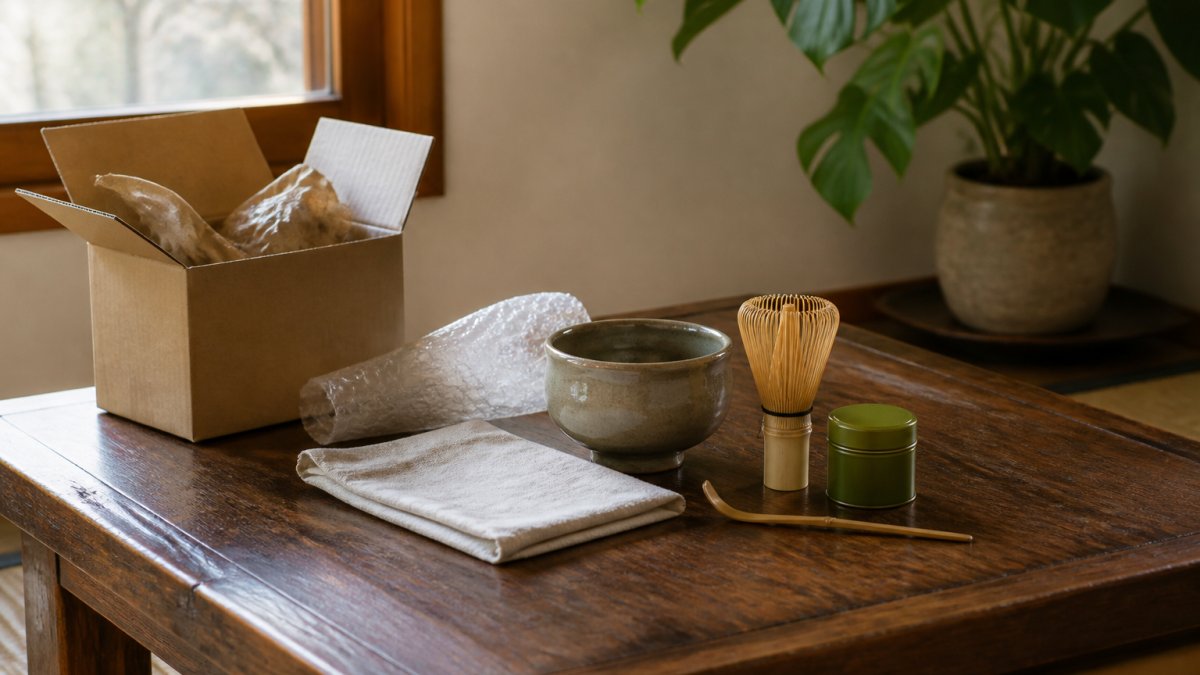
You need five things to begin: a tea bowl, a whisk, a scoop, a clean cloth, and a kettle. That's it.
- Tea bowl (chawan): wide and shallow, so the whisk can move freely
- Bamboo whisk (chasen): creates the froth that makes matcha feel special
- Scoop (chashaku): measures the powder; a small spoon works fine
- Clean cloth: wipes tools between uses
- Kettle: heats water to the right temperature
Skip the formal stand, the silk pouches, and the display shelf for now. They add atmosphere later, not function today.
Budget-Friendly Swaps That Still Feel Intentional
A wide cereal bowl can stand in for a chawan. A handheld milk frother works if you don't own a chasen. A small kitchen scale replaces the scoop.
What matters is consistency. Use the same bowl and cloth each time, and the ritual starts to feel like yours. Watch out: boiling water burns matcha and turns it bitter, so let the kettle rest a minute or two first.
Tea Ceremony Steps: A Simple Walkthrough from Start to Finish
Here is the short version of the tea ceremony steps, from empty table to final sip, with the numbers that keep a first attempt from going sideways.
- Clear the table. Remove clutter and wipe the surface with a damp cloth, then a dry one. A bare table signals to guests that the gathering has a beginning.
- Heat the water. Aim for 160-175°F for matcha. Water just off a full boil, rested for a few minutes, generally lands in that range. If you own an electric kettle with a variable setting, use it; if not, boil, then pour into a second vessel to cool faster.
- Cleanse the tools. Rinse the bowl and whisk with hot water, then dry them with a clean cloth. Stand the whisk in the bowl briefly to help the tines soften.
- Sift the tea. Use about 2 grams of matcha per bowl, roughly half a level teaspoon. Sift through a fine-mesh strainer to break up clumps.
- Whisk. Add about 2 ounces of water first, whisk in a brisk "W" or "M" motion from the wrist (not the elbow) for 15-20 seconds until a soft foam forms, then top up with another 2-3 ounces and give a few gentle strokes to lift the froth.
- Serve the first guest. Bowl in both hands, a small bow, bowl turned so the front faces the guest.
- Repeat for each guest. Fresh bowl each time; rinse and dry between servings so no residue carries over.
- Close with a quiet pause. Thank your guests, let the last bowls rest empty for a moment, then clear slowly.
Cleansing the Tools and Preparing the Space
Rinse the bowl with hot water and stand the whisk in it briefly. Dry both with a clean cloth. This step is called purification, and it signals to guests that the gathering has begun. Some hosts keep one cloth for the bowl and a separate one for the table.
For proper temperatures and ratios across tea types, our guide on how to steep loose leaf tea properly covers the details that keep your cup smooth instead of bitter.
Whisking, Pouring, and Serving in Order
Whisk fast and light, moving in a "W" shape, until a soft foam forms. Pour gently. Serve the oldest or most honored guest first, then work around the table. Serve each guest a fresh bowl.
Rest the whisk on a small stand or a clean saucer between uses so the tines keep their curve.
Your Simple Tea Ceremony Script: What to Say and When
No formal words are required, but a light script helps everyone relax. Use this tea ceremony script as a starting point:
"Thank you for coming. I'll whisk a bowl for each of you. Take your time with it."
As you serve: "Here is your tea. Please enjoy."
As guests finish: "Thank you for sharing this with me."
Guests can reply with a simple "thank you" and a small bow. That's enough.
Matcha (Ceremonial Green Tea Powder) →
Tea Ceremony Etiquette for Hosts and Guests
Tea ceremony etiquette comes down to three habits: attention, gratitude, and pace. Hosts serve with care. Guests receive with both hands and drink while the tea is warm.
- Hold the bowl with both hands
- Drink the last sip with a small sound of appreciation
- Avoid checking your phone during the ceremony
- Keep conversation soft and unhurried
Handling Awkward Moments and Guest Comfort
Most first ceremonies hit a snag or two. Someone doesn't know when to drink. Someone talks too much. You can smooth it over.
- If a guest seems unsure, demonstrate: lift your bowl, sip, and smile.
- If the mood gets chatty, slow your own movements and let silence settle.
- If the tea turns out bitter, blame the water temperature, not the guest, and offer a fresh bowl.
Choosing Your Tea: Matcha, Hojicha, or Loose-Leaf
Matcha is the classic choice for a whisked bowl. Our ceremonial matcha is stone-milled and offers sweet umami with a velvety body.

Hojicha is naturally low in caffeine, with toasted, caramel-like notes. You can shop hojicha if you want a gentler cup.

For a group that wants to taste across styles, a loose leaf tea sampler for beginners lets everyone try several whole-leaf teas before committing.

| Tea | Best For | Caffeine | How to Serve |
|---|---|---|---|
| Matcha | Classic whisked bowl | High | Whisk with warm water |
| Hojicha | Evening, low caffeine | Low | Whisk or latte |
| Loose-leaf | Group tasting | Varies | Steep and pour |
Modern vs. Traditional: Adapting the Ceremony to Your Home
Traditional ceremonies can run long and follow strict rules. A modern home version keeps the spirit and drops the formality. A middle path is a ceremony that respects the roots without requiring a dedicated tea room or a formal kimono. Here is how to bend the form without breaking the ritual.
What to Keep, What to Bend
The parts worth keeping are presence, gratitude, and slow movement. The parts you can bend are seating, dress, and length.
- Seating: A low table and floor cushions are traditional, but a kitchen table and ordinary chairs work. What matters is that everyone can see the bowl being whisked.
- Dress: No formal attire required. Clean, comfortable clothes are enough; the ritual is about attention, not costume.
- Length: A full traditional ceremony can run 45 minutes or more. A home version of 15-20 minutes, one bowl per guest, keeps attention fresh.
- Utensils: A wide cereal bowl, a handheld milk frother, and a small kitchen scale can stand in for a chawan, chasen, and chashaku. The trade-off is foam quality: a frother produces larger bubbles than a bamboo whisk, so whisk a few seconds longer and tap the bowl gently on the table to settle them.
- Setting: A tray on a cleared table is enough. You do not need a dedicated tea room, a scroll, or a flower arrangement; a single clean cloth and one small object of beauty (a bowl, a branch, a stone) carry the same signal.
A Budget-Friendly Setup That Still Feels Intentional
A first ceremony does not require specialty spending. A wide bowl from the kitchen cabinet, a handheld frother, a fine-mesh strainer, and a clean dish towel cover the core. The one place worth spending is the tea itself: ceremonial-grade matcha is a common choice for a smoother, sweeter cup. A small tin is a practical choice for a first ceremony.
Watch out: a frother plunged to the bottom of the bowl will fling matcha up the sides and leave clumps. Keep the head just below the surface and move it in small circles.
Handling the "Am I Doing This Right?" Question
New hosts often worry about protocol. The honest answer is that a home ceremony has no referee. If a guest picks up the bowl with one hand, let it go. If someone asks whether to slurp, tell them the last sip with a small sound is traditional but optional. The host's calm is the instruction manual; guests mirror your pace more than your words.
For a group that wants to taste across styles without committing to a full kit, a loose leaf tea sampler for beginners lets everyone try several whole-leaf teas before investing in matcha equipment.
Stock Your Tea Shelf for Your First Ceremony
Buy slightly more tea than you think you need, and store it away from light and heat. Our guide on how to store loose leaf tea at home explains how to keep leftover leaves fresh between gatherings.
Start with one tea you love, one backup for guests who want less caffeine, and a clean cloth you use only for tea. That shelf will carry you through your first several ceremonies.
Frequently Asked Questions
How long does a simple tea ceremony usually take?
A pared-back home ceremony runs about 30 to 45 minutes for a small group, including setup, whisking, and two rounds of tea. The formal Japanese version can stretch past an hour, but you do not need that length to make it feel intentional. Set aside 15 minutes before guests arrive for setup and cleansing, then let the serving itself move at a relaxed pace.
What do you need for a simple tea ceremony at home?
You need a tea bowl, a bamboo whisk (chasen), a scoop, and good tea such as ceremonial-grade matcha. A linen cloth for wiping tools and a small tray help keep things tidy. You can skip the expensive collector pieces at first. A wide mug works as a bowl, and a fine-mesh strainer stands in for a sifter. Build the setup around what you already own.
What etiquette should guests follow at a tea ceremony?
Guests should wait to be invited before sitting, accept the bowl with both hands, and turn it slightly before drinking so the front faces away. Sip slowly and comment on the tea rather than the host's equipment. Phones stay away during the whisking and serving. If you are unsure, mirror what the host does and keep conversation soft.
What is the difference between a Japanese and Chinese tea ceremony?
A Japanese ceremony centers on whisked matcha, with set movements and a strong emphasis on host-guest formality. A Chinese ceremony, often called gongfu cha, uses whole loose leaves steeped repeatedly in a small pot or gaiwan and poured into tiny cups. Both value presence and hospitality. For a first home ceremony, pick one style and keep it simple rather than blending both.
Hosting a simple tea ceremony is a skill you build one gathering at a time, and having the right tea on hand makes the first one far easier. LGBrewTeaQ roasts coffee to order and sources premium teas, including ceremonial matcha and hojicha, delivered fresh to your door. Every order ships through a simple process with fast, reliable delivery. Get started with LGBrewTeaQ and make your next tea ceremony one your guests remember.
