

Best Brewing Method for Floral Coffee Notes
Table of Contents
- Why Brewing Method Matters for Floral Coffee Notes
- Pour-Over: The Gold Standard for Floral Clarity
- The Coffee Bloom Technique for Maximum Aroma
- Coffee Grind Size for Pour-Over Brewing
- Water Temperature for Brewing Coffee: Finding the Sweet Spot
- How to Avoid Bitter Coffee When Brewing Floral Beans
- Comparing Brewing Methods for Floral Coffee
- Recommended Floral Coffees and Their Ideal Brew Methods
- Frequently Asked Questions
Last Updated: October 10, 2026
Why Brewing Method Matters for Floral Coffee Notes
The best brewing method for floral coffee notes determines whether those aromatics shine or disappear. Different techniques extract flavors at different rates, and delicate floral aromatics are among the first compounds to dissolve. Pick the wrong method, and you'll get a flat, one-dimensional cup. Pick the right one, and you unlock the complexity that makes these coffees worth seeking out.
Understanding how each technique affects extraction is the foundation of brewing floral coffee well. The brewing method reveals what's already in the beans.
The best brewing method for floral coffee notes depends on how you want those aromatics to express themselves. Some methods highlight brightness and clarity; others bring forward sweetness and perfume.
Pour-Over: The Gold Standard for Floral Clarity
Pour-over brewing is the gold standard for floral coffee notes because it gives precise control over extraction, pulling out delicate aromatics without over-steeping and producing clarity that other techniques struggle to match.
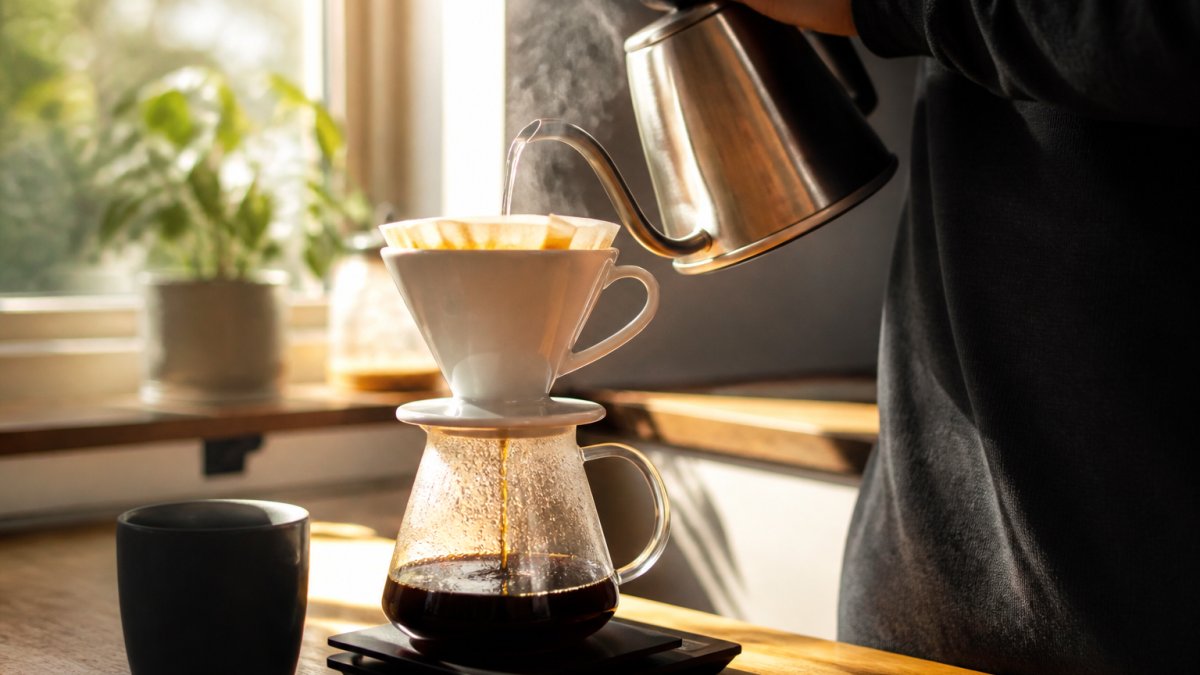
The paper or metal filter traps oils and sediment, leaving a clean cup where delicate floral notes come through clearly.
The brew takes about 3-4 minutes and gives you real-time feedback and control.
V60 vs. Chemex vs. Kalita Wave
Each pour-over device has a different shape, which changes how water flows through the grounds and how long extraction takes.
V60 is a cone-shaped dripper with spiral ridges that speed water flow, producing brightness without over-extraction. It's forgiving and inexpensive, ideal for beginners.
Chemex is an hourglass-shaped glass brewer with a thick filter that removes more oils, creating an exceptionally clean cup with pronounced clarity.
Kalita Wave uses a flat-bottomed dripper with wave-shaped filters that reduce channeling, producing consistent extraction and balanced flavor.
The Coffee Bloom Technique for Maximum Aroma
The bloom is the first 30-45 seconds of brewing, when you pour just enough water to saturate the grounds. This step releases CO2 and opens up flavor compounds; skipping it means losing aroma.
During the bloom, the grounds expand and bubble as the coffee releases gas. This preps the beans to release delicate aromatics in the next phase.
To bloom:
- Pour water just off boiling (around 200°F)
- Use twice as much water as coffee by weight (for example, 30 grams of water for 15 grams of coffee)
- Wait 30-45 seconds without pouring more
- Watch for bubbling and expansion
After the bloom, proceed with your normal pour-over technique. The bloom alone can be the difference between a bright, aromatic cup and a dull one.
Coffee Grind Size for Pour-Over Brewing
Grind size controls extraction speed. For floral coffees, use a medium-fine grind that balances clarity with sweetness.
Too fine causes over-extraction and bitterness; too coarse causes under-extraction and weakness.
Aim for a grind that looks like fine sand, not powdery, not chunky.
If bitter, make your grind coarser. If weak or sour, make it finer. Adjust in small increments.
Invest in a burr grinder, not a blade grinder. Burr grinders produce consistent particle size. Blade grinders create a mix of dust and chunks, making it impossible to dial in extraction properly. The USB Rechargeable Ceramic Electric Coffee Grinder ($24.36) offers reliable, portable grinding with ceramic burrs that handle floral beans well.

Water Temperature for Brewing Coffee: Finding the Sweet Spot
Water temperature dramatically affects how floral notes taste. Too hot extracts harshness; too cool misses aromatics.
The ideal range for floral coffees is 195-205°F. Use water just off boiling (around 200°F), or let boiling water cool for 30 seconds.
For floral coffees, 200°F hits the sweet spot, extracting aromatics without bitterness.
How to Avoid Bitter Coffee When Brewing Floral Beans
Bitterness stems from over-extraction, which pulls out harsh compounds that mask delicate aromatics.
The Extraction Problem
Aromatic compounds dissolve early in the brew cycle; bitter compounds dissolve later. Over-extraction pulls out both, drowning out florals. Extract enough to reveal aromatics without harshness.
Optimal extraction occurs between 18-22% of soluble solids. Below 18% tastes sour; above 22% tastes bitter.
Diagnostic Workflow: Which Variable Is the Problem?
1. Grind Too Fine (Most Common)
How to fix: Make your grind coarser by one setting.
Why this works: Coarser grounds let water flow faster, reducing contact time and bitter compound extraction.
2. Water Temperature Too High
Water hotter than 205°F accelerates extraction.
How to diagnose: Measure water temperature with a thermometer. Many kettles run hotter than advertised.
How to fix: Let boiling water cool for 45-60 seconds. Aim for 198-202°F.
Why this works: Cooler water extracts more slowly, favoring aromatic compounds over bitter ones.
3. Brew Time Too Long
How to diagnose: If brew time consistently hits 4.5-5 minutes, you're extending contact time unnecessarily.
How to fix: Pour faster during the main phase.
Why this works: Shorter contact time extracts fewer bitter compounds.
A Sensory Test: Is It Over-Extraction or Something Else?
Over-extracted coffee tastes bitter and astringent. Under-extracted coffee tastes sour and thin. If sour, make your grind finer, not coarser.
Bean Age and Roast Freshness
Stale beans (roasted more than 4 weeks ago) lose aromatic compounds and taste flat or bitter. If your technique is dialed in but the cup still tastes harsh, try fresh beans roasted within 2 weeks.
Ethiopia Single Origin Coffee →
Comparing Brewing Methods for Floral Coffee
Different brewing techniques extract floral notes in different ways. Understanding these differences helps you pick the technique that matches your palate.
Pour-Over vs. Immersion vs. Espresso: A Sensory Comparison
Pour-Over (V60, Chemex, Kalita Wave)
Floral character: Bright and crisp, with pronounced aromatic clarity.
Why: Single-pass extraction pulls aromatics early, before bitter compounds dissolve. The filter removes oils and sediment.
Best for: Tasting individual floral notes with precision.
Trade-off: Less body and sweetness than immersion methods.
Immersion Brewing (French Press, Cold Brew)
Floral character: Softer and more integrated.
Why: Long contact time extracts more oils and sugars, creating a fuller, sweeter cup.
Best for: Drinkers who prefer smooth, sweet cups.
Trade-off: Less clarity and brightness; floral notes are less distinct.
Espresso
How it works: Hot water forced through finely ground coffee under pressure for 25-30 seconds.
Floral character: Concentrated and aromatic, with floral notes in the crema.
Why: High pressure forces rapid extraction of aromatic oils into the crema.
Best for: Small, intense servings and espresso-based drinks.
Trade-off: Requires skill and equipment. Floral notes can be overshadowed by intensity if extraction is off.
Method Comparison Table
| Brewing Method | Brew Time | Floral Clarity | Floral Sweetness | Body | Best For |
|---|---|---|---|---|---|
| Pour-Over | 3-4 min | Very High | Medium | Light | Tasting distinct floral notes |
| French Press | 4 min | Medium | High | Full | Smooth, sweet floral cups |
| Cold Brew | 12+ hrs | Low | High | Full | Iced coffee, less acidity |
| Espresso | 25-30 sec | High | Medium | Medium | Intense, concentrated flavor |
A Tested Recipe for Floral Pour-Over (The Baseline)
If you're new to brewing floral coffee, start here. This recipe is designed to maximize aromatic clarity while avoiding over-extraction. Use it as a baseline, then adjust based on your taste.
Equipment:
- V60 or Kalita Wave dripper
- Paper or metal filter
- Burr grinder
- Scale (digital, accurate to 0.1 gram)
- Gooseneck kettle (optional but helpful)
- Instant-read thermometer (optional)
Recipe (for one 12 oz cup):
- Coffee: 18 grams, medium-fine grind (like fine sand)
- Water: 300 grams, 200°F
- Bloom: 30 seconds with 36 grams of water
- Main pour: 264 grams of water over 2.5-3 minutes
- Total brew time: 3-4 minutes
Steps:
- Heat water to 200°F.
- Rinse filter and dripper with hot water.
- Add ground coffee and tare scale.
- Pour 36 grams of water slowly. Wait 30 seconds.
- Pour remaining 264 grams in a steady spiral over 2.5-3 minutes.
- Total brew time should be 3-4 minutes.
Expected result: A bright, aromatic cup with clear floral notes, light body, and clean finish. If it tastes bitter, your grind is too fine, make it coarser next time. If it tastes sour, your grind is too coarse, make it finer next time.
How to Adapt the Recipe to Other Methods
For French Press (same beans, different character):
- Use 18 grams coffee, 300 grams water at 200°F
- Steep for 4 minutes
- Press slowly
- Result: Fuller body, softer floral notes, more sweetness
For Espresso (concentrated, intense):
- Use 18 grams coffee, finely ground
- Pull a double shot (2 oz output)
- Aim for 25-30 second extraction
- Result: Intense, aromatic, with floral notes in the crema
Which Method Should You Choose?
If you want to taste floral notes clearly and learn what they taste like, start with pour-over. It gives you the most control and the clearest result. Once you understand what jasmine or citrus blossom tastes like in isolation, you can explore how those notes express differently in French press or espresso.
If you already prefer full-bodied, sweet coffee, French press will give you floral character without the brightness that some drinkers find too sharp.
If you're an espresso enthusiast, floral single-origins shine in espresso, but dial in your machine carefully, because technique matters more with espresso than with pour-over.
Recommended Floral Coffees and Their Ideal Brew Methods
Certain origins naturally express floral notes more prominently. Pairing the right coffee with the right brewing method amplifies those aromatics.
Ethiopia Single Origin from LGBrewTeaQ ($23.99) delivers wild jasmine, bergamot citrus, and wildflower honey.

Kenya Single Origin ($23.99) bursts with sweet Valencia orange, Meyer lemon, and wild jasmine florals.
Tanzania ($23.99) offers crisp pear, blooming jasmine, and sweet strawberry.
Blonde blend ($23.99) combines Central American and African beans to create Meyer lemon, honeyed peach, and delicate jasmine.
Start with the Single Origin Favorites Sample Pack ($24.99), which includes six 2-ounce portions to taste side-by-side.
Brewing floral coffee well comes down to controlling three variables: water temperature, grind size, and brew method.
Frequently Asked Questions
Which brewing method brings out floral notes in coffee best?
Pour-over brewing methods, particularly V60, Chemex, and Kalita Wave, unlock floral notes most effectively. These methods use paper or metal filters and allow precise control over water temperature, contact time, and extraction, which highlight delicate floral aromatics. Immersion methods like French press can muddy floral clarity by over-extracting, while espresso's high pressure and short contact time compresses flavor layers. For maximum floral expression, pour-over with proper grind size and bloom technique is the gold standard.
What water temperature is best for brewing floral coffee?
Water between 195-205°F (90-96°C) works best for floral coffees. Temperatures below 195°F under-extract, leaving floral notes muted and sour. Above 205°F over-extracts, creating bitter, harsh flavors that mask delicate aromatics. Light and light-medium roasts, which typically carry the strongest floral profiles, benefit most from the lower end of this range (195-200°F). Let freshly boiled water cool for 30 seconds before pouring to hit this sweet spot.
How do I grind coffee beans to preserve floral flavors?
For pour-over brewing of floral coffees, use a medium-fine grind, slightly finer than table salt but coarser than sand. This grind size slows water flow through the grounds, allowing proper extraction without over-extracting bitter compounds. A grinder with burrs (not blade) gives you consistency; the USB Rechargeable Ceramic Electric Coffee Grinder from LGBrewTeaQ offers ceramic burrs for precise, repeatable results. Grind just before brewing to preserve volatile floral aromatics.
What is the coffee bloom technique and why does it matter for floral notes?
Blooming is pouring just enough hot water (roughly twice the weight of dry grounds) over coffee grounds and waiting 30-45 seconds before continuing the pour. This initial saturation releases carbon dioxide trapped in the beans, allowing water to extract flavors more evenly. For floral coffees, blooming is essential: it opens the bean structure and lets delicate floral aromatics escape into the cup rather than remaining locked inside. Skip the bloom and you'll lose brightness and floral complexity.