

How to Brew Turkish Coffee at Home Step by Step
Last Updated: October 22, 2026
Quick Summary
To brew turkish coffee at home, measure one small cup of cold water into a cezve, add one heaping teaspoon of powder-fine coffee and optional sugar, stir three or four turns, then heat slowly over low heat. Pull the pot off as the foam rises to the rim, pour slowly, and let the grounds settle for one to two minutes before drinking.
- Use powder-fine grounds, finer than espresso and close to a 200-micron grind.
- The classic ratio is one heaping teaspoon of coffee per small cup of water.
- Stir only three or four turns so you don't knock down the foam.
- Keep the pot no more than half full so the foam has room to rise.
- Wait one to two minutes for the grounds to settle, and don't stir your cup.
Table of Contents
- What You Need to Brew Turkish Coffee at Home
- Step-by-Step: How to Brew Turkish Coffee at Home
- Turkish Coffee to Water Ratio: Exact Measurements
- Turkish Coffee Grind Size: Powder-Fine and Non-Negotiable
- How to Make Turkish Coffee Without a Cezve
- How to Serve Turkish Coffee (and What to Pair With It)
- Troubleshooting Turkish Coffee by Symptom
- Frequently Asked Questions
What You Need to Brew Turkish Coffee at Home
Turkish coffee simmers ultra-fine grounds in water, unfiltered, in a small long-handled pot. It takes about five minutes and rewards you with a thick, aromatic cup.
- A cezve or ibrik: the small pot. Copper is traditional, but steel works.
- Powder-fine coffee: finer than espresso. This is the make-or-break detail.
- Cold drinking water: filtered if your tap is hard.
Skip the drip machine and the paper filters. This method is about the grounds staying in the cup.
Step-by-Step: How to Brew Turkish Coffee at Home
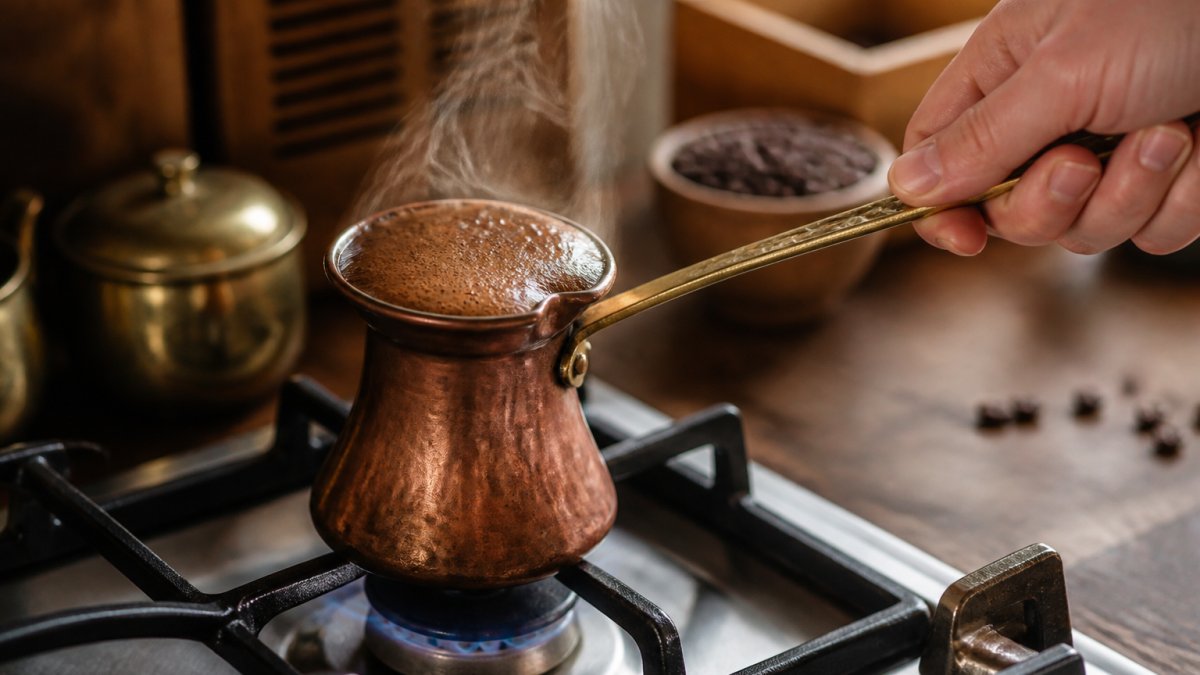
The whole process: measure water with your cup, add coffee and sugar, stir once, heat slowly, and pull it off the heat just as the foam rises.
Step 1: Measure the Water with a Serving Cup
Fill your small coffee cup with cold water, then pour it into the cezve. One cup makes one serving, use the same cup you'll drink from so the volume matches your expectation. For precision, one small cup holds roughly 60 to 75 milliliters.
Step 2: Add Coffee and Sugar, Then Stir
Add one heaping teaspoon of finely ground coffee per cup. For a stronger cup, add a little more. Add sugar now if you want it, from none to two teaspoons.
Stir briefly, just three or four turns, then stop. Over-stirring creates clumps and knocks down the foam you're trying to build.
Step 3: Heat Slowly and Watch for the Foam
Set the cezve over low heat. Slow heating is the whole game. A fast boil scorches the grounds and turns the cup bitter.
Watch the surface. Within a few minutes, dark foam builds and rises toward the rim. As soon as it's about to spill over, lift the pot off the heat. Some cooks repeat this rise two or three times for thicker foam, but one good rise is enough for a solid cup.
Step 4: Pour, Serve, and Let the Grounds Settle
Pour slowly into your cup, keeping the foam on top. Wait one to two minutes for the grounds to settle into a soft layer at the bottom.
Don't stir your cup before drinking. Sip from the top and leave the sediment behind.
Turkish Coffee to Water Ratio: Exact Measurements
The classic ratio is one heaping teaspoon of coffee to one small cup of water, about 5 to 7 grams per 60 to 75 milliliters. It makes a small, intense serving, not a mug.
For larger batches, scale up but keep the pot no more than half full. The foam needs room to rise.
| Servings | Water | Coffee | Sugar (optional) |
|---|---|---|---|
| 1 | 1 small cup (60-75 ml) | 1 heaping tsp (5-7 g) | 0-2 tsp |
| 2 | 2 cups | 2 heaping tsp | 0-4 tsp |
| 3 | 3 cups | 3 heaping tsp | 0-6 tsp |
| 4 | 4 cups | 4 heaping tsp | to taste |
Use a scale for repeatable results: weigh the coffee, then pour water to the matching volume.
A Tested Recipe in Grams and Milliliters
Spoon and cup measures vary enough that two people following the same recipe get noticeably different cups. For repeatable results, weigh the coffee and measure the water by volume at a 1:10 coffee-to-water ratio by weight, the traditional strength range without turning the cup into sludge.
| Servings | Water (ml) | Coffee (g) | Sugar (g, optional) |
|---|---|---|---|
| 1 | 70 | 7 | 0-8 |
| 2 | 140 | 14 | 0-16 |
| 3 | 210 | 21 | 0-24 |
| 4 | 280 | 28 | to taste |
A few notes on the numbers:
- Water volume: 70 ml per serving is a good middle ground. If your cup holds closer to 60 ml, use 6 g of coffee; if it holds 75 ml, use 7.5 g. The 1:10 ratio stays the same.
- Coffee weight: a level teaspoon of powder-fine grounds weighs roughly 2 to 2.5 g, so a heaping teaspoon lands near 5 to 7 g. Weighing removes the guesswork.
- Sugar weight: one teaspoon of granulated sugar is about 4 g. Adjust to taste, but add it before brewing so it dissolves into the water as it heats.
Converting Between Cups, Spoons, and Grams
If you don't own a scale yet, these conversions will get you close:
- 1 small Turkish coffee cup = 60 to 75 ml (about 2 to 2.5 fl oz)
- 1 level teaspoon of powder-fine coffee = about 2 to 2.5 g
- 1 heaping teaspoon of powder-fine coffee = about 5 to 7 g
Start with the gram-based recipe for the first few brews, then switch to spoon measures once you know your preferred strength. The scale is a calibration tool, not a permanent requirement.
Why the Ratio Matters More Than the Pot
Turkish coffee is unfiltered, so every gram stays in the cup and keeps extracting as the pot heats. Too strong turns bitter fast; too weak tastes thin and muddy. The 1:10 starting point balances both, adjust in 1 g steps per serving.
Turkish Coffee Grind Size: Powder-Fine and Non-Negotiable
Turkish coffee grind size is the one thing you can't compromise on. The grounds must be powder-fine, almost like baby powder. CoffeeGeek's brewing guide describes it as finer than espresso, close to a 200-micron grind.
Colombia Single Origin Coffee →
Why so fine? The grounds never get filtered out, they steep in the water and settle in the cup.
Most grocery store grinders can't hit this level. Ask a specialty roaster to grind for Turkish coffee, or use a burr grinder on its finest setting.
How to Make Turkish Coffee Without a Cezve
No cezve? You can still make Turkish coffee in any small, heavy saucepan with a long handle, a butter warmer or small milk pan works well. Thin pots heat too fast and scorch the grounds; heavy-bottomed cookware gives the slow, gentle heat this method needs.
A few more swaps that work:
- A measuring cup in place of the serving cup for water volume
- A whisk instead of a spoon to stir gently
- A gas, electric, or induction burner on the lowest setting
Avoid the microwave. It heats unevenly and won't build the foam.
How to Serve Turkish Coffee (and What to Pair With It)
Serve Turkish coffee in a small cup immediately, the foam is the mark of a well-made cup. Traditionally it comes with a glass of cold water and something sweet.
What to pair with it:
- A square of dark chocolate: brings out the cocoa notes in the brew
- Turkish delight or a date: balances the intensity
- A plain biscuit: keeps the focus on the coffee
For the beans themselves, a medium roast with chocolate and fruit notes holds up well. Our Colombia Single Origin Coffee brings dark chocolate depth with mango and peach, and it grinds down beautifully for this method. Our Mexico lot adds warm cinnamon spice that plays nicely with a pinch of cardamom in the pot.


Serve it after a meal, or as a slow morning ritual. Small cup, big flavor.
Troubleshooting Turkish Coffee by Symptom
Something went wrong? Match the symptom to the cause.
| Symptom | Likely Cause | Fix |
|---|---|---|
| Bitter, burnt taste | Heat too high, or pot left on too long | Lower the heat and pull it off as foam rises |
| Weak, watery cup | Grind too coarse, or too little coffee | Grind finer and add a heaping spoon per cup |
| No foam | Stirred too much, or heated too fast | Stir only 3-4 turns and use low heat |
| Gritty texture | Grind not fine enough | Regrind to a powder-fine texture |
| Grounds in every sip | Poured too fast, didn't let it settle | Wait 1-2 minutes before drinking |
| Coffee boiled over | Pot too full, or heat too high | Fill pot halfway and watch closely |
Most problems come down to two things: grind size and heat control. Nail those and the cup takes care of itself.
Symptom, Cause, and Mechanism
Bitter or burnt taste. Powder-fine grounds extract quickly, and past roughly 200°F burnt-tasting compounds develop fast with no filter to hold them back.
Weak or watery cup. Two causes dominate: a grind coarser than powder-fine and too little coffee for the water volume. Check the grind first; if it's right, move to the 1:10 gram ratio.
No foam. Foam shows the coffee releasing gas and proteins as it heats.
Gritty texture. Almost always a grind problem: powder-fine should feel like flour.
Boiled over. The foam rises fast once it starts, and a pot filled past halfway has no headroom.
Matching Heat to Your Cooktop
- Gas: the most responsive option. Use the smallest burner on its lowest setting, flame under the pot, and cut the heat instantly when the foam rises.
- Electric coil or glass-top: these stay hot after you turn them down. Preheat on low, and lift the cezve off the burner entirely when the foam reaches the rim rather than relying on the dial.
- Induction: only works with a magnetic-base cezve; copper and many steel pots won't heat. It responds quickly but cycles on and off, so the foam rises unevenly. Use the lowest setting and watch closely, the pot can go from quiet to rising in seconds.
Treat the first brew on a new cooktop as a calibration run: note where the dial sits when the foam rises, and start there next time.
The two variables that matter most are a powder-fine grind and low, slow heat. Get both right and Turkish coffee becomes almost foolproof.
Frequently Asked Questions
What is the ratio of coffee to water for Turkish coffee?
Use one heaping teaspoon (about 7 grams) of finely ground coffee per small serving cup (about 60-75 ml or 2-2.5 oz) of cold water. For a standard two-cup cezve, that is 2 teaspoons of coffee to roughly 150 ml of water. Weighing your coffee on a small scale gives the most repeatable results: 7 grams per 60 ml is a reliable starting point. Adjust slightly stronger or weaker after your first brew, but keep the coffee-to-water ratio consistent so you can taste the difference.
How finely should coffee be ground for Turkish coffee?
Turkish coffee grind size must be powder-fine, finer than espresso and close to baby powder. CoffeeGeek describes it as a 200-micron grind. Most home grinders cannot reach this consistency, so ask your roaster to grind for Turkish coffee or use a dedicated Turkish grind setting. If the grind feels gritty between your fingers, it is too coarse and will produce a thin, weak cup with sediment that floats rather than settles. Freshly roasted beans ground just before brewing give the best foam and aroma.
Can you make Turkish coffee without a cezve?
Yes. A small heavy-bottomed saucepan works well because it heats evenly and gives you room to watch the foam. A metal measuring cup or a small butter warmer also works in a pinch. Avoid thin pans that heat unevenly, and keep the heat low. The cezve's narrow neck helps control the foam, so if you use a saucepan, pour slowly and stop before the foam collapses. The coffee tastes the same; only the pour control is slightly harder.
Do you drink the grounds in Turkish coffee?
No. The grounds settle at the bottom of the cup and stay there. Let the cup rest for a minute or two after pouring so the sediment compacts, then sip slowly and stop before you reach the bottom. Drinking the grounds is unpleasant and gritty. Some people use the pattern left in the cup for traditional fortune-telling, but for everyday drinking, simply leave the last sip. Serve with a glass of water to cleanse your palate between sips.