

How to Steep Loose Leaf Tea Properly: 2026 Guide
Table of Contents
- Essential Tea Brewing Tools for Loose Leaf
- Loose Leaf Tea Brewing Ratios: Getting the Measurements Right
- Water Temperature and Quality: The Foundation of a Good Cup
- Steeping Time for Black vs Herbal Tea (and Everything Between)
- Step-by-Step: How to Steep Loose Leaf Tea Properly
- Troubleshooting Common Steeping Mistakes and Bitterness
- Re-Steeping Leaves and Storing Loose Leaf Tea for Freshness
- Conclusion
- Frequently Asked Questions
Last Updated: September 24, 2026
Essential Tea Brewing Tools for Loose Leaf
Loose leaf tea needs room to move. That single fact drives every equipment choice you'll make.
Infusers, Strainers, and Brewing Vessels
Start with how much space your leaves get. Leaf expansion is the whole point of loose leaf brewing.
- Mesh infuser baskets give leaves the most room. Best for large-leaf oolong and white tea.
- Tea balls work for fine-cut black tea but squeeze bigger leaves.
- Basket strainers sit in your mug and lift out clean.
- Gaiwans and small pots suit gongfu style brewing, where you use more leaf and shorter steeps.
Loose Leaf Tea Brewing Ratios: Getting the Measurements Right
Loose leaf tea brewing ratios follow one simple rule: about 1 teaspoon of leaf per 8 ounces of water. That's the western brewing method baseline.
Tea-to-Water Ratio by Leaf Size
Here's how the ratio shifts:
| Leaf Size | Amount per 8 oz Water | Why |
|---|---|---|
| Fine cut or fannings | 1 teaspoon | Dense, fast extraction |
| Medium broken leaf | 1.5 teaspoons | Moderate surface area |
| Large whole leaf | 2 teaspoons | Light weight, slow release |
| Rolled oolong | 2 teaspoons | Expands a lot when wet |
Weighing your tea in grams gives more consistent results than spoons. A small kitchen scale costs little and removes the guesswork.
Water Temperature and Quality: The Foundation of a Good Cup
Water temperature decides what gets pulled out of the leaf. Too hot, and you drag out harsh tannins. Too cool, and you leave the good stuff behind.
- Boiling point: 212°F. Let it cool slightly for delicate teas.
- Green and white tea: 160-180°F.
- Oolong: 185-205°F.
- Black and herbal: 200-212°F.
Steeping Time for Black vs Herbal Tea (and Everything Between)
Steeping time for black vs herbal tea differs more than most people expect. Black tea needs 3-5 minutes. Herbal infusions need 5-7 minutes because dried herbs and roots release flavor slowly.
Green, Oolong, and White Tea Steeping Times
Delicate teas need less time, not more.
- White tea: 4-5 minutes at 175°F
- Green tea: 2-3 minutes at 175°F
- Oolong: 3-4 minutes at 195°F
- Black tea: 3-5 minutes at 205°F
- Herbal infusion: 5-7 minutes at 212°F
Watch the color, not just the clock. A green tea turning olive means it's done. Black tea should look deep amber, not muddy brown.
Step-by-Step: How to Steep Loose Leaf Tea Properly
Learning how to steep loose leaf tea properly comes down to six repeatable steps. Follow them once and the process becomes second nature. The difference between this walkthrough and most others is that each step includes a visual or sensory checkpoint, so you can confirm you got it right before moving on.
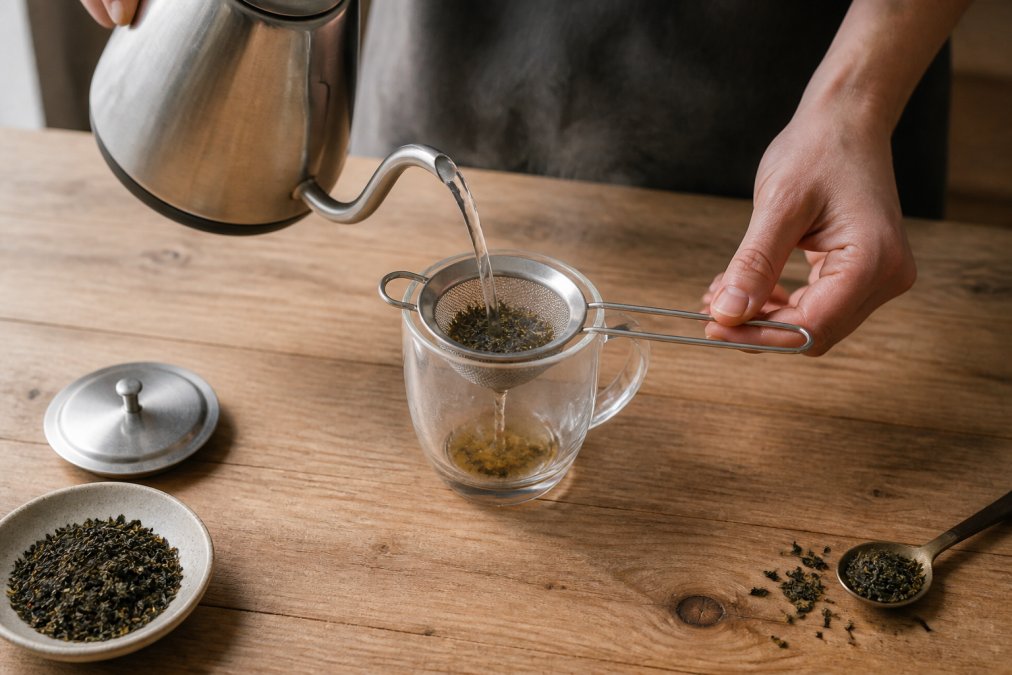
- Warm your vessel. Swirl hot water inside, then dump it out. A cold mug can drop your water temperature by 10-15°F the moment it hits, which stalls extraction on delicate greens. Checkpoint: the mug should feel hot to the touch before you add leaf.
- Measure your leaf. Use the ratio table above, or weigh 2-3 grams per cup. For whole leaf, err on the side of more, under-leafing is the most common cause of a thin cup. Checkpoint: the dry leaf should cover the bottom of your infuser in a loose, single layer, not a packed mound.
- Heat your water. Stop at the right temperature for your tea type. If you don't own a variable-temperature kettle, boil and then rest: about 2-3 minutes for green, 1-2 minutes for oolong, and 30-60 seconds for black. Checkpoint: a small bubble or two should cling to the bottom of the kettle, not a rolling boil, for delicate teas.
- Add leaf, then water. Give leaves room to expand. Don't pack them tight. Pour in a slow circle so every leaf gets wet at the same time. Checkpoint: within 30 seconds, whole leaves should begin to unfurl and sink; if they float in a tight clump, you've crowded them.
- Time the steep. Start counting the moment water hits the leaf. But use the clock as a guardrail, not a rule. Checkpoint: watch the liquor color. Green tea shifting from pale yellow to olive means pull it now. Black tea should read deep amber, not muddy brown. Oolong goes from light gold to a warm honey tone. If you can see the color through the side of a glass mug, you have all the timer you need.
- Remove the leaves. Lift your infuser or pour through a strainer. Leaving leaves in keeps extracting tannins, and the extraction curve steepens in the last minute. Checkpoint: taste at the 30-second mark before your target time. If it already tastes right, stop. If it tastes flat, give it another 30 seconds and taste again.
Reading the Leaf After the Steep
Once you've poured, look at the spent leaves. This is the sensory evaluation step most guides skip, and it tells you more than the timer ever will.
- Fully unfurled, pliable leaves mean you brewed them properly. Whole leaves should open flat or nearly flat.
- Leaves still tight or leathery mean the water was too cool or the steep too short. Next time, bump the temperature 5-10°F.
- Leaves that look cooked, mushy, or torn mean the water was too hot or the steep too long. Drop the temperature and shorten the time.
- Aroma on the wet leaf is the truest preview of flavor. If the wet leaf smells sharp or stewed, the cup will taste that way too.
The difference between a good cup and a bitter one is usually thirty seconds of over-steeping, not the tea itself. Taste at the 30-second mark and let your palate, not the clock, call it.
Troubleshooting Common Steeping Mistakes and Bitterness
Bitterness comes from three places: too much heat, too much time, or too much leaf. Fix the variable you changed last.
Mesh Tea Infuser Strainers Filters Tea →
Here's a quick diagnostic:
| Problem | Likely Cause | Fix |
|---|---|---|
| Bitter, astringent | Over-steeped or water too hot | Cut time by 1 minute, drop temp 10°F |
| Weak, watery | Too little leaf | Add 1 teaspoon per cup |
| Flat, dull | Poor water quality | Switch to filtered water |
| Harsh aftertaste | Leaves left in the cup | Decant immediately after steeping |
| Metallic taste | Old or stale leaves | Check storage and freshness |
Re-Steeping Leaves and Storing Loose Leaf Tea for Freshness
Good loose leaf tea gives you more than one cup. Whole leaf and rolled oolong often re-steep three to five times, and each round tastes a little different. This is the part of loose leaf brewing most guides skip entirely, and it's where the value of whole leaf over tea bags really shows.
How to Re-Steep Without Losing Flavor
The mechanics are simple, but the timing matters more than most people expect.
- Add 15-30 seconds to each re-steep. The leaves have already given up their easiest flavor compounds, so the second and third steeps need a little more time to extract what's left.
- Keep the water temperature the same. Don't crank up the heat to compensate for a weaker second cup, you'll pull tannins instead of flavor.
- Don't squeeze or press the leaves. Pressing forces out bitter compounds that wouldn't otherwise release.
- Re-warm your vessel. A cooled mug drops the temperature of your re-steep water just as it does on the first pour.
How Flavor Evolves Across Steeps
Each steep pulls a different set of compounds, which is why the same leaves taste different cup to cup.
- First steep: bright, aromatic, often the most floral or grassy. This is where volatile oils dominate.
- Second steep: rounder and sweeter. The astringency softens and the body fills out.
- Third steep and beyond: deeper, sometimes earthier or more mineral. Oolongs often show their roasted or stone-fruit notes here.
Knowing When to Stop
You don't need a rulebook. Watch the leaves and taste the cup.
- Color: if the liquor turns pale and watery, the leaves are done.
- Aroma: if the wet leaf smells like nothing, stop.
- Taste: if the cup tastes like hot water with a faint memory of tea, stop.
Typical re-steep counts by type:
- Green tea: 2-3 steeps
- Oolong: 4-6 steeps
- Black tea: 2-3 steeps
- Herbal infusion: 1-2 steeps
Storage That Protects Your Re-Steeps
Storage keeps those extra steeps worth drinking. Leaves that have gone stale will taste flat on the first steep and give you nothing on the second.
- Airtight container. Oxygen is the main enemy. A tin with a tight lid or a resealable bag pressed flat works.
- Away from light. Ultraviolet light degrades the leaf. Keep tins in a cabinet, not on an open shelf.
- Away from heat. Store away from the stove, the kettle, and any sunny windowsill.
- Away from moisture. Never store tea in the fridge unless it's sealed in a truly airtight container, condensation will ruin it.
- Away from strong smells. Tea absorbs odors. Don't store it next to coffee, spices, or onions.
Label your containers with the purchase date. You'll be surprised how fast a "recent" tin becomes a year old. If you can't remember when you bought it, it's probably time to finish it or replace it.
Conclusion
Getting loose leaf tea right takes a few tries. The variables are simple: leaf amount, water temperature, and time. Nail those three and every cup improves.
Frequently Asked Questions
How much loose leaf tea should I use for one cup?
Use about 1 teaspoon of loose leaf tea per 8 ounces of water for most teas. For large-leaf teas like white or oolong, use 1.5 to 2 teaspoons because the leaves take up more space. For small-leaf teas like fannings or broken black tea, 1 teaspoon is plenty. Weighing 2 to 3 grams per cup gives the most consistent results if you have a kitchen scale.
What is the ideal water temperature for different tea types?
Water temperature varies by tea type. Black and herbal teas need water at 200 to 212 degrees Fahrenheit (a full boil). Oolong sits around 185 to 195 degrees. Green tea prefers 160 to 180 degrees, and white tea does well at 175 to 185 degrees. Using water that is too hot scalds delicate leaves and pulls out tannins, which makes the cup bitter.
How long should I steep loose leaf tea to avoid bitterness?
Most green and white teas need 2 to 3 minutes. Oolong takes 3 to 5 minutes, black tea 3 to 5 minutes, and herbal infusions 5 to 7 minutes. Bitterness comes from steeping too long or using water that is too hot. Set a timer and taste at the low end of the range first, then adjust to your preference.
Can I re-steep loose leaf tea leaves?
Yes, and good loose leaf tea is built for it. Whole-leaf green and oolong teas often give 3 to 5 solid steeps. Black tea usually handles 2 to 3. Add about 30 seconds to each subsequent steep. Herbal infusions made from roots or bark may only give one or two good cups. Re-steeping saves money and lets you taste how the flavor profile shifts.