

Premium Tea Delivery Service for Home: 7 Top Picks
Table of Contents
- Why Choose a Premium Tea Delivery Service for Home?
- Quick Comparison: Top Premium Tea Delivery Services
- 1. LGBrewTeaQ: Best for Ethical Sourcing and Community
- 2. Artisan Tea Co.: Best for Single-Origin Connoisseurs
- 3. The Wellness Tea Club: Best for Health-Specific Blends
- What to Look For When You Buy Premium Loose Leaf Tea Online
- How to Brew Loose Leaf Tea at Home Like a Pro
- Tea Storage Best Practices for Maximum Freshness
- Frequently Asked Questions
Last Updated: September 5, 2026
Why Choose a Premium Tea Delivery Service for Home?
Most grocery store tea has been sitting in warehouses for months, losing the delicate oils that create aroma and flavor. A premium tea delivery service for home changes that equation by shipping freshly harvested, whole leaf teas directly from estates to your door. At LGBrewTeaQ, we've built our model around this farm-to-cup philosophy, ensuring you receive teas at their peak.
Premium tea delivery is the practice of sourcing high-quality loose leaf teas from specific estates and shipping them directly to consumers, bypassing the months of storage that dull commercial tea. This preserves the volatile compounds responsible for flavor, which begin degrading immediately after harvest, resulting in a brighter, more complex cup that rewards the slightly higher cost per serving.

The convenience factor matters as much as the quality. A curated subscription eliminates guesswork, introduces single-origin varieties you would never find locally, and delivers on a schedule matching your consumption. You also gain access to small-batch roasters and artisan blenders prioritizing ethical sourcing and sustainability.
Quick Comparison: Top Premium Tea Delivery Services
A premium tea delivery service for home should be evaluated on more than just flavor. Two factors most reviews ignore are the true cost per cup and the environmental footprint of your subscription. Here is how the leading services stack up on those metrics, based on publicly listed prices and standard 8-ounce serving sizes.
| Service | Best For | Signature Offering | Price Per Cup (approx.) | Shipping & Packaging |
|---|---|---|---|---|
| LGBrewTeaQ | Ethical sourcing and community | Organic Darjeeling from Makaibari Estate | $0.20 (based on $49.78 for 250 cups) | Plastic-free, compostable mailers; nitrogen-flushed packets for freshness |
| Artisan Tea Co. | Single-origin connoisseurs | Estate-specific harvests | $0.85-$1.50 (limited lots, higher leaf-to-water ratio) | Standard cardboard boxes; some lots ship in resealable foil pouches |
| The Wellness Tea Club | Health-specific blends | Caffeine-free functional infusions | $0.35-$0.60 | Bulk refill pouches to reduce packaging waste |
The cost-per-cup reality check. A $50 bag of tea sounds extravagant until you divide it by the number of cups it yields. Whole leaf teas typically allow for multiple infusions, dropping the effective cost further, a high-quality oolong can be steeped three to four times, meaning a 250-cup bag might deliver 750 cups. When comparing services, ask whether the price reflects a single steep or multiple infusions.
The sustainability angle most reviews miss. Shipping tea has a carbon footprint, but packaging is where waste accumulates. Look for compostable mailers, recyclable tins, or refillable pouches. LGBrewTeaQ ships its sampler in plastic-free packaging and uses nitrogen-flushed, recyclable packets for portioned teas. Artisan Tea Co. has moved to cardboard-only shipping for most orders, though some limited lots still arrive in foil-lined pouches. The Wellness Tea Club offers bulk refill pouches cutting per-delivery packaging by roughly 60 percent.
For a deeper look at how to store your tea to make that cost-per-cup calculation work, see the storage section below.
1. LGBrewTeaQ: Best for Ethical Sourcing and Community
Our top recommendation for a premium tea delivery service for home is LGBrewTeaQ, and it comes down to more than just the leaves. We source directly from estates with verifiable certifications. Every purchase supports transparent supply chains where farmers receive fair compensation.
The USDA organic certification standards ensure that teas labeled organic are free from synthetic pesticides and fertilizers, a distinction that matters for both your health and the environment. LGBrewTeaQ's selection includes USDA-certified options like the Organic Darjeeling Black Loose Leaf Tea, priced at $49.78 for 250 cups, which works out to roughly 20 cents per cup for a genuinely exceptional brew.
What sets this service apart is the curation philosophy. Rather than flooding you with dozens of similar blends, the focus stays on distinctive, high-quality offerings that tell a story about their origin. The brand serves the LGBTQIA+ community and everyone else, creating a welcoming space where the ritual of tea becomes a point of connection.
LGBrewTeaQ's Signature Loose Leaf Teas
The catalog balances approachable daily drinkers with special-occasion teas. English Breakfast ($22.99) delivers a rustic, sweet blend of African and Indian leaves that stands up to milk and sugar. Jasmine ($22.99) pairs hand-picked green tea with freshly plucked blossoms for a silky, medium-bodied cup that rewards multiple steepings.
For those exploring Chinese tea traditions, the Loose Leaf Tea Sampler ($25.04) walks beginners through eight whole leaf varieties spanning white, oolong, black, and pu-erh styles. More experienced drinkers will appreciate the Yingde Black Tea Gift Set ($42.75), featuring 24 nitrogen-sealed packets of single-origin tea from Guangdong's misty mountains. Caffeine-free options like the Lemon Ginger ($17.62) and Valerian Sleep blends ($15.88) round out the wellness-focused side of the menu.

2. Artisan Tea Co.: Best for Single-Origin Connoisseurs
Artisan Tea Co. earns its reputation among serious tea drinkers who chase specific harvests the way wine enthusiasts chase vintages. Their platform focuses on limited-production lots from renowned growing regions, with detailed tasting notes and terroir information published for every offering, providing education alongside the product.
The tradeoff is accessibility. Single-origin lots sell out quickly, and the pricing reflects their scarcity. This is not the service for someone seeking an everyday breakfast blend; it is for the drinker who wants to compare a first-flush Darjeeling against a winter harvest from the same estate and notice the difference.
3. The Wellness Tea Club: Best for Health-Specific Blends
The Wellness Tea Club targets drinkers who view tea primarily through a functional lens. Their blends are formulated around specific outcomes: sleep support, digestion, energy without caffeine jitters, and stress reduction. Each tea lists its active botanicals and suggested timing, such as drinking valerian-based blends 30 to 60 minutes before bed.
What this service lacks in single-origin prestige, it makes up for in purposeful formulation. The caffeine-free herbal infusions use whole ingredients rather than the dust and fannings found in many commercial tea bags, removing the guesswork from choosing teas for a specific wellness goal.
What to Look For When You Buy Premium Loose Leaf Tea Online
The phrase "premium loose leaf" gets thrown around loosely, so knowing what separates genuine quality from marketing matters. Buy premium loose leaf tea online requires evaluating four factors: leaf grade, harvest date, processing method, and packaging.
Whole leaf teas, where the leaf remains intact rather than crushed, preserve more essential oils and produce a cleaner, more nuanced cup. Look for specific harvest information; a tea that names its season and estate demonstrates traceability. Packaging should protect against light, air, and moisture, ideally with resealable features or nitrogen flushing.
The FDA guidance on tea labeling and safety provides a baseline for what claims manufacturers can make about health benefits, which is worth understanding when evaluating wellness-focused blends. A tea marketed for sleep can contain calming botanicals, but it cannot claim to treat insomnia without regulatory approval.
How to Brew Loose Leaf Tea at Home Like a Pro
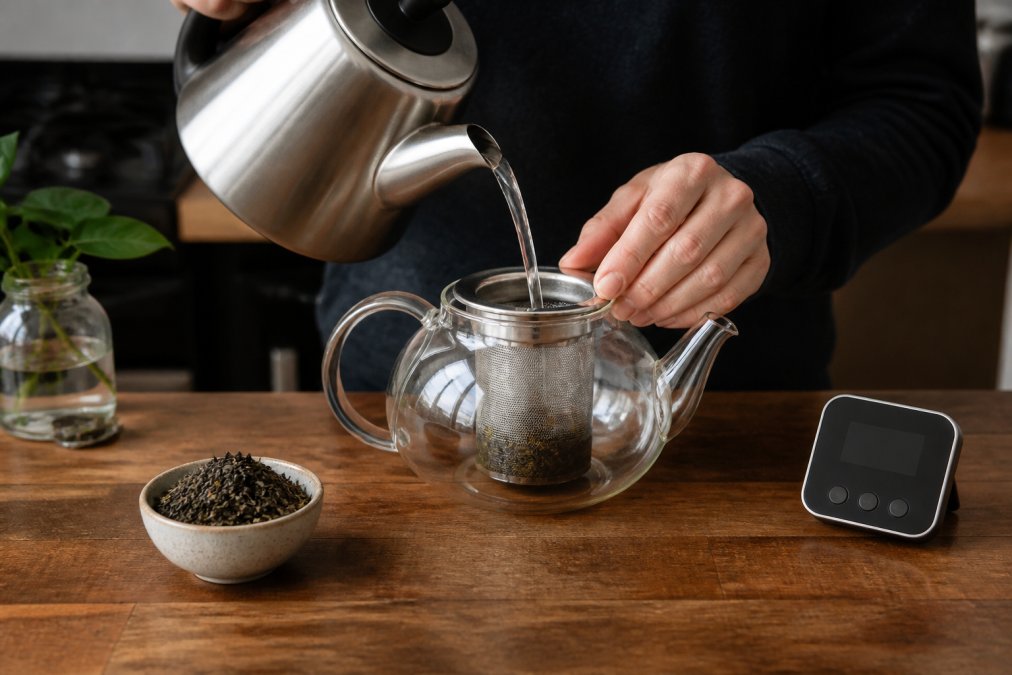
Brewing loose leaf tea well does not require a cabinet full of specialized teaware. How to brew loose leaf tea at home starts with three essentials: quality leaves, temperature control, and a timer.
Start with the correct water temperature. Black teas need water at a rolling boil, around 200-212°F, while green and white teas prefer cooler water near 175-185°F to avoid bitterness. Use roughly one teaspoon of leaves per 8-ounce cup, then adjust to taste. Steep black tea for 3-4 minutes, green tea for 2-3 minutes, and herbal infusions for 5-7 minutes to extract their full character.
A simple mesh infuser works perfectly for single cups. For larger quantities, a French press doubles as an excellent tea brewer: add leaves, pour hot water, steep, then press and pour. Cold brewing, where leaves steep in cold water in the refrigerator for 8-12 hours, produces a smooth, low-bitterness tea ideal for summer.
Tea Storage Best Practices for Maximum Freshness
A premium tea delivery service for home solves the freshness problem at the source, but it creates a second one: what do you do with a month's worth of tea once it arrives? Most subscription services ship in quantities meant to last several weeks, and improper storage can undo all the care that went into sourcing and shipping.
The three enemies of tea: oxygen, light, and moisture. Oxygen triggers oxidation, which dulls the delicate volatile compounds that create aroma. Light, especially UV light, breaks down chlorophyll and other pigments, leading to a flat, hay-like taste. Moisture is the most destructive: it encourages mold growth and accelerates chemical degradation. A storage system must address all three simultaneously.
Immediate steps when your delivery arrives. Do not transfer the entire shipment into one large canister if you plan to drink it over several weeks. Every time you open the container, you introduce oxygen and moisture. Instead, divide the tea into smaller, airtight portions. Keep one small jar or tin for daily use and store the rest in a cool, dark place. This "split-storage" method is the single most effective practice for bulk tea.
What to use and what to avoid. Airtight ceramic canisters with silicone gaskets or food-grade stainless steel tins with tight-sealing lids are ideal. Avoid clear glass jars on open shelves; even indirect light degrades tea over time. If your subscription ships in resealable foil pouches with nitrogen flushing, a method used by LGBrewTeaQ for its Yingde Black Tea Gift Set, keep the tea in the original pouch and press out as much air as possible before sealing.
The temperature and humidity sweet spot. The Specialty Tea Institute recommends keeping tea below 75°F in a dry environment with humidity below 70 percent (teausa.org). Most kitchens stay within this range, but cabinets above the oven or refrigerator can run hotter. A pantry shelf away from heat sources is ideal. Refrigeration is generally unnecessary and can introduce moisture when the container is opened, causing condensation that damages the leaves. The exception is very delicate green teas, which some enthusiasts store in the refrigerator in fully sealed, moisture-proof containers, but this is an advanced practice.
How long does tea actually last? Whole leaf tea stored properly maintains its character for up to two years, but the clock starts at harvest, not at delivery. A tea that sat in a warehouse for six months before shipping has less shelf life remaining. This is why harvest dates matter: a first-flush Darjeeling delivered in May is at its peak; the same tea delivered in December has already begun to fade. Most premium services, including LGBrewTeaQ, list harvest or packaging dates on their labels.
:::takeaway If you buy in bulk to save money, split your delivery into daily-use and long-term storage portions. This simple habit extends freshness by months and ensures every cup tastes as close to the harvest as possible.
For a practical example: a 250-cup bag of Darjeeling at $49.78 is a great value at roughly 20 cents per cup, but only if you drink it within a year. If you are a one-cup-a-day drinker, that bag will last over eight months, which is within the safe window. If you drink tea less frequently, consider a smaller, more frequent delivery schedule instead of a bulk purchase.
Frequently Asked Questions
What should I look for when choosing a premium tea delivery service?
Focus on sourcing and freshness. Look for services that offer whole leaf, loose leaf tea and state harvest dates. Check if they prioritize organic or ethically sourced ingredients from specific estates. Also consider delivery frequency flexibility, packaging sustainability, and whether their tasting notes match your preferences, like floral jasmine or robust masala chai.
Are premium tea subscription boxes worth the cost?
Yes, if you value freshness and variety. Premium services often source teas that are fresher and higher quality than grocery store options, which can lose flavor over time. The cost-per-cup is often comparable to a specialty coffee shop drink. You are paying for direct sourcing, better leaves, and the convenience of delivery. Start with a sampler to test the value for your palate.
How do I store premium loose leaf tea to maintain freshness?
Store your tea in an airtight, opaque container away from heat, light, and moisture. Do not keep it in the refrigerator, as this can introduce condensation and absorb odors. A cool, dark cupboard is ideal. Use your tea within six months to a year of opening to enjoy the full flavor profile, and keep different tea types separated to prevent aroma transfer.
Can I get a premium tea delivery service that focuses on caffeine-free options?
Absolutely. Many services offer dedicated caffeine-free selections. Look for terms like herbal infusions or tisanes. For example, LGBrewTeaQ offers a USDA Organic Valerian, Chamomile, and Lavender blend designed for sleep, and an Organic Lemon Ginger tea for a zesty, caffeine-free cup. These provide the premium ritual without the caffeine content.
This article was written using GrandRanker