

How to Choose Coffee Roast Profiles (2026 Guide)
Table of Contents
- What Are Coffee Roast Profiles?
- The Roast Profile Curve: Time, Temperature, and Development
- Light vs Dark Roast Flavor Differences
- How to Tell If Coffee Beans Are Fresh
- Best Coffee Roast for Espresso and Milk Drinks
- Troubleshooting Common Roast Profile Defects
- Sample Roasting vs. Production Roasting: Why It Matters for You
- Conclusion: Your First Roast Profile Decision
- Frequently Asked Questions
Choosing the Right Coffee Roast Profiles: A Practical Guide
Last Updated: September 8, 2026
Choosing the right coffee roast profiles can feel overwhelming when you are staring at a wall of bags labeled everything from "Cinnamon" to "Italian." A coffee roast profile is the documented record of bean temperature over time during roasting, and it determines whether your cup tastes bright and fruity or dark and smoky. At LGBrewTeaQ, we roast to order because the profile dictates everything from acidity to body. This guide breaks down how to choose coffee roast profiles by matching the science of the roast to your brewing style and taste preferences.
Most guides stop at telling you that light equals fruity and dark equals bold. The reality is more practical: your choice should hinge on how you brew, what you add to the cup, and how much you care about origin flavors.
What Are Coffee Roast Profiles?
A coffee roast profile is the complete temperature and time history of a bean batch from the moment it enters the roasting drum until it drops into the cooling tray. Roasters log bean temperature continuously, tracking the rate of rise, the drying phase, the Maillard reaction, and the moment of first crack. The profile also accounts for environmental temperature, heat application, and airflow.
The roast degree, often measured on the Agtron scale, describes where the bean stops in that journey. Lighter roasts stop early after first crack, preserving acidity and delicate flavor notes. Darker roasts push through second crack, developing bittersweet chocolate and smokiness while reducing origin character.
The Roast Profile Curve: Time, Temperature, and Development
The roasting curve is the backbone of how to choose coffee roast profiles. Three phases define it: the drying phase, the Maillard reaction, and development time after first crack. During drying, moisture evaporates and the bean turns yellow. The Maillard reaction creates brown color and savory complexity, while caramelization adds sweetness. Development time, the window between first crack and the drop, controls how much acidity remains versus how much roast character emerges.
The Maillard Reaction: Where Flavor Complexity Begins
The Maillard reaction is a cascade of hundreds of simultaneous reactions between amino acids and reducing sugars. It begins around 300°F (149°C) and accelerates as bean temperature climbs toward first crack (peer-reviewed research). The reaction produces melanoidins, which give roasted coffee its brown color, and volatile compounds responsible for notes like toasted grain, nut, and caramel. Crucially, it is time- and temperature-dependent: a longer, gentler Maillard phase produces different flavor compounds than a fast, hot pass.
A common pattern in specialty roasting is to extend the Maillard phase to build sweetness and complexity. Roasters using software like Artisan or Cropster often track the time between 300°F and first crack, aiming for a window of 2:30 to 4:00 minutes depending on the bean. Shorten that window too aggressively and you suppress the reaction's full range, leaving the cup one-dimensional. Stretch it too long and you risk a baked, bread-like flavor.
Caramelization: The Sweetness Ceiling
Caramelization is the thermal breakdown of sugars, distinct from the Maillard reaction, and it begins at higher temperatures, typically above 340°F (171°C) (sciencedirect.com). Sucrose, the primary sugar in coffee, caramelizes into compounds that taste sweet, slightly bitter, and complex. This is why darker roasts taste sweeter in a caramelized sense, even as origin sugars are destroyed.
There is a trade-off: caramelization produces sweetness, but it also consumes the delicate organic acids that give light roasts their brightness. A roaster choosing a profile for a naturally processed Ethiopian bean, prized for blueberry and floral notes, will typically drop the batch early to preserve those acids. A roaster working with a low-density Brazilian bean destined for espresso may extend development to build caramelized sugars that balance the shot's body.
Rate of Rise and Its Effect on the Cup
A common mistake is ignoring the rate of rise, or how quickly bean temperature climbs. A fast rate of rise can bake the bean's exterior while leaving the center underdeveloped, producing grassy, astringent flavors. Slower, controlled heat application preserves the delicate aromatics that single-origin beans are prized for. Ask whether the roaster shares these curve details; transparency signals care for the bean's potential.
Roasters logging with software track the rate of rise in degrees Fahrenheit per 30-second interval. A classic pattern is a declining rate of rise: high early in the roast, tapering as the bean approaches first crack. If the rate of rise spikes upward just before first crack, the roast is "running away," and the cup often tastes sharp or scorched. If the rate of rise is flat or negative through the Maillard phase, the roast risks baking. These mechanics are why two bags labeled "medium roast" can taste completely different.
What to Ask Your Roaster
When choosing between roasters, the depth of their profile documentation is a signal of their craft. Ask for the total roast time, the time from first crack to drop, and the drop temperature. A typical light roast might run 9:00 to 10:30 minutes total with a development time of 1:00 to 1:30. A medium-dark espresso roast might run 11:00 to 13:00 minutes with a development time of 2:30 to 3:30. Roasters who cannot answer these questions are likely not logging their profiles, meaning consistency batch to batch is a matter of luck, not design.
Light vs Dark Roast Flavor Differences
Light and dark roasts sit on opposite ends of the flavor spectrum, and your preference likely comes down to what you taste first. Light roasts preserve the bean's origin character: expect bright acidity, floral notes, and flavors like citrus or berries. Dark roasts trade that complexity for deeper roast flavors: bittersweet chocolate, caramel, and a heavier body with lower perceived acidity.
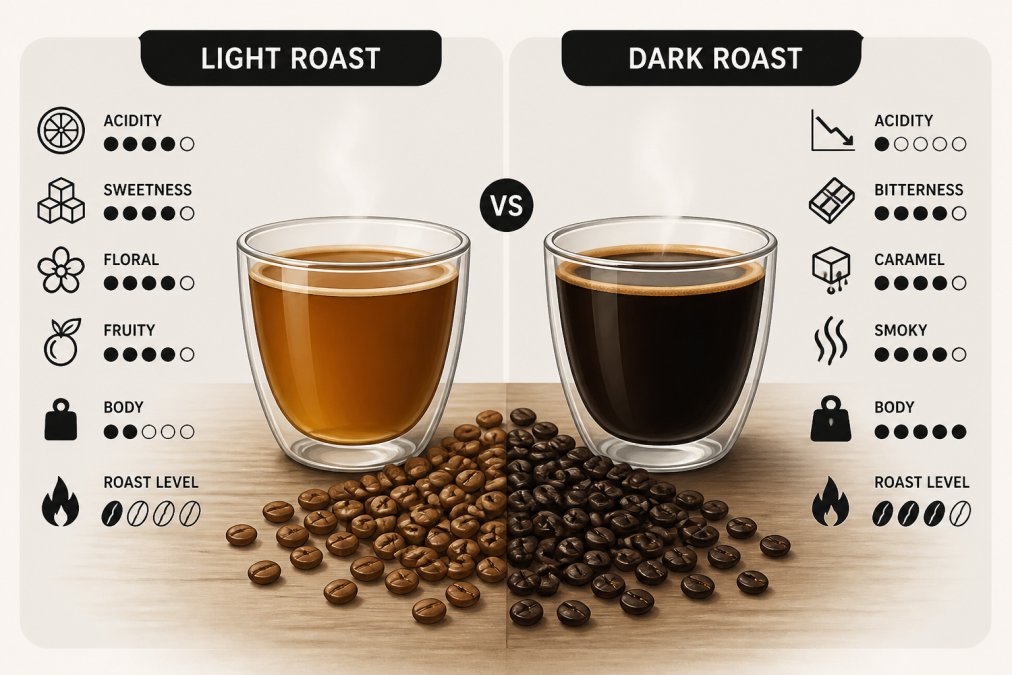
Bean density and varietal also influence how a roast develops. High-altitude beans are denser and need more thermal energy to roast evenly, which is why light roasts from these regions can taste exceptionally sweet. Caffeine content changes less than many assume; the bean density and brew ratio matter more than roast degree. If you love tasting the farm and the terroir, choose a light or medium roast. If you want a consistent, comforting cup that stands up to milk and sugar, a dark roast serves you better.
For a practical comparison of what to expect:
| Roast Level | Acidity | Body | Flavor Notes | Best Brewing Method |
|---|---|---|---|---|
| Light | High, bright | Light | Citrus, floral, berries | Pour-over, drip |
| Medium | Balanced | Medium | Caramel, nuts, cocoa | Drip, French press |
| Dark | Low | Heavy | Bittersweet chocolate, smoke | Espresso, moka pot |
How to Tell If Coffee Beans Are Fresh
Freshness is the silent partner in how to choose coffee roast profiles because a great profile is wasted on stale beans. Roasted coffee releases carbon dioxide for days after roasting, a process called degassing, and it continues to oxidize as it sits. Whole beans stay at their peak for roughly two to four weeks after the roast date, while ground coffee loses its volatile aromatics within days (peer-reviewed research). The most reliable freshness cue is a visible roast date on the bag, not a "best by" date.
Look for beans with a matte, dry surface rather than a shiny, oily one, though oily beans can simply indicate a very dark roast. Squeeze the bag and listen for a hiss of escaping gas, a sign the beans are still degassing. At home, buy whole beans and grind just before brewing. LGBrewTeaQ roasts to order and ships fast, so the beans arrive in that sweet spot.
Best Coffee Roast for Espresso and Milk Drinks
Espresso demands a roast that balances solubility with sweetness, and medium-dark roasts usually win. A roast that is too light can taste sharply acidic and thin when extracted under high pressure. A very dark roast risks tasting ashy and one-dimensional. Medium-dark profiles, often labeled as espresso roasts, develop enough sugar through caramelization to produce a syrupy body and a crema that holds its structure.
For milk drinks like lattes and cappuccinos, err toward the darker end of medium. The roast needs enough intensity to cut through steamed milk without disappearing. Our French Roast, taken right to the edge in the drum for deep caramelization, delivers that bittersweet chocolate backbone that stands up to dairy or oat milk. If you pull shots at home, a medium roast with a longer development time gives you more forgiveness with grind size and tamping pressure.

Troubleshooting Common Roast Profile Defects
Even experienced roasters hit defects, and knowing them helps you choose better coffee. A baked roast happens when heat application is too slow or airflow is too low, producing flat, bread-like flavors. Underdeveloped roasts taste grassy and peanut-like because the bean never completed the Maillard reaction. Scorching occurs when the drum or environmental temperature is too high early on, leaving dark spots and a harsh, burnt bitterness.
These defects are invisible in pre-ground coffee but obvious in the cup. If your beans taste hollow or aggressively bitter with no sweetness, the profile was likely flawed. Roasters who log their profiles and share them publicly are more likely to correct these issues. Sample roasting, where small batches are tested before production, is the industry safeguard against shipping an entire batch with a defect.
Baked Coffee: The Flat, Bread-Like Cup
A baked roast tastes flat, doughy, and slightly stale, even when the beans are fresh. The cause is insufficient thermal energy during the Maillard phase, usually from applying heat too slowly or using excessive airflow that strips heat from the drum. The bean's internal temperature stalls, and enzymatic activity degrades without the Maillard reaction completing properly.
How to fix it: Increase the heat application rate during the Maillard phase, typically between 300°F and first crack. Reduce airflow slightly to retain heat in the drum. The goal is to keep the rate of rise positive and steady, not flat. On a logged curve, a baked roast shows a rate of rise that plateaus or declines through the middle of the roast. If you consistently taste flatness, the roaster is likely baking their batches.
Underdevelopment: The Grassy, Peanut-Like Cup
Underdeveloped coffee tastes grassy, vegetal, or like raw peanuts. It happens when the roast is dropped too early, before the Maillard reaction has run its course, or when the rate of rise is so fast that the bean's exterior reaches temperature while the center stays raw. This is common with high-density beans roasted on a curve designed for softer beans.
How to fix it: Extend the total roast time, particularly the Maillard phase. For a dense Kenyan or Ethiopian bean, a roaster may need to add 30 to 60 seconds between 300°F and first crack to allow heat to penetrate the bean's center. Alternatively, reduce the charge temperature so the bean spends more time in the drum before first crack. On a curve, underdevelopment shows as a very short Maillard phase, often under 2:00 minutes, or a first crack that arrives earlier than expected.
Scorching: The Harsh, Burnt Bitterness
Scorching leaves dark spots on the bean surface and produces a harsh, acrid bitterness in the cup. It occurs when the drum temperature is too high at the start of the roast, or when the rate of rise is too aggressive in the first two minutes. The bean's exterior burns before the interior has a chance to develop.
How to fix it: Lower the charge temperature and apply heat more gradually during the drying phase. A typical charge temperature for a drum roaster is between 400°F and 450°F, but dense beans may need a lower charge to avoid scorching. Also check the drum speed; if the drum is turning too slowly, beans sit against the hot metal longer and scorch. On a curve, scorching shows as a steep rate of rise in the first 60 to 90 seconds, followed by a plateau.
Quakers and Other Density Defects
Quakers are underdeveloped beans that roast lighter than the rest of the batch, often tasting papery or peanut-like. They are usually caused by low-density beans or inconsistent bean size within the batch. Roasters remove quakers after roasting, but if you find them in your bag, it signals the roaster skipped the sorting step.
How to fix it: Screen the green coffee to remove small or broken beans before roasting. Adjust the roast curve to account for bean density; low-density beans need less heat and a shorter total roast time. If you consistently find quakers, the roaster is not investing in green coffee sorting.
How to Use This as a Buyer
When you taste a defect, you now know what to look for. Ask your roaster about their charge temperature, their Maillard phase duration, and their development time. A roaster who can articulate how they avoid baked or scorched profiles is one who logs data and corrects course. A roaster who says "we just roast it until it looks right" is flying blind, and your cup is the experiment.
Sample Roasting vs. Production Roasting: Why It Matters for You
Sample roasting is the quality-control step that separates careful roasters from bulk operators. Roasters take small batches, often just a few hundred grams, and cup them to evaluate the profile before scaling up. Production roasting then replicates that approved profile at a larger batch size, which requires adjusting heat application and airflow because a full drum behaves differently than a small one.
For you as a buyer, this matters because it explains why some bags taste consistently excellent and others vary week to week. Roasters who sample-roast and cup their beans catch defects before they reach your kitchen. This is also why trying a variety pack before committing to a full bag is a smart move. LGBrewTeaQ offers a Best Sellers Coffee Tasting Flight of 6 curated roasts so you can compare profiles side by side, and a Single Origin Favorites Sample Pack if you want to explore how different regions respond to the roast.


Conclusion: Your First Roast Profile Decision
Start with your brewing method and what you add to the cup. Pour-over drinkers who take coffee black should lean toward light or medium roasts to taste the origin. Espresso and milk drinkers should choose medium-dark profiles that carry sweetness and body. Then verify freshness with a roast date, and buy from a roaster who understands the curve behind the beans.
The fastest way to learn is to taste the spectrum side by side. LGBrewTeaQ roasts to order, so the coffee roast profiles you try arrive at their peak flavor rather than faded from shelf time. Explore our collection of freshly roasted blends and single origins and find the profile that makes your mornings worth looking forward to.
Frequently Asked Questions
What is the 15-15-15 rule for coffee?
The 15-15-15 rule is a freshness guideline for home brewers: buy coffee within 15 days of its roast date, grind it within 15 minutes of brewing, and drink it within 15 minutes of pouring. This window helps you experience the roast profile the roaster intended, before the beans lose their volatile aromatic compounds. Stale beans flatten acidity and mute flavor notes. Checking the roast date on the bag is your first step.
Which coffee roast is right for me?
Your choice depends on how you brew. Light roasts preserve bright acidity, floral notes, and origin character, ideal for pour-over and drip methods. Medium roasts balance sweetness and body, working well for most brewers including automatic drip. Dark roasts deliver bold, smoky, chocolatey flavors with a heavier body, which stands up to milk and espresso. Trying a sample pack like our Best Sellers Coffee Tasting Flight lets you compare roast profiles side by side without committing to a full bag.
Do most people prefer light or dark roast coffee?
Surveys consistently show that most American coffee drinkers prefer medium to dark roasts, often because they perceive them as stronger and more familiar. However, light roasts actually contain slightly more caffeine by volume and offer more complex, fruity flavor notes. Preference often shifts as drinkers explore single-origin beans and specialty brewing methods. The best approach is to taste different roast levels and decide based on your palate, not on marketing assumptions.
How does roast profile affect caffeine content?
Roast level has a minimal effect on caffeine content. The difference is about weight: beans lose mass and expand during roasting, so a scoop of light roast contains slightly more caffeine than a scoop of dark roast because the beans are denser. By weight, caffeine remains nearly identical. Your brewing method influences caffeine more than the roast curve does. Espresso uses a concentrated dose, so it delivers more caffeine per ounce than drip coffee.
What is the best coffee roast for espresso at home?
Medium to medium-dark roasts are the most forgiving for home espresso. They offer enough caramelized sugar development to create a sweet, syrupy shot with good crema, while still preserving origin flavors. Very light roasts can taste sour and under-extracted in espresso, and very dark roasts can turn bitter and ashy. Our Breakfast Blend, roasted to a medium profile, is a solid starting point for dialing in your machine.