

How to Keep Coffee Beans Fresh at Home
Table of Contents
- What You'll Need for Fresh Coffee Beans
- The Four Enemies of Coffee Freshness
- How Long Do Coffee Beans Stay Fresh?
- Best Coffee Storage Containers for Home Use
- Freezing Coffee Beans: When It Works and When It Hurts
- Common Coffee Storage Mistakes to Avoid
- Signs Your Coffee Beans Have Gone Stale
- Conclusion: Build a Storage Routine That Works
- Frequently Asked Questions
Last Updated: September 7, 2026
Fresh coffee is a fleeting thing. Once those beans leave the roaster, a countdown begins that no bag can fully pause, only slow down. Learning how to keep coffee beans fresh at home is the single highest-impact upgrade you can make to your morning cup. At LGBrewTeaQ, we roast to order specifically because freshness drives everything: the aroma, the crema, and that bright, complex flavor profile you paid for.
Keeping coffee beans fresh at home doesn't require expensive equipment or laboratory habits. It requires understanding four simple threats and building a routine around them.
What You'll Need for Fresh Coffee Beans
Before adjusting your habits, gather a few basics. You don't need much, but each item serves a specific purpose in the fight against staleness.
- Airtight container: An opaque vessel with a reliable seal is your primary defense.
- Whole bean coffee: Pre-ground coffee goes stale dramatically faster because more surface area is exposed to oxygen (peer-reviewed research).
- A cool, dark storage spot: A cabinet away from the stove and sink works well.
- Optional: vacuum sealer or freezer-safe bags for long-term storage.
The essential principle is simple: coffee beans fresh from roasting need protection from air, moisture, heat, and light.
The Four Enemies of Coffee Freshness
Air and oxygen trigger oxidation, the primary culprit in flavor loss. Moisture accelerates this and can introduce off-flavors. Heat speeds up all chemical reactions, including oil degradation, while light damages beans through photodegradation.
Why Air and Moisture Ruin Beans First
Freshly roasted coffee releases carbon dioxide for days after roasting, a process called degassing. This is why roasters use bags with one-way valves: they let CO2 escape without letting oxygen in. Once you open that bag, the protective CO2 atmosphere is gone.
Moisture is arguably worse. Coffee beans are porous, acting like sponges. In humid conditions, they absorb ambient moisture, accelerating staleness and introducing musty notes.
How Long Do Coffee Beans Stay Fresh?
Coffee beans fresh from the roaster are at their peak for a specific window. Most roasters, including our team, recommend using beans within two to four weeks of the roast date for optimal flavor (sca.coffee). The first three to seven days after roasting involve the "resting" period, where CO2 dissipates and flavors stabilize.
After that peak window, beans don't become unsafe to drink; they simply lose complexity. The shelf life extends to about two months for acceptable, if muted, flavor, assuming proper storage.
| Storage Condition | Optimal Flavor Window | Acceptable Quality | Notes |
|---|---|---|---|
| Whole bean, airtight, cool/dark | 2-4 weeks from roast | Up to 2 months | Check the roast date, not the sell-by date |
| Pre-ground, airtight | 3-5 days | Up to 1 week | Grind right before brewing for best results |
| Frozen whole bean | 2-3 months | Up to 6 months | Requires proper vacuum sealing to avoid freezer burn |
Best Coffee Storage Containers for Home Use
The best coffee storage containers solve two problems simultaneously: they block air and light. A container that fails at either is a compromise. The market has split into passive airtight containers and active vacuum-sealed systems; understanding the difference is key to matching the container to your consumption habits.
For daily use, look for an airtight container with a one-way valve if you buy in bulk, or a simple airtight seal if you transfer smaller amounts. The container should be opaque or stored in a dark cabinet.

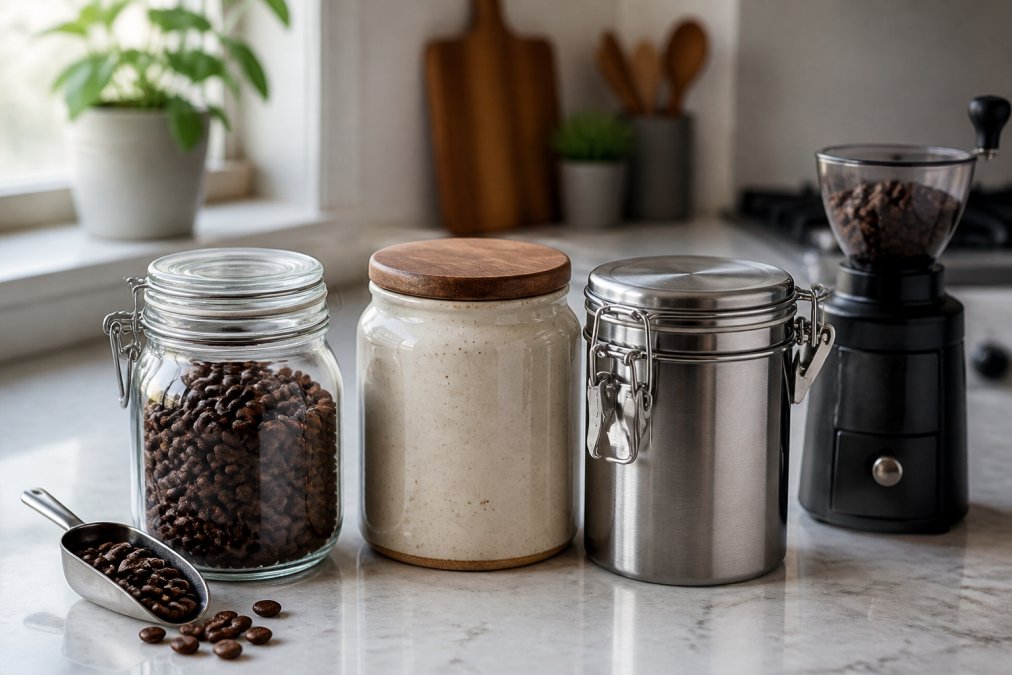
Glass vs. Ceramic vs. Stainless Steel
Each material has trade-offs. Glass is non-porous and doesn't retain odors, but it's transparent, so it must live in a dark cabinet. Ceramic offers opacity and aesthetic appeal, but seal quality varies widely by brand. Stainless steel provides the best all-around protection: opaque, durable, and non-porous.
Whichever you choose, the seal matters more than the material. A cheap container with a poor gasket fails at its only job. Look for a silicone or rubber gasket that creates a firm, airtight closure.
The Vacuum Sealing Question: Does It Actually Help?
Standard airtight containers still contain about 20.9% oxygen in the air trapped inside (nist.gov). Vacuum sealing removes that oxygen. However, coffee beans degas for days or weeks after roasting, releasing CO2. A rigid vacuum container will slowly lose its seal as pressure builds, while a flexible vacuum bag will puff up.
The practical workaround: For beans you plan to consume within two to four weeks, a high-quality airtight container with a one-way valve is sufficient. The valve lets CO2 escape without letting oxygen in, maintaining a near-inert internal atmosphere. For long-term storage (freezing or beyond a month), a home vacuum sealer with chamber bags is superior. Vacuum-seal beans only after they have fully degassed, roughly seven to ten days past the roast date. Sealing too early traps CO2, which can crush the beans and extract oils prematurely.
What about nitrogen flushing? Commercial roasters often flush bags with nitrogen to displace oxygen before sealing. Home nitrogen canisters exist but are impractical and expensive for most households. Vacuum sealing achieves a similar result by physically removing oxygen, though it also compresses the beans.
The Roast-Level Container Adjustment
Your roast level should influence your container choice. Dark roasts have more surface oils and degas faster, benefiting from a robust one-way valve. Light roasts degas slower and are more porous, making them more susceptible to moisture absorption; prioritize a container with an exceptional moisture barrier. Medium roasts are the most forgiving and work well in any quality airtight vessel.
Container Maintenance: The Overlooked Variable
Even the best container fails if its gasket is dirty or worn. Coffee oils accumulate on silicone seals, degrading flexibility and creating a path for air. Wipe the gasket with a dry cloth weekly and wash it with mild soap monthly. Replace any container whose gasket has hardened or cracked.
Freezing Coffee Beans: When It Works and When It Hurts
Freezing coffee beans is a divisive topic. The short answer: freezing works for long-term storage, but only if done correctly. Freezing whole beans in an airtight, vacuum-sealed bag can extend their life for several months. The key is to freeze once and never thaw and refreeze, as temperature fluctuations cause condensation.
The danger zone is the refrigerator. Fridges are humid and full of odoriferous foods. Beans stored there absorb moisture and smells, degrading faster than beans kept at room temperature.
If you do freeze, portion the beans into single-week batches before freezing. Remove only what you need, grind from frozen, and return the rest to the freezer immediately.
The Roast-Level Freezing Rule
Roast level fundamentally changes how beans respond to freezing. Dark roasts are the worst candidates. Their surface oils are already oxidized and volatile; freezing accelerates oil crystallization, and upon thawing, those oils can turn rancid faster than at room temperature. If you must freeze dark roasts, consume them within one month and grind from frozen immediately.
Light roasts are the best freezing candidates. They have less surface oil and a denser cellular structure, which protects them from ice crystal damage. Light roasts can survive two to three months in a deep freezer with minimal flavor loss, provided they are vacuum-sealed. Medium roasts fall in between: freeze them only if you have more than a month's supply.
Climate Matters: Freezing as a Humidity Solution
For home baristas in high-humidity regions, think Gulf Coast summers or Pacific Northwest winters, freezing offers an unexpected advantage. Standard advice to store beans in a 'cool, dry place' is nearly impossible when ambient humidity exceeds 70%. In these environments, beans left in an airtight container at room temperature still absorb moisture every time you open the lid.
Freezing provides a workaround: portion beans into vacuum-sealed bags and keep them in the freezer. The freezer's dry, cold environment protects beans from ambient humidity. When you need beans, remove one portion, let it come to room temperature while still sealed (about 30 minutes), then open it. This technique is particularly effective for light and medium roasts.
The Grind-From-Frozen Debate
A common pattern among specialty coffee enthusiasts is grinding beans directly from the freezer without thawing. This works because frozen beans are more brittle, producing a more uniform grind with fewer fines. However, this only applies to whole beans. Never freeze pre-ground coffee.
When Freezing Is Not Worth It
Freezing is a preservation tool, not a freshness enhancer. If you consume a 12-ounce bag within three weeks of the roast date, freezing will not make the coffee taste better, it will only add risk of moisture damage. Freezing is justified only when you have more beans than you can use within the optimal four-week window, or when room-temperature storage is compromised by humidity.
Common Coffee Storage Mistakes to Avoid
Most freshness problems trace back to a handful of repeatable errors. Avoiding these will extend the life of your coffee beans fresh from the roaster.
- Buying pre-ground coffee: Grinding increases surface area exponentially, accelerating oxidation. Always buy whole bean and grind immediately before brewing.
- Storing beans in the fridge: As noted, refrigerator humidity and odors are destructive.
- Leaving beans in the original bag unsealed: Once opened, the bag's protection is compromised. Transfer to an airtight container or use a clip to reseal it tightly.
- Buying more coffee than you can use in a month: Unless you plan to freeze it, overbuying guarantees you'll drink stale coffee in week three.
- Storing beans above the stove or near a window: Heat and light from these locations accelerate degradation.
Signs Your Coffee Beans Have Gone Stale
Stale coffee isn't always obvious, especially if you've been drinking it for a while. Here are the sensory signals to watch for.
Aroma: Fresh beans smell fragrant and complex. Stale beans have a flat, musty, or cardboard-like scent with little to no sweetness. Crema: In espresso, stale beans produce thin, pale crema that dissipates quickly. Taste: The most telling sign is a loss of sweetness and acidity. Stale coffee tastes bitter, flat, or dusty, with none of the bright, fruity, or chocolatey notes you'd expect from the origin.
Carbonation: This is a lesser-known test. Fresh beans, when ground, will cling to each other slightly due to CO2 and oils. Stale beans feel dry and don't exhibit that slight clumping.
Conclusion: Build a Storage Routine That Works
Keeping coffee beans fresh at home is less about perfection and more about consistent habits. Buy whole bean coffee with a visible roast date, transfer it to an opaque, airtight container, and store it in a cool, dark cabinet. Grind only what you need for each brew.
This routine preserves the volatile compounds that make specialty coffee worth the effort. When you start with beans roasted to order, as we do at LGBrewTeaQ, proper storage ensures every cup delivers the full flavor profile the roaster intended, from the first brew to the last.
Frequently Asked Questions
Is it okay to store coffee beans in a Ziploc bag?
A Ziploc bag works for a day or two, but it is not a good long-term home for coffee beans. The bag is not truly airtight, and the one-way valve found on most coffee bags is absent. Oxygen seeps in and speeds up oxidation, which dulls the flavor. If you must use a Ziploc bag, squeeze out as much air as possible before sealing and keep the bag in a cool, dark cabinet. For beans you plan to keep longer than a week, transfer them to a proper airtight container.
Should coffee beans be stored in the refrigerator or freezer?
Skip the refrigerator entirely. The fridge exposes beans to moisture, humidity, and food odors, which ruins the flavor profile. Freezing coffee beans can work only if you follow strict rules: freeze whole beans in an airtight container, remove only the portion you need, and never refreeze them. Freezing is best for long-term storage beyond two weeks. For daily use, keep beans in an opaque, airtight container in a cool, dark place. The freezer is a tool, not a daily storage solution.
Can I vacuum seal coffee beans to keep them fresh?
Yes, vacuum sealing is one of the best ways to keep coffee beans fresh for extended periods. Removing oxygen slows oxidation and protects the volatile compounds that carry aroma and flavor. This method shines for long-term storage, especially when combined with freezing. For beans you use daily, vacuum sealing is overkill and inconvenient. You lose the ability to easily access your beans, and the repeated opening and resealing defeats the purpose. Use vacuum sealing for bulk purchases or beans you will not touch for weeks.
How do I know if my coffee beans have gone stale?
Stale coffee beans lose their aroma, smell flat or musty, and produce weak, dull coffee. Fresh beans release carbon dioxide for days after roasting, which is why bags often puff up. If your bag feels flat and the beans have no scent when you open it, they are past their prime. Another sign: the crema on your espresso thins out, or your brewed coffee tastes papery and lifeless. If you cannot remember the roast date and the beans sit for a month or more, it is time for a new bag.
Most coffee drinkers accept stale cups as normal because they've never tasted the difference. Once you have, there's no going back. Start with freshly roasted, whole bean coffee from LGBrewTeaQ, delivered to your door within days of roasting, and pair it with an airtight storage routine. Our carefully sourced beans and simple ordering process make it easy to build a ritual worth protecting. Shop Coffee and taste what proper freshness actually delivers.