

How Do You Fix Sour Espresso Shots at Home?
Quick Summary
Sour espresso is usually under-extracted, meaning water ran through the coffee too fast or did not pull enough flavor from the grounds. To fix it, check your shot time first, then adjust grind size, dose, and yield one variable at a time. Log every shot to spot patterns.
- Under 25 seconds usually means the shot is running too fast and tastes sour.
- Aim for about 25 to 30 seconds for a double shot as a starting point.
- Weigh your yield, not your volume, so grind changes are measurable.
- Change one variable per shot and never adjust grind and dose together.
- Check for channeling by distributing grounds evenly and tamping level.
Table of Contents
- Why Your Espresso Tastes Sour: Under-Extraction Explained
- Sour vs. Bitter Espresso: How to Tell the Difference
- Check Your Espresso Extraction Time First
- How to Fix Sour Espresso by Adjusting Grind Size
- Dose, Yield and Water Temperature: The Other Variables
- Diagnosing Channeling, Uneven Extraction and Bean Freshness
- Dial In Your Next Shot With LGBrewTeaQ Beans
- Frequently Asked Questions
Why Your Espresso Tastes Sour: Under-Extraction Explained
Last Updated: October 27, 2026
Sour espresso is one of the most common complaints home baristas have, and it is usually fixable.
The short answer: sour espresso is usually under-extracted. Water passed through the coffee too fast, or didn't pull enough flavor out of the grounds.
Here is the good news. You don't need expensive gear to fix it.
The sections below cover how to tell sour from bitter, how to check your shot time, how to adjust grind size, and what to do with dose, yield, and temperature.
Sour vs. Bitter Espresso: How to Tell the Difference
Sour and bitter are easy to mix up, but they point to opposite problems. Sour is sharp, puckering, and thin. Bitter is dry, harsh, and heavy on the tongue.
Here is a quick way to check:
- Sour: Tart, lemony, or vinegary. Often thin in body. Usually means under-extraction.
- Bitter: Ashy, dry, or burnt. Often heavy in body. Usually means over-extraction.
- Balanced: Sweet, with some acidity that adds brightness. Full but not harsh.
Some acidity is good. Light roasts and certain origins have bright, fruity notes that feel lively, not sour. The difference is balance. If the acidity crowds out sweetness and the shot tastes thin, you're looking at extraction, not bean character.
Taste your shot on its own, without milk, before you change anything. That gives you a clear baseline.
Check Your Espresso Extraction Time First
Shot time is the fastest way to diagnose a sour shot. Start your timer when the pump starts, and stop it when the shot reaches your target volume.
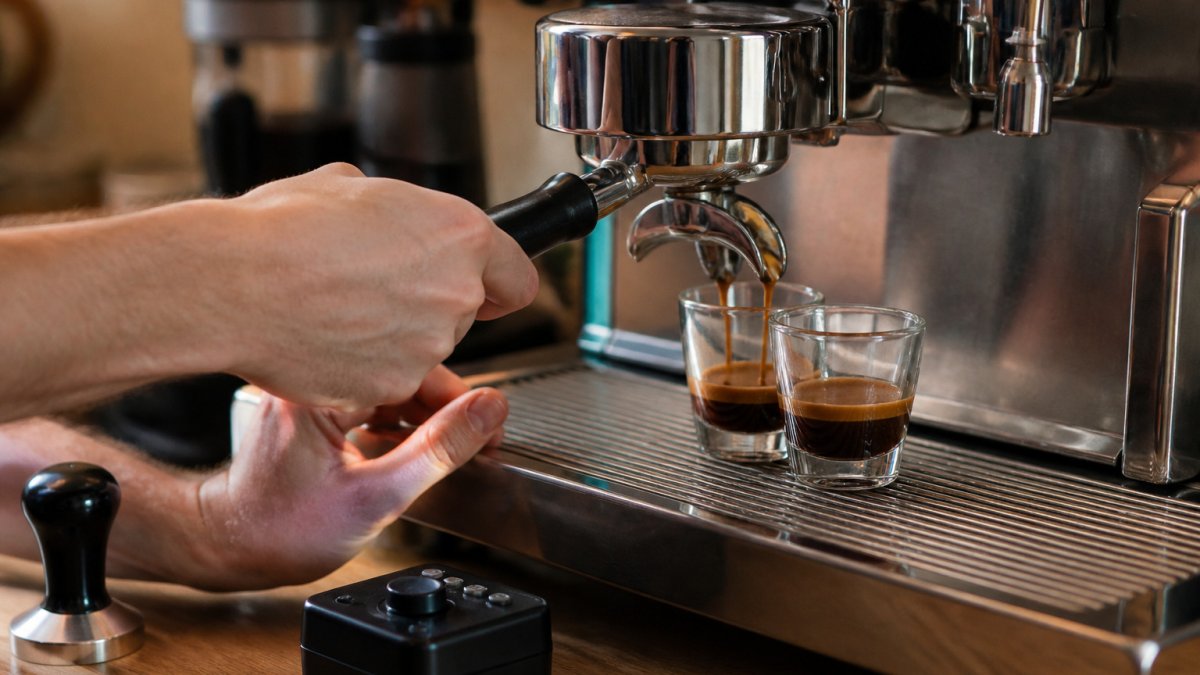
A common target is about 25 to 30 seconds for a double shot. Use this as a starting point:
- Under 25 seconds: Likely under-extracted and sour. The water ran through too fast.
- 25 to 30 seconds: Usually a good range to start from.
- Over 30 seconds: Could taste bitter or dry if the grind is too fine.
Shot time matters more than any single number. A shot that runs 20 seconds with a sour taste needs a finer grind or a higher dose.
Keep a simple log. Write down dose, grind setting, shot time, and taste. After a few shots, patterns show up quickly.
Use these shot-time ranges as a quick guide to what your timer is telling you.
| Shot time | Likely taste | What it means |
|---|---|---|
| Under 25 seconds | Sour | Water ran through too fast |
| 25 to 30 seconds | Balanced | Usually a good range to start from |
| Over 30 seconds | Bitter or dry | Grind may be too fine |
How to Fix Sour Espresso by Adjusting Grind Size
Grind size is the first lever most people should pull, because it is the variable that most directly controls how fast water moves through the puck. A finer grind slows flow, which gives water more contact time to dissolve sweetness and body. But "go finer" on its own is not a troubleshooting method. You need a baseline, a measurable checkpoint, and a rule for when to stop.
Step 1: Establish a repeatable baseline
Before you change the grind, lock everything else. Use the same dose (weigh it on a scale to 0.1 g), the same basket, the same tamp, and the same target yield every shot. Write these down:
- Dose: ____ g
- Target yield: ____ g (weigh the liquid output, do not eyeball volume)
- Grind setting: ____
- Shot time: ____ seconds (start timer when the pump starts)
- Taste: sour / balanced / bitter
A common starting point for a double shot is an 18 g dose, a 36 g yield, and a 25 to 30 second shot time. Treat those as a starting line, not a rule. The point is that every shot is measured the same way so the only thing changing is the grind.
Step 2: Change one grind step and read the checkpoint
Go finer by the smallest step your grinder allows. Pull the next shot with the same dose and target yield, and compare three numbers: shot time, flow at the start, and taste.
- Shot time rises and sourness drops: You are moving in the right direction. Keep stepping finer until the shot tastes sweet or the time pushes past your target.
- Shot time barely moves: Your grinder may have large steps, or the basket may be channelling. Check puck prep before going much finer.
- Shot chokes or runs past about 35 seconds and tastes bitter or dry: You went too far. Step back one setting.
Step 3: Know when grind is the wrong lever
Grind cannot fix every sour shot. If you are already at a fine setting, the shot time is in range, and the shot still tastes thin and sour, the problem is more likely dose, yield, water temperature, or channeling. Stop grinding finer and move to the next variable. Grinding finer when the puck is already restricted usually produces bitterness and uneven flow, not sweetness.
6 Bean Blend - Dark Roast House Espresso & Coffee →
Step 4: Fix grind consistency before chasing settings
Uneven particles are a hidden cause of sour shots. When the grind has both fine and coarse particles, water races through the coarse ones and stalls on the fine ones, so the shot tastes sour and bitter at the same time and no single grind setting fixes it. A burr grinder produces a narrower particle range than a blade grinder, and a clean burr set produces a more even range than a worn one. If your shots swing between sour and bitter with tiny grind changes, consistency is the problem, not the setting.
A quick grind decision tree
- Shot runs under 25 seconds and tastes sour → go finer one step.
- Shot runs 25 to 30 seconds, tastes sour, and flow looks even → check dose and yield next, not grind.
- Shot runs 25 to 30 seconds, tastes sour, and flow sputters or gushes unevenly → fix puck prep and channeling first.
- Shot runs over 35 seconds and tastes bitter or dry → go coarser one step.
- Shot tastes sour and bitter at once → improve grind consistency and puck prep before changing the setting.
Log every shot. After four or five shots the pattern is usually obvious, and you will know whether grind is the lever or whether the problem lives somewhere else.
Dose, Yield and Water Temperature: The Other Variables
Once grind is dialed in, the remaining variables decide whether a shot tastes balanced or thin and sour. The mistake most people make is changing several at once. The fix is a fixed order: dose first, then yield, then temperature, one change per shot, with the same grinder setting until you deliberately move it.
Dose: start with a basket that fits
Dose is how much ground coffee goes into the basket, measured in grams on a scale. A dose that is too low for the basket leaves too much headspace, so the puck can shift and channel, and the shot tastes thin and sour. A dose that is too high can press against the shower screen and restrict flow.
A practical starting point is the dose your basket is rated for. Many double baskets are designed around 18 g. If your shots taste sour and thin at 16 g, try 18 g with the same grind and yield, then re-check shot time.
Yield and brew ratio: the lever most people underuse
Yield is the weight of liquid espresso in the cup, and brew ratio is dose divided by yield. A 1:2 ratio means 18 g of coffee in and 36 g of espresso out. A 1:2.5 ratio means 18 g in and 45 g out.
A longer yield extracts more from the same puck, which is often the fastest way to pull sweetness out of a sour shot. If your 18 g dose is producing 30 g of espresso in 25 seconds and tasting sour, try the same dose and grind but stop at 40 g.
Water temperature: check it before you trust it
Water that is too cool extracts less, and under-extraction tastes sour. Most espresso is brewed with water around 195 to 205°F. But the number on the display is not always the temperature at the puck, and many machines have limited adjustment.
- Machines with a PID or adjustable temperature: set it near 200°F for a medium roast and let the machine stabilize for at least 15 to 20 minutes before pulling shots. A cold group head pulls heat out of the first shot.
- Machines with no temperature control: let the machine warm up fully, and pull a blank shot to heat the group and cup before the real shot. If shots are consistently sour and grind and yield are in range, temperature may be the limit you cannot adjust.
- Pressurized baskets: if your machine uses a pressurized basket, grind changes have much less effect because the basket creates back-pressure. In that case, dose, yield, and bean freshness matter more than grind, and you should not expect the same dialing-in response as a non-pressurized setup.
The order to change things
- Fix dose so the basket is properly filled.
- Adjust yield and brew ratio to taste, keeping dose and grind fixed.
- Adjust temperature only after dose and yield are settled.
- Change grind last if the first three steps do not solve the sourness.
Write down dose, yield, ratio, temperature setting, and taste for every shot. After a few shots you will see which variable is actually moving the flavor, and you will stop guessing.
Diagnosing Channeling, Uneven Extraction and Bean Freshness
Some sour shots have a cause that grind and dose won't fix. Two causes are worth checking: channeling and stale beans.
Channeling happens when water finds a path through the puck instead of soaking the whole bed. Water rushes through the gap, so part of the coffee is under-extracted and sour, while the rest may taste harsh. Signs include a shot that gushes out in streams and tastes uneven.
A few habits reduce channeling:
- Distribute the grounds evenly before tamping.
- Tamp level and firm, without twisting.
- Keep your portafilter and basket clean.
Bean freshness matters too.
For more on keeping your beans in good shape, read our guide on how to store coffee beans for freshness.
Dial In Your Next Shot With LGBrewTeaQ Beans
Our 6 Bean Blend - Dark Roast House Espresso & Coffee has a heavy, syrupy body and gentle, low acidity. You can also browse our espresso collection.

If you want to keep working on extraction, our guide on how to improve coffee extraction at home covers more techniques. And if your shots tip into bitter instead, see why does my coffee taste bitter and how to fix it.
Frequently Asked Questions
How do you fix sour-tasting espresso?
For general troubleshooting, you can try grinding finer, checking dose and puck preparation, and changing one variable at a time.
Can grinding finer make espresso less sour?
You can try a finer grind in small steps and taste after each change.
How do I tell whether espresso is sour or bitter?
Sour espresso may taste sharp or thin, while bitter espresso may taste harsh, dry or ashy. Sip the shot and note whether sharpness or dryness dominates.
How long should an espresso shot take?
Shot time and yield can vary with the beans and machine. You can use a consistent shot time and taste as starting points when adjusting your brew.
