

Is a Coffee Subscription Worth the Cost in 2026?
Last Updated: October 27, 2026
Quick Summary
A coffee subscription can be worth the cost for regular drinkers, since it can run about $0.58 to $0.71 per cup for someone drinking one bag every one to two weeks, according to Bean Box. Whether it saves money depends on your bag price, shipping, and brewing dose compared with what you currently pay per cup.
- Compare cost per cup, not sticker price: (bag price plus shipping) divided by cups per bag.
- A $5 shipping charge on a $16 bag adds roughly 31% to the effective price.
- A 12-ounce bag holds about 340 grams, enough for roughly 34 small drip cups.
- Subscriptions usually save money against cafe drinks or pods, but cost more than cheap bulk store beans.
- Set your delivery interval to match how fast you drink through a bag to keep beans fresh.
Table of Contents
- What a Coffee Subscription Actually Costs Per Cup
- Coffee Subscription vs Buying Beans at the Store
- Break-Even Points by How Much You Drink
- How Often to Order Coffee Beans for Freshness and Value
- Coffee Subscription Pros and Cons
- Freshness, Flexibility, and Keeping Control of Your Subscription
- Deciding If a Subscription Fits Your Morning Routine
- Frequently Asked Questions
Is a coffee subscription worth the cost? For most regular coffee drinkers, the answer depends on three things: how much you drink, how much you pay per bag, and whether the convenience matters to you. Coffee subscriptions can cost as little as about $0.58 to $0.71 per cup for someone who drinks one bag every one to two weeks, according to Bean Box. That is a real, low-cost figure, but only if the bag price and volume line up with how you actually brew. Below, we break down the real cost per cup, compare subscriptions against buying beans at the store, and show where the break-even points fall.
What a Coffee Subscription Actually Costs Per Cup
Most subscription reviews quote a per-cup number without showing the arithmetic. That is the single biggest reason readers cannot tell whether a subscription is worth the cost. The honest way to compare is to build the cost per cup from four inputs: bag price, bag weight, dose per cup, and shipping. Change any one and the answer moves.
Start with the dose. A standard 12-ounce bag holds about 340 grams of coffee. A typical drip or pour-over dose is 10 grams per 6-ounce cup, an espresso double shot uses roughly 18 grams, and a large 16-ounce mug brewed strong can take 20 grams or more. That means one 12-ounce bag yields roughly 34 small drip cups, about 19 espresso doubles, or about 17 large mugs. A 2-pound bag (about 907 grams) roughly triples those counts.
Now layer in price. Atlas Coffee Club subscriptions start at around $13 per bag, according to Podium Coffee Club's 2026 coffee subscription roundup, and that starting price does not include shipping. Bean Box has published a per-cup range of roughly $0.58 to $0.71 for a subscriber drinking one bag every one to two weeks, per Bean Box's subscription guide, but that figure does not disclose its bag price or serving size, so treat it as a ballpark rather than a benchmark.
Here is the mechanism that matters: cost per cup equals (bag price + shipping per bag) divided by (bag grams divided by grams per cup). A $16 bag with $5 shipping and 340 grams at 10 grams per cup works out to about $0.62 per cup. The same bag at 18 grams per espresso shot works out to about $1.11 per shot. The coffee did not get more expensive; the dose did. This is why a subscription that looks cheap per bag can be expensive per cup if you brew strong or drink large mugs.
Shipping is the hidden multiplier. A flat $5 shipping charge on a $16 bag adds roughly 31% to the effective bag price. If the service ships every two weeks, that is about $130 a year in shipping alone. Consolidating to a larger bag or a longer interval can cut shipping per cup sharply, which is why bag size and cadence belong in the same calculation as price.
Run the math on your own brew before you commit. If you do not know your dose, weigh it once, a cheap kitchen scale pays for itself the first time it stops you from overpaying per cup.
The per-cup cost depends on four inputs, so here is how they combine.
| Input | Example value | Effect on cost per cup |
|---|---|---|
| Bag price | $16 per bag | Higher price raises cost per cup |
| Shipping | $5 per bag | Adds about 31% to a $16 bag |
| Bag size | 12 oz (about 340 g) | Yields about 34 small drip cups |
| Dose per cup | 10 g per 6 oz cup | Stronger brewing lowers cups per bag |
| Espresso double shot | About 18 g | Yields about 19 shots per 12 oz bag |
| Result at 10 g per cup | About $0.62 per cup | Matches (bag + shipping) ÷ cups per bag |
Coffee Subscription vs Buying Beans at the Store
Buying beans at a grocery store is usually cheaper per bag, but you give up freshness and control. Subscriptions tend to pitch freshness as their main advantage, with several services saying coffee is roasted and shipped to order. That matters because beans lose aroma quickly after roasting.
Store-bought bags often carry no roast date, so you cannot tell how old the coffee is. A subscription removes that guesswork. The tradeoff is price: you pay for the roast-to-order process and the delivery. For a closer look at whether that premium pays off, see whether small-batch coffee is worth it. Whether that premium is worth it depends on how much you value fresh flavor against a lower sticker price.
Break-Even Points by How Much You Drink
Break-even is not one number. It is a function of how many cups you drink per day, how many grams each cup uses, and what you would otherwise pay per cup. The useful exercise is to find the cups-per-day threshold at which a subscription beats your current habit.
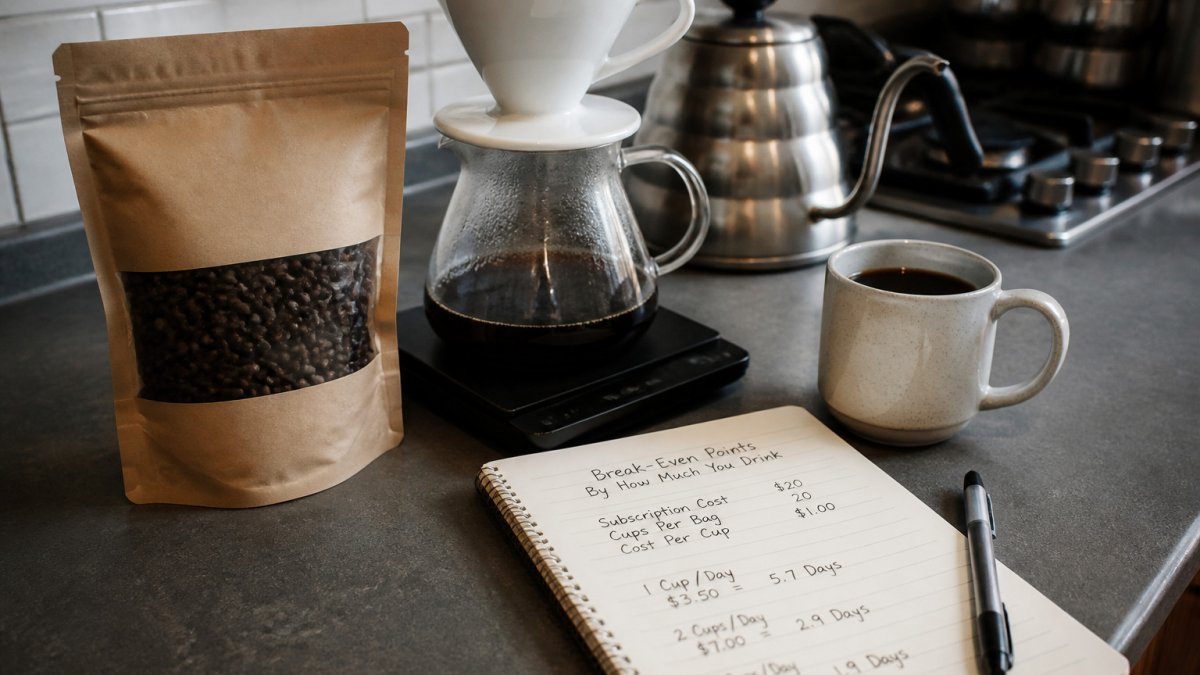
Set a baseline first. If you buy a 12-ounce bag of supermarket beans for about $10 and brew 10-gram cups, your cost per cup is roughly $0.29 before any shipping. A subscription at $16 per bag plus $5 shipping works out to about $0.62 per cup at the same dose. On that comparison, the subscription costs more per cup no matter how much you drink, volume does not fix a higher unit price. Break-even only appears when the alternative is more expensive per cup, such as cafe drinks, single-serve pods, or frequent small-bag specialty purchases.
That is where the drinking-habit math gets interesting. A daily cafe habit of two $5 drinks is about $3,650 a year. A subscription delivering one $16 bag every two weeks plus $5 shipping is about $546 a year and yields roughly 34 cups per bag, or about 884 cups a year at 10 grams per cup, far more coffee than two cafe drinks a day. Even accounting for milk, filters, and equipment, the subscription wins on cost per cup by a wide margin. The break-even is not about volume; it is about what you are replacing.
Household size changes the cadence, not the verdict. A one-person household drinking two 10-gram cups a day uses about 20 grams daily, or 140 grams a week, roughly one 12-ounce bag every two and a half weeks. A two-person household at the same rate finishes a bag in about nine days. The right order interval is your bag weight divided by your daily grams, rounded down. Ordering faster than that builds a stale backlog; ordering slower means gaps.
Single Origin Favorites Sample Pack →
A simple decision rule: if your current cost per cup is above the subscription's cost per cup, subscribe; if it is below, buy beans a la carte and treat the subscription as a freshness and variety upgrade rather than a savings play. Track your usage for two weeks before you pick an interval so the break-even math reflects your real habit, not an assumed one.
How Often to Order Coffee Beans for Freshness and Value
Order frequency should match how fast you drink through a bag. Most subscribers who drink one bag every one to two weeks find that cadence keeps beans fresh without overstocking. Ordering too often leaves you with surplus; ordering too rarely means you buy more than you can finish while it is still at its best.
A common mistake is choosing a delivery schedule before you know your real consumption. Track your usage for two weeks first, then set the interval. Our Single Origin Favorites Sample Pack is a low-commitment way to test flavors before you settle on a schedule.

Coffee Subscription Pros and Cons
Subscriptions bring convenience, freshness, and variety. You get a steady supply without a trip to the store, and you can try roasts you would not normally pick up. Some services also offer subscriber pricing or shipping perks that make them cheaper than one-time orders, according to Bones Coffee's subscription guide.
The downsides are real. Trying unfamiliar coffees means some bags will miss your taste, and a subscription can feel like a commitment you forget about. Subscriptions are also not worth it for every drinker. If you brew only occasionally, a store purchase often costs less overall. For a smaller test, our Best Sellers Coffee Tasting Flight lets you compare six roasts before committing to a recurring order.

Best for: daily drinkers who want fresh, roast-to-order coffee and enjoy trying new blends. Skip if: you brew only a few cups a week or want the lowest possible price per bag.
Freshness, Flexibility, and Keeping Control of Your Subscription
A subscription is only worth the cost if you can adjust it. Look for services that let you pause deliveries, skip a shipment, or change your bag size without penalty. Before you sign up, check how cancellation works. You can start with the Single Origin Favorites Sample Pack to test a few roasts first. Clear, low-friction cancellation is a good sign of a fair subscription.
Freshness also depends on your delivery interval. If bags arrive faster than you drink them, the coffee ages before you finish it. Matching your order frequency to your consumption protects both flavor and value. Our guide on how to pause a coffee subscription explains the steps.
Deciding If a Subscription Fits Your Morning Routine
A subscription fits best when it removes a chore you already do. If you buy beans every few weeks, run out at inconvenient times, or want to explore new roasts, a subscription can make sense. If you brew casually, a single store purchase may be enough.
Start with the numbers. Calculate your current cost per cup, estimate how many cups you drink each week, and compare that against a subscription's bag price. Then try a sample pack first. Our Single Origin Favorites Sample Pack gives you six origins to test your palate before you commit to a recurring delivery.
Coffee subscriptions are worth the cost for steady, daily drinkers who value freshness and variety. Everyone else is usually better served by occasional store purchases. Run the math on your own routine, then decide.
Frequently Asked Questions
Is it worth getting a coffee subscription?
Whether a coffee subscription is worth it depends on your coffee use and the price. Light drinkers may find buying a smaller bag at a store cheaper, so compare your monthly bean use against the subscription price before deciding.
How much does a coffee subscription typically cost?
Prices vary by roast, bag size, and delivery frequency. LGBrewTeaQ's Colombia and Ethiopia single origin coffees are $23.99 each, and the House Blend is $23.99. The Single Origin Favorites Sample Pack and the Best Sellers Coffee Tasting Flight are $24.99 each, which lets you sample several roasts before committing to a recurring order.
Is a coffee subscription cheaper than buying coffee in a store?
Whether a subscription is cheaper depends on how much you drink and what you would otherwise buy.
Can you pause or cancel a coffee subscription?
Subscription policies differ by company. Check the terms before signing up and confirm how to pause or cancel.
