

Is Small-Batch Coffee Worth It? The Real Value
Table of Contents
- What Small-Batch Coffee Roasting Actually Means
- Small-Batch Coffee vs. Commercial Coffee: The Core Differences
- How to Tell if Coffee Beans Are Fresh
- Why Specialty Coffee Costs More
- Best Coffee Beans for Home Brewing: Finding Your Match
- The Real Cost Comparison: Price Per Cup
- Who Benefits Most from Small-Batch Coffee
- Conclusion: Is the Investment Worth Your Money
- Frequently Asked Questions
Last Updated: October 10, 2026
What Small-Batch Coffee Roasting Actually Means
Small-batch coffee roasting means roasting beans in limited quantities, typically 5 to 50 pounds per batch, rather than the 500+ pounds commercial roasters process, and small-batch coffee worth seeking out offers distinct flavor characteristics and aromatic complexity. At LGBrewTeaQ, we roast every batch to order to preserve the distinct flavor characteristics and aromatic complexity that make small-batch coffee worth seeking out.
The core difference is control. Small-batch roasters adjust temperature, airflow, and roast duration with precision, monitoring bean development and making real-time adjustments to highlight each origin's terroir. Commercial operations prioritize speed and consistency across massive volumes.
This approach directly impacts freshness. Small-batch beans are roasted within days of your order, not weeks before shipment. Flavor compounds degrade over time once roasted, so proximity between roast date and your cup matters significantly.
Small-Batch Coffee vs. Commercial Coffee: The Core Differences
Commercial roasters prioritize efficiency and shelf stability over peak flavor, roasting massive batches weeks or months before retail distribution. Supermarket beans may be 3-6 months old, long enough that volatile flavor compounds have faded considerably.
Small-batch roasting operates on the opposite principle: every batch is roasted in response to actual demand, meaning fresher beans reach you faster. The tradeoff is clear, small-batch operations cost more per pound because they sacrifice production volume for quality control.
A commercial roaster running a 200-pound batch uses standardized profiles regardless of incoming bean variations. A small-batch roaster adjusts for those variations mid-batch, responding to differences in bean density or moisture content.
| Aspect | Small-Batch Roasting | Commercial Roasting |
|---|---|---|
| Batch Size | 5-50 lbs | 500+ lbs |
| Roast-to-Cup Timeline | 2-7 days | 8-24 weeks |
| Temperature Adjustments | Real-time, per batch | Standardized profile |
| Flavor Priority | Peak aromatic complexity | Shelf stability |
| Production Cost | Higher per pound | Lower per pound |
| Typical Retail Price | $20-28/lb | $8-14/lb |
The flavor difference is measurable. Fresh small-batch coffee exhibits bright acidity, pronounced aromatics, and nuanced sweetness. Commercial coffee tastes flatter with dulled acidity, faded aromatics, and primarily body and bitterness.
How to Tell if Coffee Beans Are Fresh
Freshness determines whether your beans taste vibrant or stale. Understanding the timeline and storage mechanics helps you maximize the freshness you paid for.
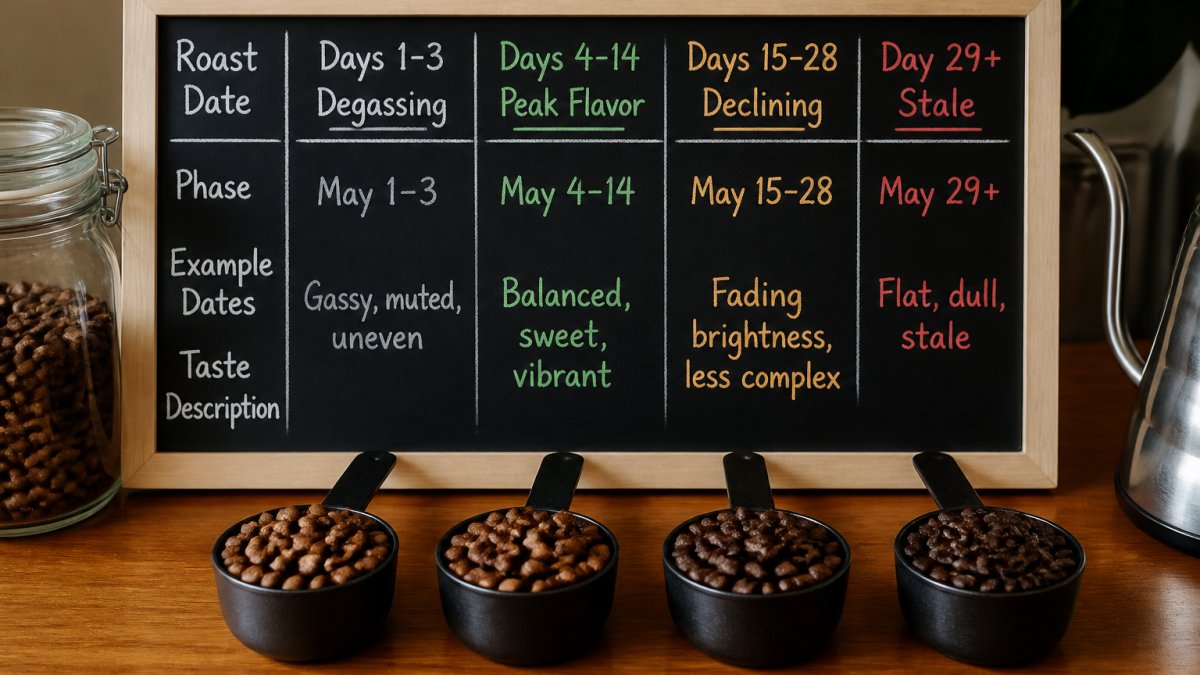
The roast date is your primary indicator: The roast date printed on the bag is your most reliable freshness marker.
The degassing window (days 1-3 post-roast): Beans release carbon dioxide rapidly after roasting. Wait 24-48 hours before brewing, CO2 interferes with water saturation, resulting in under-extracted, sour coffee.
Peak flavor window (days 4-14 post-roast): Once degassing stabilizes, volatile aromatic compounds are at their highest concentration.
Decline phase (days 15-28 post-roast): After day 14, volatile compounds oxidize and break down. Most specialty coffee is still drinkable through day 28, but the flavor advantage over supermarket coffee narrows significantly.
Stale phase (day 29+): Beyond 4 weeks post-roast, aromatic complexity has degraded substantially.
Visual and tactile cues: Freshly roasted beans have a subtle sheen and vibrant color; older beans look dull and chalky.
Storage conditions that extend freshness: Once opened, storage method dramatically affects freshness. Oxygen is the primary enemy.
- Sealed bag with one-way valve: Keep the bag sealed and folded closed after opening. Beans stay fresh 2-3 weeks.
- Airtight container at room temperature: Store in a cool, dark place away from direct sunlight, heat, and humidity. Beans stay fresh 2-3 weeks.
- Freezer storage for long-term: Freezing extends shelf life to 2-3 months. Use an airtight, freezer-safe container and thaw to room temperature before opening.
- Avoid: Refrigerators, clear containers, open shelves, and warm locations near appliances.
Consumption rate determines whether you experience peak freshness: You only benefit from small-batch coffee's freshness if you consume it during the peak window. A 12-ounce bag yields 15-18 cups.
Why Specialty Coffee Costs More
Specialty coffee commands premium pricing because every step prioritizes quality over volume. Commercial coffee comes from commodity markets graded by basic standards. Specialty coffee originates from named farms or cooperatives where traceability matters. Roasters work directly with growers, often paying above-market rates to ensure consistent quality and ethical harvesting. A bag from LGBrewTeaQ, like our Colombia Single Origin at $23.99, reflects direct relationships with smallholder farming families who hand-harvest at peak ripeness.

Small-batch roasting adds cost, running a 20-pound batch requires the same labor and overhead as a 500-pound batch but yields far fewer sellable pounds. Quality control and testing increase expenses. Small-batch roasters cup every batch to ensure consistency and dial in the roast profile. Commercial operations use standardized profiles requiring less active monitoring.
Shipping beans quickly after roasting requires more frequent, smaller shipments rather than bulk warehouse orders, raising distribution costs.
Best Coffee Beans for Home Brewing: Finding Your Match
The best beans depend on your brewing method and flavor preferences. Single-origin coffees highlight their growing region's characteristics: Ethiopian beans deliver floral and citrus notes, Colombian beans offer caramel and cocoa sweetness, Indonesian beans provide heavy body and low acidity.
If you're new to specialty coffee, start with a sampler.
Colombia Single Origin Coffee →
For pour-over brewing (Chemex, V60, Kalita Wave), choose light to medium roasts with bright acidity. Ethiopia Single Origin works well, its floral aromatics and citrus notes shine with the clarity pour-over extraction provides.

French press suits medium to dark roasts with heavier body. Bali Blue, a medium-dark roast from LGBrewTeaQ at $23.99, delivers dark chocolate, molasses sweetness, and syrupy mouthfeel that immersion brewing amplifies.
Espresso demands precision. Choose beans roasted specifically for espresso, typically roasted slightly darker to develop sweetness and body that cut through milk. The Best Sellers Coffee Tasting Flight at $24.99 includes the 6 Bean Blend, engineered for espresso's high pressure extraction.
The Real Cost Comparison: Price Per Cup
Calculating the actual cost per cup reveals whether small-batch coffee represents genuine value or premium pricing, but the math is more nuanced than sticker price alone.
Direct per-cup cost: A typical specialty coffee bag contains 12 ounces, yielding roughly 15-18 cups depending on brew strength and method. At $24 per bag, that's $1.33 to $1.60 per cup.
Hidden costs that shift the equation: Shipping adds $5-8 per order if buying direct. A single $24 bag shipped costs $29-32 total. A $60 order (three bags) shipped costs $65-68, lowering per-bag shipping impact. Buying in bulk reduces the shipping penalty.
The consumption-rate threshold: Small-batch coffee only delivers value if you consume it within its peak window. A daily drinker finishes a 12-ounce bag in 15-18 days, during the good-to-excellent window.
Real-world break-even scenarios:
Scenario 1: Daily drinker, buying direct online
- Consumption: 1 bag every 15-18 days
- Cost: $24 per bag + $6 shipping per order (amortized across 3-bag quarterly purchases) = $26 per bag
- Per-cup cost: $1.73
- Annual spend: ~$700
- Versus supermarket coffee at $0.65 per cup: ~$240 annually
- Premium: $460 per year
- Value proposition: Tastes noticeably better for 90% of consumption window; premium justifiable if flavor matters
Scenario 2: Casual drinker (3 cups weekly), buying direct
- Consumption: 1 bag every 5-6 weeks
- Cost: $26 per bag (including amortized shipping)
- Per-cup cost: $1.73
- Annual spend: ~$220
- Versus supermarket coffee at $0.65 per cup: ~$100 annually
- Premium: $120 per year
- Value proposition: Tastes better for first 50% of bag, then indistinguishable from supermarket coffee; premium harder to justify
Scenario 3: Daily drinker, local roaster (no shipping)
- Consumption: 1 bag every 15-18 days
- Cost: $24 per bag (no shipping)
- Per-cup cost: $1.60
- Annual spend: ~$640
- Versus supermarket coffee: ~$240 annually
- Premium: $400 per year
- Value proposition: Consistently fresh, no shipping delays, can verify roast date in person; best value for daily drinkers near a quality roaster
Sample packs as a low-risk entry: Sample packs offer a lower-risk entry point. A Single Origin Favorites Sample Pack at $24.99 containing six 2-ounce portions yields 25-35 cups across multiple origins for roughly $0.70-1.00 per cup, closer to commercial pricing while delivering specialty quality.

Who Benefits Most from Small-Batch Coffee
Small-batch coffee is worth the investment for specific groups. Home baristas with grinders and brewing equipment see the highest return, without proper tools, flavor advantages diminish. Coffee enthusiasts who notice flavor differences naturally gravitate toward small-batch; if coffee is simply your morning caffeine, the nuances won't register. People with specific preferences benefit significantly, low-acid coffees eliminate digestive discomfort; lighter, more aromatic cups deliver what commodity blends cannot. Remote workers and professionals who drink multiple cups daily see cumulative value. Gift shoppers find real value in sample packs like the Best Sellers Coffee Tasting Flight at $24.99.
Conclusion: Is the Investment Worth Your Money
Is buying from small-batch coffee roasters worth it? Yes, if you own a grinder and brewing equipment, notice flavor differences, and drink coffee regularly enough that the per-cup premium fits your budget. Skip it if you drink casually, use automatic drip makers, or view coffee as functional caffeine. The safest approach is to start with a sample pack. LGBrewTeaQ's Single Origin Favorites Sample Pack or Best Sellers Coffee Tasting Flight lets you taste across origins and roast levels at roughly $0.70-1.00 per cup to test whether the flavor difference matters to you personally.
Frequently Asked Questions
Is small-batch coffee actually fresher than what I buy at a grocery store?
Yes. Small-batch roasters roast to order in small quantities, meaning your beans ship days after roasting, not weeks or months. Grocery store coffee is often roasted 2-6 months before purchase. Look for a roast date on the bag; anything roasted within 2 weeks delivers noticeably brighter flavor and aroma. LGBrewTeaQ roasts small batches to order, so your beans arrive at peak freshness.
How can you tell if coffee beans are fresh?
Check three things: a visible roast date (within 2 weeks is ideal), a one-way valve on the bag (traps gases released during roasting), and the beans themselves (fresh beans have a matte or slightly oily sheen, not a dull or waxy appearance). When you open the bag, fresh beans release a strong, pleasant aroma. Stale beans smell flat or musty. Grind a small amount and smell it immediately; fresh grounds have a vibrant, complex aroma.
Why does small-batch coffee cost more than commercial coffee?
Small-batch roasters pay more for specialty-grade beans from named farms, roast in smaller quantities (which costs more per pound), and focus on quality control and flavor consistency rather than volume. They also typically source directly from smallholder cooperatives, ensuring fair wages. A single-origin small-batch coffee like LGBrewTeaQ's Colombia or Ethiopia ($23.99) costs more because each step prioritizes traceability and craft over speed and scale.
Is small-batch coffee worth it if I just use a regular coffee maker?
Yes. Small-batch coffee improves any brewing method because the beans are fresher and more flavorful. Even a basic drip maker will produce a noticeably better cup with freshly roasted specialty beans. You don't need expensive equipment to benefit. Start with a sample pack like LGBrewTeaQ's Best Sellers Flight ($24.99) to test different roasts and find what you enjoy; then decide if upgrading your brewer makes sense for your routine.
How long do small-batch coffee beans stay fresh?
Small-batch beans peak in flavor 5-14 days after roasting and remain excellent for 3-4 weeks. After 4 weeks, they gradually lose brightness and aroma. Store beans in an airtight container away from heat, light, and moisture to extend freshness. Whole beans last longer than ground coffee (which should be used within days). Buy smaller quantities more frequently from small roasters to ensure you're always brewing fresh coffee.
Ready to discover whether small-batch coffee matches your taste and budget? Shop Coffee at LGBrewTeaQ and explore our freshly roasted single-origin beans and curated sample packs. Each batch is roasted to order and shipped within days, ensuring peak flavor and aroma in every cup.