

Benefits of Drinking Organic Fair Trade Tea
Table of Contents
- Why Organic Fair Trade Tea Is Worth the Switch
- Organic Tea Benefits: What Certified Organic Really Delivers
- Fair Trade Tea Benefits: How Premiums Reach Farmers
- Organic vs Non-Organic Tea: What the Research Shows
- Soil Health, Biodiversity, and Climate Resilience
- How to Choose Organic Fair Trade Tea
- Does It Taste Different? Quality and Brewing
- Conclusion: A Cup That Supports People and the Planet
- Frequently Asked Questions
Last Updated: October 5, 2026
Why Organic Fair Trade Tea Is Worth the Switch
A cup of tea can carry two certifications, but most shoppers check for only one. Organic covers how the tea was grown; Fair Trade covers how the people who grew it were treated and paid.
At LGBrewTeaQ, we source loose leaf teas with exactly this in mind: a leaf should be good for the drinker and fair to the grower.
The short version: organic addresses the chemicals, and Fair Trade addresses the people. Neither one replaces the other.
Organic Tea Benefits: What Certified Organic Really Delivers
Organic tea is grown without synthetic pesticides or fertilizers, under a certification system that inspects the farm rather than taking its word for it. In the U.S., that is the USDA's National Organic Program, which sets the production and labeling rules certified operations must follow.
Fewer Synthetic Pesticides and Fertilizers
Conventional tea cultivation often relies on synthetic inputs to control pests and boost yield. Organic farming replaces those with compost, cover crops, and biological pest control, leaving fewer synthetic pesticide residues on the leaf, which matters more with tea, because you pour hot water directly over the leaf and drink what comes off it.
Antioxidants and Polyphenols in Every Cup
Tea leaves naturally contain polyphenols, including catechins and flavonoids. Green tea is especially rich in catechins because it is minimally oxidized, while black tea develops different polyphenol compounds during processing. These compounds appear in organic and conventional tea alike, certification changes the farming method, not the plant's chemistry.
Fair Trade Tea Benefits: How Premiums Reach Farmers
Fair Trade tea is traded under a third-party certification that sets a floor price for producers and adds a separate premium paid on top of that price for community and business investment. The model exists because tea workers on large estates often sit at the far end of a long, opaque supply chain.
The Two-Part Mechanism: Minimum Price Plus Premium
The Fair Trade model rests on two distinct payments, and conflating them is the most common mistake shoppers make.
- The minimum price is a floor that applies when the market price falls below it, protecting producers from selling at a loss during a glut or bad harvest. When the market price is above the floor, the market price applies.
- The Fair Trade premium is a separate sum paid on top of the price, regardless of whether the market is high or low. It is not wages and not profit, it goes to the producer organization, and members decide collectively how to spend it.
That second payment is the part most people miss: the label is not a direct transfer to an individual worker's pocket, but a governance mechanism that routes money to a democratically run organization.
Producer Organizations and Democratic Control
For smallholder tea, the certified entity is typically a cooperative owned and governed by its member farmers. For estate-grown tea, it is often the estate itself, with requirements around worker representation and a joint body that includes workers in premium decisions.
The premium typically funds what members prioritize: a processing facility to capture more value locally, training in organic methods, school fees or a clinic, or labor-saving equipment.
What Fair Trade Standards Cover
Fair Trade standards generally address:
- Wages and income, requirements around pay for hired labor, plus the price floor and premium described above.
- Working conditions, health and safety provisions, limits on child labor, and protections against forced labor.
- Freedom of association, the right of workers to organize and bargain collectively.
What Fair Trade Does Not Guarantee
Fair Trade certification does not, by itself:
- Guarantee organic production. A tea can be Fair Trade certified and still grown with synthetic inputs. The two standards are separate.
- Guarantee a specific wage to every individual worker. The premium flows to the organization; how it reaches members depends on the organization's decisions.
- Guarantee a living wage in every context. Standards set floors, but whether those floors equal a living wage varies by region and cost of living.
How the Two Certifications Work Together
Organic and Fair Trade answer different questions, and neither substitutes for the other:
- Organic governs the growing method, what goes on the soil and the leaf, and how the farm is inspected.
- Fair Trade governs the trading relationship, the price floor, the premium, the labor standards, and the governance of the producer organization.
A tin carrying both certifications does two jobs at once, addressing both the farm's environmental footprint and the economic position of the people who work it. A tea with only one certification is not bad; it simply makes one promise instead of two.
Organic vs Non-Organic Tea: What the Research Shows
The honest answer is that the evidence is mixed and more limited than marketing suggests.
On the farming side, the comparison is cleaner. Organic certification restricts synthetic pesticide and fertilizer use, reducing chemical exposure for farm workers and lowering the residue load on the finished leaf.
What we would tell a friend: treat health claims with caution and certification claims with attention.
Organic Lavender Herbal Tea - Loose Leaf (2 oz Tin) →
Soil Health, Biodiversity, and Climate Resilience
Organic farming builds soil fertility through organic matter, compost, cover crops, crop rotation, and mulching, rather than synthetic nitrogen and phosphate. Organic matter feeds the soil food web, improves water infiltration and retention, and builds structure that lets roots and soil organisms thrive, so soil holds moisture better in drought and drains better in heavy rain.
What Organic Farming Actually Changes on the Ground
- Inputs. Synthetic pesticides and fertilizers are restricted. Growers substitute compost, cover crops, biological pest control, and mechanical or manual weed management.
- Soil biology. More organic matter generally means more microbial and fungal activity, which supports nutrient cycling.
- Biodiversity. Farms that avoid broad-spectrum synthetic pesticides tend to support more insect life, and more insect life means more birds, bats, and other predators up the food chain.
For tea specifically, soil health feeds directly into leaf quality. A tea bush grown on living soil tends to produce leaf with more consistent flavor across seasons than one grown on inert, input-dependent ground.
The Trade-Offs Shoppers Should Know
Organic and Fair Trade tea usually costs more than conventional tea, for structural reasons:
- Lower yields and higher labor. Organic tea farms often produce less per acre and rely on more hand labor for weeding and pest management.
- Certification and audit costs. Third-party inspection, record-keeping, and annual audits are real expenses built into the price.
- Supply and availability. Not every tea type or origin is available with both certifications. Some regions have strong organic infrastructure; others do not, so a single-estate tea you love may not exist in a certified version.
What to Do If You Cannot Find or Afford Both Certifications
A practical approach is to prioritize based on what matters most to you:
- If pesticide exposure is your main concern, prioritize organic certification, which governs what goes on the leaf.
- If labor conditions are your main concern, prioritize Fair Trade certification, which governs wages, working conditions, and the premium.
- If cost is the constraint, buy organic or Fair Trade loose leaf rather than bags, loose leaf often delivers more cups per dollar, spreading the certification cost across more tea.
A Note on Climate and Tea
Tea is sensitive to temperature and rainfall patterns, and many growing regions are already seeing shifts in both. Farms that build soil organic matter and on-farm diversity adapt better than farms locked into a single input regime, sustainable agriculture in the practical sense, making a farm more likely to still produce good leaf in twenty years.
How to Choose Organic Fair Trade Tea
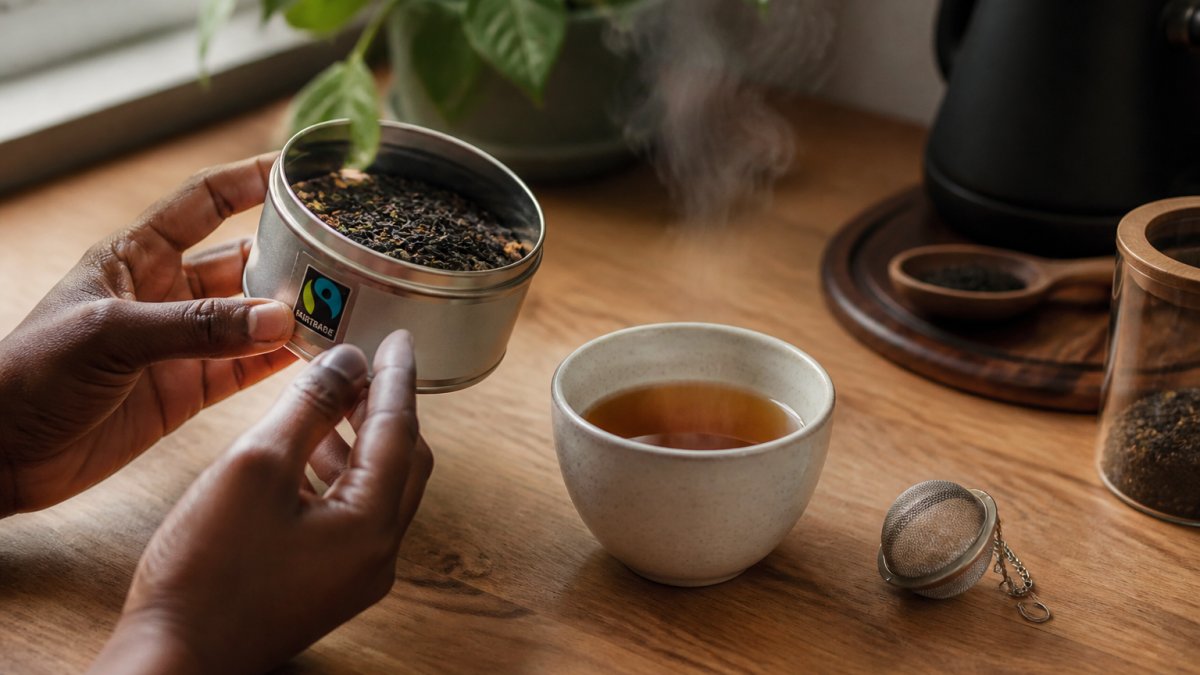
Start with the certification mark, then check who is behind it. A USDA Organic seal means the product met National Organic Program standards; a Fair Trade mark means it met a third-party social and economic standard.
Reading Certification Labels and Sourcing Claims
Check the label for three things: the certifier's name, the specific standard, and whether the claim covers the whole product or just one ingredient. Blends get slippery here, because a "made with organic ingredients" claim can apply to only part of the mix.
A quick checklist we use when evaluating any tin:
- Is there a USDA Organic seal, or a named certifying body?
- Is there a Fair Trade mark, and does it name the certifying organization?
- Does the sourcing claim name a region or estate, or is it vague?
For loose leaf, whole leaves unfurl slowly and give you more control over strength. Our Mesh Tea Infuser Strainers Filters Tea Ball Interval Diffuser Stainless Steel Tea Strainer is the simplest way to brew loose leaf without a teapot, and it works with any of the teas below.
Does It Taste Different? Quality and Brewing
Certification does not automatically make tea taste better, but sourcing quality and certification often travel together, because farms that invest in organic methods tend to invest in the leaf itself. What you taste is mostly leaf grade, processing, and brewing.
Brewing matters more than most people expect. Water temperature and steep time do more damage to a good leaf than any certification ever will. Here is how we brew three very different teas from our own shelf:
| Tea | Water Temp | Steep Time | Best For |
|---|---|---|---|
| Organic Lavender Herbal Tea | 205°F | 5-7 min | Evening wind-down |
| Hibiscus Berry Tea | 212°F | 5-7 min | Iced summer refresher |
| English Breakfast | 208-212°F | 3-5 min | Morning, with milk |
Our Organic Lavender Herbal Tea is 100% certified organic whole French lavender blossoms, naturally caffeine-free, and packed in small batches.


Conclusion: A Cup That Supports People and the Planet
Choosing organic fair trade tea means asking two questions instead of one, and holding a label to a higher standard than a nice-sounding word. It is a small decision that reaches a farm, a worker, and a soil system you will never see.
At LGBrewTeaQ, we source teas with that standard in mind, roast and pack in small batches, and ship them straight to your door. Browse our loose leaf selection, grab an infuser, and start with a tin that carries both certifications. Shop Coffee and tea, and make your next cup one you can actually trace.
Frequently Asked Questions
What does organic tea mean?
Organic tea is grown without synthetic pesticides or fertilizers. In the US, certified organic tea must follow USDA National Organic Program rules, which cover soil health, pest management, and how leaves are handled after harvest. The certification is verified by a USDA-accredited agent, so the label reflects an inspection process rather than a marketing claim. Organic farming also tends to support biodiversity and soil fertility on the tea estate.
Is organic tea healthier than non-organic tea?
Organic tea offers a lower chance of synthetic pesticide residues, which matters if you drink several cups a day. Both organic and conventional tea contain antioxidants, polyphenols, and catechins, so the core health benefits are similar. The main difference is what is not used during cultivation. If avoiding chemical exposure is a priority, certified organic is the clearer choice.
Does Fair Trade tea benefit tea farmers?
Yes. Fair Trade certification sets a minimum price for tea leaves and adds a premium that farming cooperatives decide how to spend. That money often goes toward community development, clean water, education, or better equipment. Fair Trade standards also cover working conditions and fair wages for tea workers, which is why the label is about people as much as it is about the environment.
How do I choose organic fair trade tea?
Check for two separate certifications on the package: a USDA organic seal and a Fair Trade mark. Look for the farm or cooperative name on the tin so you can trace the supply chain. Buy from brands that describe their sourcing, then match the tea type to your routine. A loose leaf option like an English Breakfast or a caffeine-free herbal blend lets you taste the difference fresh leaves make.