

Best Manual Coffee Grinders for Travel and Camping 2026
Table of Contents
- Quick Comparison: Best Manual Coffee Grinders for Travel and Camping 2026
- What to Look for in a Travel Coffee Grinder
- Manual vs Electric Coffee Grinders for Camping
- Coffee Grind Size Guide for Different Brewers
- Portability, Weight, and Packability
- Durability, Cleaning, and Maintenance for Outdoor Use
- Why Manual Coffee Grinders Belong in Your Camp Kit
- Frequently Asked Questions
Last Updated: October 1, 2026
Quick Comparison: Best Manual Coffee Grinders for Travel and Camping 2026
The best manual coffee grinders for travel and camping in 2026 balance burr quality, weight, and grind consistency in a package that survives a backpack. This guide from LGBrewTeaQ breaks down what actually matters when you're choosing a hand grinder for the trail, the campsite, or a hotel room with terrible coffee.
Here's the short version before the details:
| Priority | What to Look For | Why It Matters |
|---|---|---|
| Grind quality | Conical burrs, stainless steel or ceramic | Even particle size means better extraction |
| Adjustability | Stepped or stepless adjustment | Dial in espresso through French press |
| Weight | Under 450 g for backpacking | Every ounce counts on multi-day trips |
| Capacity | 20-30 g hopper | One to two cups per fill |
| Build | Metal body, serviceable parts | Survives drops, packs flat |
Below, we'll show you exactly how to weigh these trade-offs, plus the grind settings that match each brew method.
What to Look for in a Travel Coffee Grinder
A travel coffee grinder is a portable hand-powered mill that crushes roasted beans between two burrs to produce a consistent grind size. The features that matter most for camping are burr material, adjustment mechanism, weight, and how easily the unit comes apart for cleaning.
Burr Type: Ceramic vs. Stainless Steel
Ceramic burrs stay sharp for years and resist rust, which suits damp campsites. They chip if you drop the grinder on rock.
Stainless steel burrs cut faster and hold an edge under heavy use. They're heavier and can corrode if you store them wet.
For most campers, stainless steel conical burrs offer the best balance of speed and durability. Ceramic makes sense if you prioritize rust resistance and lighter weight.
Grind Consistency and Adjustment Settings
Grind consistency describes how uniform your coffee particles are after grinding. Uneven particles extract at different rates, which is why a muddy French press or a sour espresso shot often traces back to the grinder.
Look for either stepped adjustment (discrete clicks) or stepless adjustment (infinite tuning). Stepped is easier to repeat; stepless gives finer control for espresso.
Manual vs Electric Coffee Grinders for Camping
Manual grinders win for camping because they need no power, pack smaller, and weigh less. Electric grinders deliver speed and less physical effort, but they require batteries or a power source that most campsites don't provide.
Here's the honest trade-off. A hand grinder takes 30-90 seconds of cranking for a full dose. An electric burr grinder does the same job in under 15 seconds but adds bulk and a charging dependency.
For backpacking, canoe trips, and car camping without hookups, a hand-crank grinder is the practical choice. For RV travel with reliable power, an electric model can work, though it takes up more space in your kit.
Coffee Grind Size Guide for Different Brewers
Matching grind size to your brew method is the single biggest lever on cup quality. Too fine and you get bitterness and clogged filters; too coarse and you get weak, watery coffee.
| Brew Method | Grind Size | Texture Reference |
|---|---|---|
| French press | Coarse | Sea salt |
| Pour-over | Medium | Table salt |
| AeroPress | Medium-fine | Fine sand |
| Moka pot | Fine | Powdered sugar |
| Espresso | Fine | Flour |
Start at the coarse end for French press, then tighten one click at a time until the cup tastes balanced. Most travel grinders cover the full range from espresso to French press.
Portability, Weight, and Packability
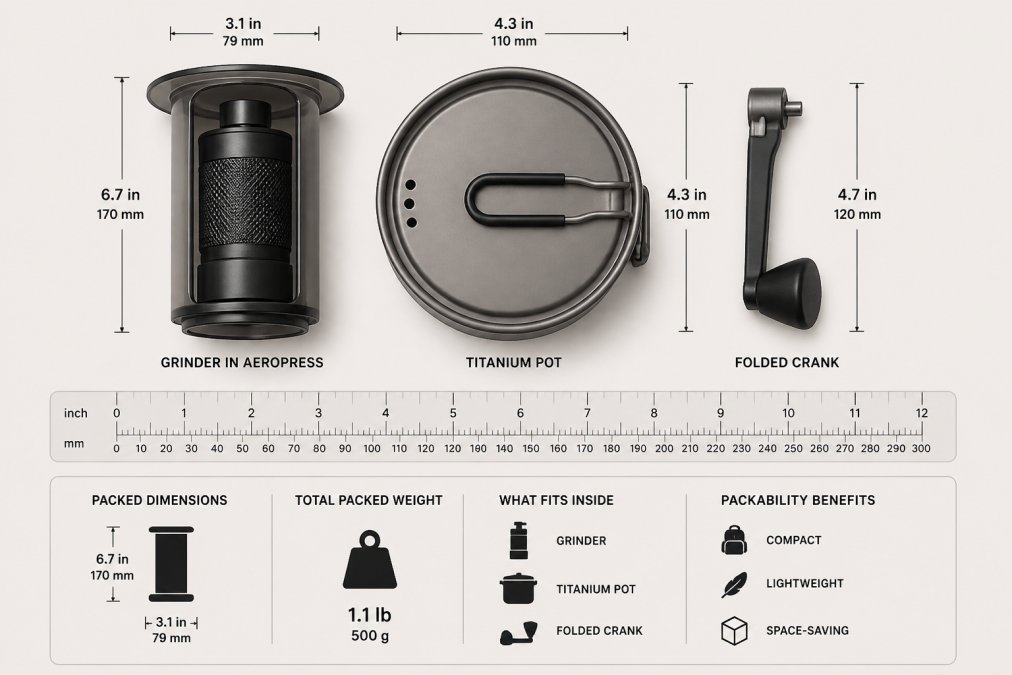
Weight and packability decide whether a grinder earns a permanent spot in your pack. A good travel grinder nests inside its own catch cup and adds less bulk than a water bottle. But "portable" is a vague word, so here is how to measure it before you buy.
The three numbers that matter
- Packed weight, the grinder with the handle removed and the catch cup attached. Most travel grinders land between 300 g and 550 g. Under 450 g is a reasonable backpacking target.
- Packed dimensions, height and diameter with the crank detached. A grinder that fits inside a 750 ml titanium pot or a standard AeroPress chamber is dramatically easier to pack than one that does not.
- Grind time per gram, how many seconds of cranking it takes to produce one gram of ground coffee. This is the metric almost no review publishes, and it is the one you feel every morning.
Grind time: the missing metric
Grind time varies with burr material, burr diameter, and how fine you set the grind. A common pattern across field testing:
| Grind setting | Typical time per gram | Time for a 20 g dose |
|---|---|---|
| Coarse (French press) | 1.5-2.5 seconds | 30-50 seconds |
| Medium (pour-over) | 2.5-3.5 seconds | 50-70 seconds |
| Fine (AeroPress, moka) | 3.5-5 seconds | 70-100 seconds |
| Espresso-fine | 5-8 seconds | 100-160 seconds |
Steel burrs sit at the faster end of each range; ceramic burrs sit at the slower end. If you brew espresso on the trail, budget two to three minutes of cranking per shot. If you brew French press, most grinders finish before your water boils.
Packability and nesting
The best travel grinders are designed to nest. Look for these features:
- Detachable crank so the grinder body fits inside a mug, pot, or AeroPress chamber
- Catch cup that doubles as a storage container for whole beans or ground coffee
- Foldable or collapsible handle that stores flat against the body
- Non-slip grip for stable grinding on uneven ground
- Threaded or magnetic lid that will not pop off inside a pack
A grinder that nests inside your brewing vessel effectively costs zero extra pack space.
Capacity and hopper size
Capacity is measured in grams of whole beans the hopper holds. Most travel grinders hold 20-30 g, enough for one large mug or two small cups. If you are brewing for a group, look for a larger hopper or plan to grind in batches.
A quick capacity reference:
| Brew method | Beans per cup | Cups from a 25 g hopper |
|---|---|---|
| AeroPress | 15-18 g | 1-2 |
| Pour-over | 18-22 g | 1 |
| French press (single mug) | 20-25 g | 1 |
| French press (32 oz pot) | 30-40 g | 0 (grind in batches) |
Durability, Cleaning, and Maintenance for Outdoor Use
Durability comes down to body material and how serviceable the grinder is in the field. Aluminum and stainless bodies survive drops better than plastic. A grinder you can disassemble without tools is easier to clean when grit and moisture get inside.
Maintenance routine for camping:
- Brush out grounds after every use
- Wipe burrs dry before packing
- Check burr alignment monthly
- Store with the handle removed to prevent bending
Why Manual Coffee Grinders Belong in Your Camp Kit
Freshly ground beans change camp coffee more than any other upgrade. Whole beans stay fresh longer than pre-ground, and grinding right before brewing preserves the oils that carry aroma and flavor.
Frequently Asked Questions
Are manual coffee grinders better than electric for camping?
Manual grinders win for camping because they need no electricity and pack smaller. They also run quieter, which matters at shared campsites. Electric grinders are faster, but they add battery weight and charging hassle. For backpacking or car camping, the best manual coffee grinders for travel and camping 2026 give you fresh grounds anywhere. Choose manual if portability and reliability top your list; choose electric only for basecamp setups with power.
What features should I look for in a travel coffee grinder?
Focus on burr type, adjustment range, and build. Conical burrs (ceramic or stainless steel) give more even particle distribution than blade grinders. Look for stepped or stepless adjustment so you can switch from coarse grind for French press to fine grind for espresso. Check weight, capacity, and whether the handle folds or detaches. A rugged, lightweight body with a stable bearing and easy disassembly for cleaning makes a grinder truly travel-friendly.
How do I clean a manual coffee grinder while camping?
Disassemble the grinder and brush out grounds with a small brush or cloth. Avoid water unless the manufacturer says it is safe; moisture can rust steel burrs and swell wooden parts. For a deeper clean at home, use dry rice or grinder cleaning tablets, then wipe. While camping, a quick brush after each use prevents grind retention and keeps flavors fresh. Pack a microfiber cloth and a compact brush in your kit.
Does grind consistency matter for camping coffee?
Yes. Uneven grounds lead to sour or bitter cups because water extracts differently from fine and coarse particles. A consistent grind from a quality manual grinder lets you dial in your brew method, whether you use a pour-over, French press, or espresso maker. For camping, consistency is even more important because you have less control over water temperature and timing. Good burrs and a stable axle make the difference.
Camp coffee only tastes as good as the beans you put into it, and whole beans ground fresh at the campsite beat pre-ground every time. LGBrewTeaQ roasts to order and delivers fresh, high-quality coffee straight to your door, so your grinder always has something worth grinding. Start with a bag of single-origin beans or a curated blend, add an enamel camp mug or a stainless travel mug to your kit, and get started with LGBrewTeaQ for better mornings wherever you pitch your tent.