

Brew Specialty Coffee in a Regular Machine
Table of Contents
- Can You Brew Specialty Coffee in a Regular Machine?
- How to Grind Coffee Beans for Your Drip Machine
- Best Coffee to Water Ratio for Drip Coffee
- Water Temperature and Contact Time for Extraction
- Why Does My Coffee Taste Bitter and How to Fix It
- Calibrating Your Machine and Mastering the Bloom Technique
- Common Brewing Mistakes to Avoid
- Frequently Asked Questions
Last Updated: September 23, 2026
Can You Brew Specialty Coffee in a Regular Machine?
Yes, you can brew specialty coffee in a specialty coffee regular machine, a standard drip coffee maker that delivers exceptional results when you master extraction, grind size, and brewing technique. A standard drip coffee maker delivers exceptional results when you master extraction, grind size, and brewing technique.
The difference between mediocre and exceptional coffee comes down to three variables: grind size, coffee-to-water ratio, and brewing temperature. Master these, and your regular machine becomes a specialty coffee tool.
Specialty coffee demands precision, but that requires technique, not expensive equipment. This guide shows how to make specialty coffee shine in your specialty coffee regular machine, the one you already own.
How to Grind Coffee Beans for Your Drip Machine
Grind size is the most critical variable in brewing specialty coffee. Get this wrong, and no amount of premium beans will save your cup.
For drip machines, you need a medium grind, think sea salt or coarse sand. This size allows water to pass through the grounds at the right speed. Too fine, and water moves too slowly, over-extracting and creating bitterness. Too coarse, and water rushes through, leaving the coffee sour and thin.
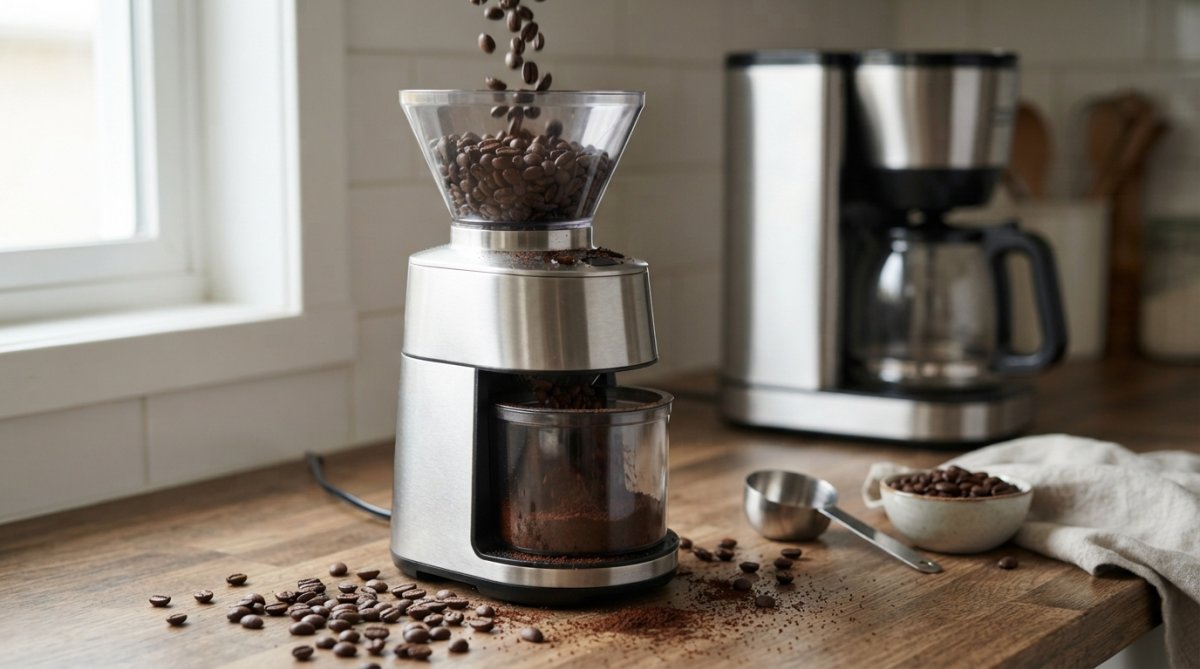
Burr grinders produce consistent particle size; blade grinders create uneven pieces that brew unevenly. A basic burr grinder costs less than two bags of specialty beans and transforms results.
Grind immediately before brewing. Specialty coffee loses flavor within 15 minutes of grinding; whole beans stay fresh for weeks in an airtight container.
Grind size quick reference:
- Too fine: Bitter, over-extracted, slow drip
- Too coarse: Sour, under-extracted, fast drip
- Just right: Balanced flavor, smooth body, 4-5 minute brew time
Best Coffee to Water Ratio for Drip Coffee
The standard ratio is 1:16 (one part coffee to 16 parts water by weight). Specialty coffee often performs better at 1:15 or 1:14, which brings forward delicate tasting notes and fruit clarity without heaviness.
Start with 1:15 and adjust based on your taste. If your cup tastes thin or sour, use slightly more coffee. If it tastes heavy or bitter, use slightly less. This small adjustment transforms how specialty coffee tastes in your regular machine.
Ratio guide for common brew sizes:
- 10 oz cup: 0.65 oz coffee (about 2.5 tablespoons)
- 12 oz cup: 0.8 oz coffee (about 3 tablespoons)
- 20 oz cup: 1.3 oz coffee (about 5 tablespoons)
A basic kitchen scale (under $20) removes guesswork and ensures consistency, letting you dial in grind size and temperature without variables shifting.
Water Temperature and Contact Time for Extraction
Specialty coffee brews best between 195°F and 205°F. Most drip machines hit 200°F, which is ideal. Cooler machines produce sour, thin coffee; hotter machines risk over-extraction and bitterness.
Contact time, how long water sits with the grounds, is equally important. For drip machines, aim for 4 to 5 minutes of total brew time. This includes the bloom phase, where hot water first saturates the grounds and releases CO2.
Understanding Extraction Yield
Extraction yield is the percentage of the coffee bean's soluble solids that end up in your cup. Specialty coffee typically extracts best between 18% and 22% yield. Below 18%, your coffee tastes sour and thin because you're missing the sweet, balanced flavors. Above 22%, you're pulling out harsh, astringent compounds that create bitterness.
Use the taste test: bright but thin = under-extracting (under 18%); smooth and balanced = optimal (18-22%); harsh or bitter = over-extracting (above 22%).
The bloom phase (30-45 seconds) allows grounds to absorb moisture and release CO2. After the bloom, water pulls out sugars, acids, and aromatic oils. A proper bloom ensures even extraction rather than some grounds over-extracting while others under-extract.
Standard drip machines lack a manual bloom phase. To add one, let the first few drops fall into the filter basket without reaching the cup. This slows initial flow and noticeably improves clarity and reduces bitterness.
Temperature and Grind Interaction
Temperature and grind size work together. If your machine runs hot, use a coarser grind to slow water passage. If it runs cool, use a finer grind to increase contact time.
Colombia Single Origin Coffee →
Extraction window:
- Under 3.5 minutes or sour taste: Under-extracted (below 18% yield), thin body, missing sweetness
- 4-5 minutes and balanced taste: Optimal extraction (18-22% yield), smooth body, full flavor
- Over 6 minutes or bitter taste: Over-extracted (above 22% yield), harsh finish, heavy body
Why Does My Coffee Taste Bitter and How to Fix It
Common causes:
Grind too fine. Coarsen by one setting on your burr grinder. This single change fixes most bitterness.
Calibrating Your Machine and Mastering the Bloom Technique
Calibration means understanding how your specific machine brews and adjusting technique to match. Every machine differs slightly in temperature, speed, and water distribution. You can't change the design, but you can work with it.
Step 1: Measure Your Machine's Brew Time
Step 2: Check Your Machine's Temperature
Step 3: Master the Manual Bloom Technique
Manual bloom steps:
- Place filter and grounds in the basket
- Pour just enough hot water to saturate the grounds (about 1 ounce for a standard filter basket)
- Wait 30-45 seconds while the grounds absorb water and release CO2 (you'll see small bubbles form)
- Pour the remaining water slowly over 3-4 minutes, pouring in a circular motion to ensure even saturation
- Total brew time should be 4-5 minutes from the first pour to the last drop
Step 4: The Bypass Brewing Technique (Advanced)
Bypass brewing steps:
- Use a 1:8 coffee-to-water ratio (double strength)
- Brew with the manual bloom technique
- Dilute with hot water to desired strength
Troubleshooting by Machine Type
- Automatic drip machines with warming plates: These machines often over-extract if coffee sits on the plate. Brew only what you'll drink in the next 20 minutes. If you must brew ahead, pour into a thermal carafe immediately after brewing stops.
- Machines with adjustable brew strength: These typically work by controlling water flow rate. "Stronger" settings slow the flow, increasing contact time. Test both settings with the same grind and ratio to see which produces better flavor.
- Machines with a pre-brew or soak cycle: Some machines pause briefly before brewing. This is a built-in bloom. Don't add a manual bloom if your machine already has one, you'll over-extract.
- Machines with a water filter: If your machine has a built-in filter, replace it every 2 months. A clogged filter slows water flow and can cause over-extraction.
Calibration Checklist
Once you've calibrated, use this checklist before each brew:
- Grind whole beans fresh, immediately before brewing
- Use a scale to measure coffee and water by weight
- Pour water at 195-205°F
- Perform a 30-45 second bloom
- Complete the full brew in 4-5 minutes
- Taste and note if the coffee is sour (under-extracted), balanced (optimal), or bitter (over-extracted)
- Adjust grind size by one setting if needed and test again
Common Brewing Mistakes to Avoid
Using stale water. Water sitting in your machine's reservoir absorbs minerals and tastes flat. Use fresh, filtered water each time. If your tap water is hard or chlorinated, run it through a basic filter pitcher first.
| Mistake | Fix | Impact |
|---|---|---|
| Stale water | Use fresh, filtered water | Cleaner, brighter flavor |
| Grind too fine | Coarsen by one setting | Eliminates bitterness |
| No bloom phase | Wait 30-45 seconds after first pour | Better clarity, less extraction |
| Pre-ground coffee | Grind whole beans fresh | Stronger aroma, fuller flavor |
| Brew time under 4 minutes | Coarsen grind or slow water pour | Balanced extraction |
| Machine not cleaned | Monthly vinegar flush | Removes rancid oils |
SCAA specialty coffee brewing standards
National Coffee Association brewing guide
Coffee extraction science research
Frequently Asked Questions
Can I use specialty coffee beans in a standard drip machine without losing flavor?
Absolutely. Specialty coffee beans retain their tasting notes, caramel, citrus, floral, chocolate, in a standard drip machine when you control three variables: grind size (medium-fine), brew ratio (1:16 coffee to water by weight), and water temperature (195-205°F). The key difference between specialty and grocery-store coffee is freshness and origin precision. Freshly roasted beans from single-origin farms like Colombia or Ethiopia deliver clarity and complexity that stale, pre-ground coffee cannot match, regardless of equipment. Your regular machine becomes capable of extracting those notes if you dial in the basics.
What grind size should I use for my drip coffee maker?
Use a medium-fine grind for standard drip machines, slightly finer than beach sand. This size maximizes contact time between water and grounds (optimal extraction happens between 195-205°F over 4-6 minutes) without causing over-extraction or bitterness. If you're using specialty beans with high clarity and acidity, a medium-fine grind helps you extract those bright tasting notes fully. Invest in a burr grinder; blade grinders create inconsistent particle sizes that lead to uneven extraction and muddy flavor. Consistency matters far more than equipment cost when brewing specialty coffee.
How much coffee should I use per cup of water?
Use a 1:16 ratio by weight as your starting point, 1 gram of coffee to 16 grams of water. For a standard 12-ounce cup, that's roughly 0.75 ounces (about 21 grams) of ground coffee. This ratio extracts specialty coffee's full flavor profile without under-extraction (sour, thin) or over-extraction (bitter, harsh). Adjust slightly based on your taste: prefer stronger? Try 1:15. Prefer lighter? Try 1:17. The precision here is what separates a muddy cup from one that highlights the peach and jasmine notes in an Ethiopian single-origin or the caramel sweetness in a Colombian roast.
Why does my coffee taste bitter when brewing specialty beans?
Bitterness usually signals over-extraction, your water is in contact with the grounds too long or at too high a temperature. Check three things: water temperature (aim for 195-205°F, not boiling), grind size (if it's too fine, water moves through too slowly), and brew time (standard drip should finish in 4-6 minutes). Also verify your beans are fresh; specialty coffee roasted more than 4 weeks ago loses brightness and can taste flat or bitter. If you've ruled out these factors, your machine's filter basket or water distribution might be causing uneven saturation. Try the bypass technique: pour a small amount of water through the grounds first (bloom), wait 30 seconds, then continue. This improves extraction evenness and reduces bitterness.