

How to Clean Glass Tea Infusers Without Harsh Chemicals
Table of Contents
- Why Glass Tea Infusers Need Their Own Cleaning Routine
- How to Clean a Tea Infuser: The Quick Daily Rinse
- How to Remove Tea Stains From Glass Without Scratching
- Cleaning a Glass Teapot With Vinegar and Lemon
- Deep-Cleaning Fine Metal Mesh, Seals, and Small Parts
- How to Care for a Glass Tea Infuser So It Lasts
- What Not to Use on Borosilicate Glass
- Troubleshooting Stubborn Residue and Cloudiness
- Frequently Asked Questions
Last Updated: October 9, 2026
Why Glass Tea Infusers Need Their Own Cleaning Routine
Glass tea infusers need a gentler cleaning routine than metal or ceramic teaware because the material shows every smudge, stain, and scratch. That visibility is a gift: you can see what is building up and catch it early.
Glass is non-porous, so it does not absorb flavors the way plastic does. But it holds onto what sits on its surface: skip a rinse and residue bonds to the walls; wait a week and you are restoring, not rinsing.
What Builds Up on Glass and Why It Matters
Three things collect on a glass tea infuser: tea oils, tannin stains, and fine tea leaf crumbs.

Tea oils leave a faint film that dulls the glass and carries stale flavors into your next cup. Tannins bond to glass over time as a brown haze.
Why does this matter beyond looks? A cloudy infuser makes it harder to watch your leaves unfurl, and residue traps moisture and odor, so your next delicate white tea can pick up notes from yesterday's smoky lapsang.
How to Clean a Tea Infuser: The Quick Daily Rinse
The daily rinse takes about 30 seconds and prevents many common problems.
- Empty the leaves while the infuser is still warm
- Rinse under hot running water immediately
- Swish a drop of mild dish soap if you used an oily tea
- Rinse thoroughly until the water sheets off clean
- Set it upside down on a rack to air-dry
Hot water does most of the work, melting tea oils before they harden. Let the infuser sit with wet leaves overnight and those oils set like glue, requiring a soak instead of a rinse.
A common mistake is skipping the rinse because "it's just tea." Tea carries oils, minerals, and color compounds that all want to stay on the glass.
How to Remove Tea Stains From Glass Without Scratching
How to remove tea stains from glass: the safest method is a baking soda paste applied with a soft-bristled brush, followed by a thorough warm water rinse.
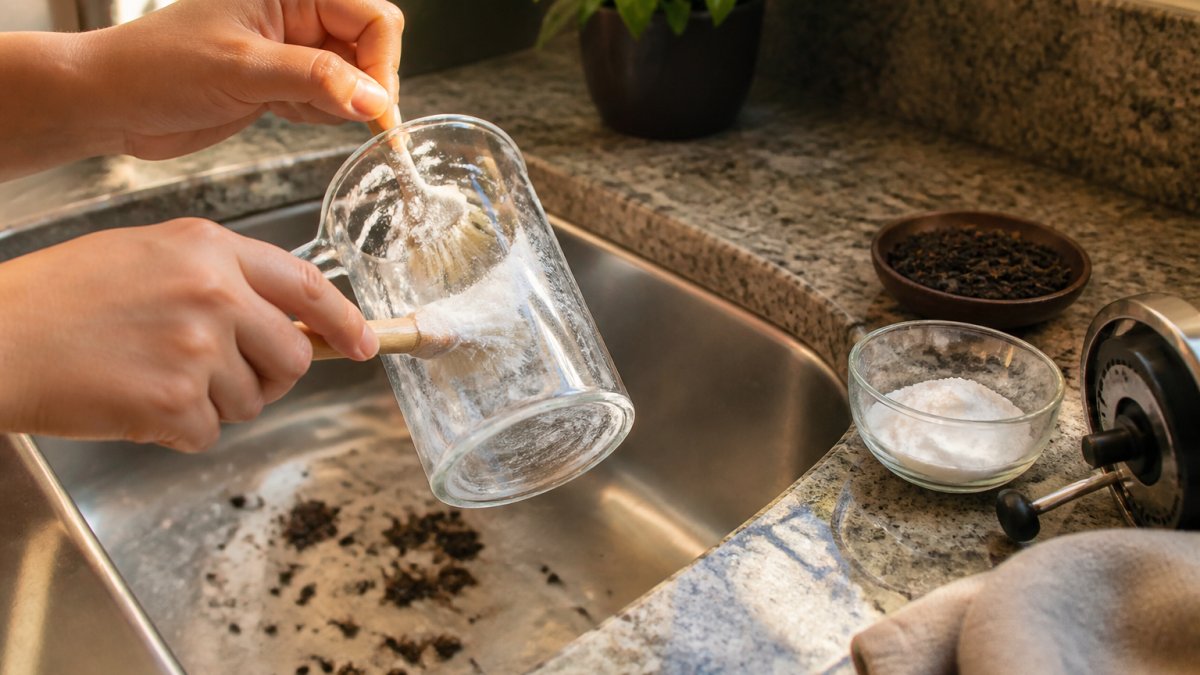
Baking soda is mildly alkaline, breaking the bond between tannins and glass, yet soft enough not to etch the surface.
The Baking Soda Paste Method
Mix two parts baking soda with one part warm water into a thick paste.
Rinse thoroughly with warm water and check for streaks by holding the glass to the light.
Never use steel wool, scouring pads, or abrasive cleansers. They leave micro-scratches that trap tannins faster than smooth glass, and a scratched infuser stains more easily forever.
Cleaning a Glass Teapot With Vinegar and Lemon
Cleaning a glass teapot with vinegar works well for larger vessels and metal mesh parts that baking soda paste cannot easily reach. White vinegar and lemon contain acids that dissolve mineral scale and lift tannin films, but the method changes depending on which part you are cleaning.
Match the Soak to the Part
A glass tea infuser is usually three or four materials, a glass body or basket, a stainless-steel mesh or perforated insert, a silicone or rubber gasket, and sometimes a plastic lid, hinge, or collar, and each tolerates acid differently.

| Part | Vinegar/Lemon Soak | Time Limit | Notes |
|---|---|---|---|
| Borosilicate glass body | Safe | Up to overnight | Rinse well; acid will not etch glass |
| Stainless-steel mesh | Safe | Up to 30 minutes | Longer soaks can dull the finish |
| Silicone gasket or seal | Safe but limited | 10-15 minutes | Extended acid soaks dry out and stiffen silicone |
| Plastic lid, hinge, or collar | Use caution | 5-10 minutes | Some plastics cloud or craze with repeated acid exposure |
| Painted or printed decoration | Avoid | , | Acid can lift decals and printed logos |
If you cannot tell what a small part is made of, test it first: soak it alone in vinegar solution for five minutes, rinse, and check for clouding, tackiness, or color change.
The Soak Method, Adjusted for Infusers
- Disassemble completely: basket, lid, gasket, and any removable mesh.
- Fill a bowl with equal parts white vinegar and warm (not hot) water, hot water plus acid is harder on seals and plastic.
- Add a squeeze of fresh lemon if you have it; citric acid is gentler on silicone than vinegar alone.
- Submerge glass and metal parts. Soak 30 minutes for routine buildup, up to overnight for heavy scale.
- Soak silicone and plastic parts separately for no more than 15 minutes.
- Rinse every part thoroughly with warm water, acid residue tastes sour in your next cup.
- Air-dry completely before reassembly.
For a glass infuser bottle with a threaded neck, use a bottle brush to work the vinegar solution into the threads. Threads are where residue hides and where mold starts.
Killing the Vinegar Smell
If the vinegar smell lingers, mix one tablespoon of baking soda into a cup of warm water and swish it through the infuser. The two neutralize each other, and the odor disappears. Rinse once more with plain water.
When Vinegar Is the Wrong Choice
Vinegar is right for white or gray mineral scale and dull tannin haze, but wrong for oily film, which needs a surfactant (mild dish soap) rather than an acid.
It is also wrong if the glass is already scratched: acid will not fix scratches or prevent new stains from settling into them. Once glass is scratched, only gentler habits slow the decline.
Deep-Cleaning Fine Metal Mesh, Seals, and Small Parts
Fine metal mesh is where most people give up: the holes are small, crumbs wedge in tight, and scrubbing the wrong way pushes debris deeper.
The trick is to clean from both sides: run warm water through the mesh one direction, then flip and run it the other way to flush out trapped particles instead of driving them in.
For silicone seals and gaskets, remove them if the design allows.
Dry every small part completely before reassembly. Moisture trapped between a seal and glass is where mildew starts.
| Part | Cleaning Method | Frequency |
|---|---|---|
| Glass body | Warm water rinse, baking soda paste for stains | Daily rinse, weekly paste |
| Fine metal mesh | Reverse-flow rinse, soft toothbrush | After every use |
| Silicone seals | Mild soap soak, soft cloth wipe | Weekly |
| Metal basket | Vinegar soak for scale | Monthly |
| Lid and hinge | Damp cloth, air-dry fully | Weekly |
How to Care for a Glass Tea Infuser So It Lasts
How to care for a glass tea infuser comes down to four habits: rinse immediately, control temperature changes, handle the rim like the weakest point (because it is), and store it dry and separate from other dishes. Most infusers fail not from stains but from a crack, a chip, or a stiff seal that leaks.
Mesh Tea Infuser Strainers Filters Tea Ball Interval Diffuser Stainless Steel →
Thermal Shock: The Real Reason Glass Infusers Break
Borosilicate glass handles heat well but not sudden temperature swings.
A common pattern is pouring cold water into a hot infuser or running a hot infuser under cold tap water, both of which create a sharp temperature gradient.
A practical rule: if the glass is too hot to hold comfortably, it is too hot to rinse with cold water. Wait two or three minutes.
The Rim Is the Weak Point
Glass chips at the rim. A chipped rim is not just cosmetic, it is a stress concentrator, and small chips spread into cracks under heat. Two habits prevent most rim damage:
- Do not stack infusers in a drawer with metal utensils, knives, or other glassware.
- Do not use the rim to pry off a stuck lid. Run warm water over the joint instead.
If your infuser came with a stand or cradle, use it. If it did not, a small silicone mat or a dedicated shelf space is enough.
Quick Routine vs. Deep Clean
Match the routine to the situation rather than using the same effort every time.
| Situation | Routine | Time |
|---|---|---|
| After every use | Warm water rinse, air-dry upside down | 30 seconds |
| Oily tea (oolong, pu-erh) | Warm water + one drop mild dish soap | 1 minute |
| Weekly, or when glass looks dull | Baking soda paste on stains, soft brush | 5-10 minutes |
| Monthly, or when white haze appears | Vinegar/lemon soak, disassembled | 30 minutes |
| After a forgotten wet-leaf overnight | Full deep clean: soap, paste, soak, rinse | 45+ minutes |
The quick routine prevents 90% of the problems. The deep clean fixes the ones that slip through.
Seals, Threads, and Small Parts
Silicone gaskets, threaded necks, and hinged lids are where residue hides and odors and mold start.
Do not stretch silicone seals or use water hotter than you would brew with, heat warps seals, and a warped seal leaks.
For threaded necks, a small bottle brush or soft toothbrush reaches the grooves.
Dry every small part completely. Moisture trapped between a seal and glass is where mildew starts, and mildew is much harder to remove than tea stain.
Storage That Protects the Glass
Store the infuser assembled but dry, or disassembled if the design traps moisture. Keep it on its own shelf or box, and never store it with the lid screwed tight on a damp gasket, that traps moisture and compresses the seal over time.
If you rotate between several infusers, label or separate them so you are not digging through a drawer. Digging is how rims get chipped.
What Not to Use on Borosilicate Glass
Borosilicate glass is tough but not indestructible. A few common cleaners shorten its life or leave residue behind.
- Bleach: can leave a lingering smell and taste
- Abrasive powders: scratch the surface and trap stains
- Steel wool and scouring pads: same problem, worse scratches
Most glass tea infusers are dishwasher safe on the top rack, but hand washing keeps them clearer longer.
Hard water is its own issue. Mineral deposits show up as a white haze that baking soda will not touch. That is scale, and it needs an acid.
Troubleshooting Stubborn Residue and Cloudiness
Persistent cloudiness usually means tannin buildup or mineral scale, and the fix depends on which one you have.
Tannin stains are brown and respond to baking soda paste; mineral scale is white or gray and responds to vinegar or lemon.
If the glass stays cloudy after both treatments, the damage may be etched into the surface from past abrasive cleaning.
A regular maintenance schedule keeps you out of this situation: rinse daily, deep clean weekly, soak monthly.
Keeping a glass tea infuser clear takes minutes a day, not hours a month. At LGBrewTeaQ, we stock the gear that makes the habit easy: a stainless steel mesh tea infuser that rinses clean in seconds, a stainless steel tea strainer with a fine wire mesh for full-leaf brews, and a portable tea infuser ball for brewing on the go.

Frequently Asked Questions
What is the best way to clean a tea infuser?
Rinse it with warm water right after each use to remove loose tea leaves and tea leaf crumbs. Once a week, soak the infuser in warm water with a drop of mild dish soap, then scrub gently with a soft-bristled brush. For stubborn tea stains or tannin buildup, make a baking soda paste and work it into the glass with your fingers or a toothbrush. Rinse thoroughly and air-dry upside down so water does not pool in the base.
Can I clean a glass tea infuser with vinegar?
Yes. White vinegar is one of the safest options for glass tea infusers. Mix equal parts white vinegar and warm water, then soak the infuser for 15 to 30 minutes to loosen residue and tea stains. For heavier tannin buildup, leave it overnight. Rinse thoroughly afterward so no vinegar taste carries into your next cup. Avoid soaking any metal seals or lids for long periods, since acid can wear them down over time.
How often should I clean a reusable tea infuser?
Rinse after every use, and do a deeper clean once a week if you brew daily. If you notice tea oils or a dull film on the glass, clean it right away rather than waiting. Infusers used with flavored or heavily oxidized teas may need more frequent cleaning because those leaves leave behind more residue. A regular maintenance routine keeps your tea tasting clean and extends the life of the glass.
Are stainless steel tea infusers safe to use with glass teaware?
Stainless steel is a durable, food-safe material that pairs well with borosilicate glass. The main concern is scratches, not safety. Fine metal mesh and metal baskets can scuff the inside of a glass infuser or teapot if you scrub hard or drop them in. Use a soft cloth or sponge when cleaning both materials together, and avoid abrasive cleaners that could damage the glass surface.