

How Do You Store Coffee Beans Without a Container?
Last Updated: October 25, 2026
Quick Summary
To store coffee beans without a container, keep them in their original bag, squeeze out as much air as you can, fold the top down tightly, and clip it shut. Then place the bag in a dark, cool cupboard away from the stove and window. This setup keeps beans good for about one to two weeks.
- Most coffee bags have a one-way valve and a foil or lined interior that blocks light.
- Skip the fridge, since condensation is worse than a little warmth.
- A mason jar works well but needs a dark cupboard because clear glass lets light through.
- Never put loose beans straight into a freezer; use a zip-top bag with the air pressed out.
- If a container smells like anything other than nothing, don't use it for coffee.
Table of Contents
- Why Coffee Beans Need Protection Even Without a Container
- How to Store Coffee Beans After Opening When You Have Nothing to Put Them In
- Ranked: The Best Household Options for Storing Coffee Beans Without a Container
- How Long Do Coffee Beans Stay Fresh Without a Proper Container?
- Can You Freeze Coffee Beans Without a Container?
- Food-Safe Household Substitutes and Contamination Risks to Avoid
- How to Tell Whether Your Stored Beans Have Lost Quality
- Stock Up on Freshly Roasted Beans That Arrive Ready to Store
- Frequently Asked Questions
Why Coffee Beans Need Protection Even Without a Container
You brought home a fresh bag of beans, opened it, and now there's no jar, no canister, nothing. So how do you store coffee beans without a container?
Coffee bean storage is the practice of limiting a roasted bean's exposure to air, light, heat, and moisture so it keeps its flavor and aroma longer. The container matters, but the conditions matter more.
The Four Enemies: Air, Light, Heat, and Moisture
Air is the big one. Oxygen reacts with the oils on the bean surface, turning bright coffee flat and stale. Light speeds that process up, heat pushes it along faster, and moisture invites both staleness and, in bad cases, mold.
Starbucks' own coffee guidance identifies air, light, and heat as the main factors that degrade coffee over time and advises keeping beans airtight and away from light (Starbucks on storing coffee beans(EXTERNAL_LINK: Starbucks on storing coffee beans | about.starbucks.com)).
How to Store Coffee Beans After Opening When You Have Nothing to Put Them In
The best setup when you have no container: keep the beans in their original bag, squeeze out as much air as you can, fold the top down tightly, and clip it shut. Then place the bag in a dark, cool cupboard away from the stove and the window. It beats a fancy jar left on a sunny counter. Here's the full sequence.
Step-by-Step: The Best Improvised Setup
- Keep the original bag. Most coffee bags have a one-way valve and a foil or lined interior that blocks light. Use what you have.
- Squeeze out the air. Press the bag gently from the bottom until the beans sit tight together. Don't crush them.
- Fold the top down. Roll or fold the opening over two or three times to create a seal.
- Clip it. A binder clip, chip clip, or clothespin works. The goal is a tight fold that stays put.
- Pick the right spot. A dark cupboard or pantry shelf, away from the oven, dishwasher, and any sunny window.
- Store at room temperature. Skip the fridge. Condensation is worse than a little warmth.
- Use it within a couple of weeks. The improvised setup buys you time, not forever.
Ranked: The Best Household Options for Storing Coffee Beans Without a Container
Not every household substitute is equal, and some are a genuine mistake.
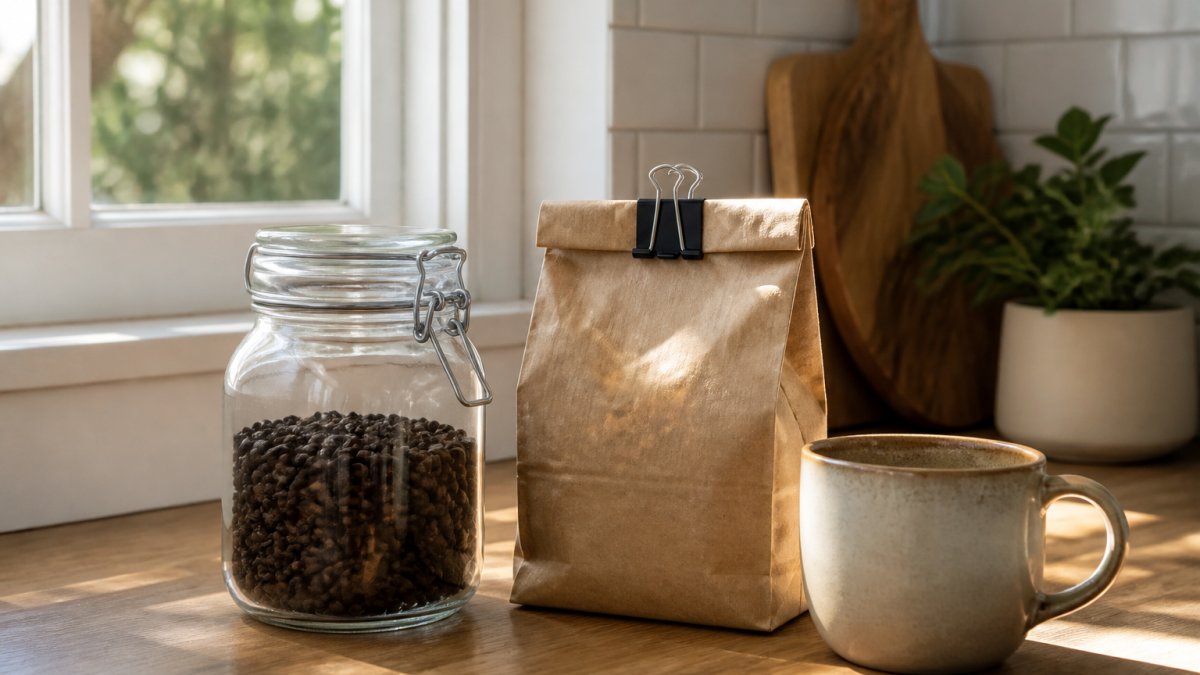
**1. The original bag, folded and clipped.
**2. A mason jar with a tight lid.
**3. A ceramic canister with a rubber gasket.
**4. A clean, dry food storage tub.
**5. A zip-top freezer bag with the air pressed out.
**6. A paper bag rolled shut.
**7. An open bowl or mug.
What to Do With a Bag That Cannot Be Resealed
Some bags are torn, or the zip failed. Don't leave it open. Work through this in order and stop at the first option you have:
- Fold and clip anyway. A torn top can often still be rolled down two or three times and held with a binder clip or clothespin. This is the least-effort fix and usually good enough for a week.
- Decant into a zip-top bag. Press the air out from the bottom up, seal most of the way, squeeze the last of the air out through the gap, then finish the seal. Double-bag it and keep it dark.
- Transfer to any clean, dry jar with a lid. A mason jar, a clean sauce jar with the label soaked off, or a food storage tub all work. Dry it fully first, a damp jar is worse than an open bag.
- Cover tightly if you have no lid. A clean food-safe tub topped with plastic wrap and a rubber band beats an open bag, as long as the wrap is snug and the tub stays in the dark.
- Plan to brew through it faster. Whatever barrier you improvise, a torn bag has already lost some protection. Use it within a week and grind right before brewing.
The goal is a barrier, not a specific product. Any food-safe barrier beats an open bag, and a dark cupboard multiplies it.
Here is how the household options stack up, judged on air, light, moisture, odor, and how long they actually buy you.
| Option | Air and light protection | Realistic window |
|---|---|---|
| Original bag, folded and clipped | Good air seal, light blocked, one-way valve | About one to two weeks |
| Mason jar with tight lid | Very good air, poor light unless stored dark | Two to three weeks in a dark cupboard |
| Ceramic canister with rubber gasket | Good air while gasket holds, light blocked | Two to three weeks |
| Clean, dry food storage tub | Fair to good air, poor light unless opaque | One to two weeks |
| Zip-top freezer bag, air pressed out | Fair air, no light blocked, double-bag it | About a week |
| Paper bag rolled shut | Poor air, no light or moisture barrier | A few days |
| Open bowl or mug | None blocked, fully exposed | A day or two at best |
How Long Do Coffee Beans Stay Fresh Without a Proper Container?
Expect roughly one to two weeks of good quality with a well-folded, clipped bag, and less if the bag sits in light or heat. Whole beans hold up far better than ground coffee, which stales within days once opened.
For broader guidance on stretching that window, our guide on how to keep coffee beans fresh at home walks through the habits that matter most.
Can You Freeze Coffee Beans Without a Container?
Yes, but only with a real barrier. Freezing works because cold slows the oils from going stale, but it fails badly if moisture gets in. Never put loose beans straight into a freezer.
If you want to freeze:
- Move beans into a zip-top bag, press out all the air, and seal it fully.
- Double-bag for extra protection against freezer odors.
- Freeze in small portions you'll use in one go.
The container question doesn't disappear in the freezer. It gets more important.
Food-Safe Household Substitutes and Contamination Risks to Avoid
The rule is simple: only food-safe materials touch your beans, and only clean, dry, unscented ones. Roasted coffee is porous and coated in oils that absorb volatile compounds from whatever surrounds them. That's why a jar that held pickles can flavor a batch of beans, and why beans stored next to cleaning supplies taste like the cupboard. Coffee is a sponge for smells, the container's history matters as much as its material.
Safe household materials
- Glass, mason jars, clean sauce jars with lids. Inert, doesn't hold odors once washed, and seals well. Keep it out of light.
- Food-grade plastic, zip-top freezer bags, food storage tubs, and deli containers sold for food use. Check for a food-safe mark or buy from the kitchen aisle, not the hardware aisle.
- Ceramic, canisters with intact gaskets. Opaque and inert, provided the glaze is food-safe and the lid seals.
Materials and containers to avoid
- Non-food plastic. Storage bins meant for hardware or craft supplies can leach odors and chemicals. If it wasn't sold for food, it doesn't touch the beans.
- Scented or previously used containers. A jar that held spices, pickles, or garlic will flavor your coffee. Wash thoroughly, and if it still smells like anything, retire it.
- Damp containers. Any moisture inside invites mold. Dry everything fully, a towel-dry followed by air-dry is safer than a quick wipe.
Short-term versus long-term: match the substitute to the duration
The right substitute depends on how long the beans will sit. For a week or two, the original bag folded and clipped, a zip-top bag, or a clean jar all work, prioritize a tight seal and a dark spot.
A few more contamination traps worth naming:
- Don't reuse a bag that held something else. A grocery bag that carried onions or a tote that held detergent will transfer odors.
- Don't store beans in the fridge in an open or loosely sealed container. The fridge is a odor-rich, humid environment, and beans will pick up both smells and condensation.
- Don't stack beans against a wall that gets sun. Warm drywall radiates heat into whatever sits against it.
If you follow one rule from this section, make it this: clean, dry, unscented, food-safe, and dark. Everything else is a detail.
How to Tell Whether Your Stored Beans Have Lost Quality
Your nose and eyes will tell you before your tongue does. Fresh beans smell sweet and complex. Stale beans smell flat, papery, or faintly like cardboard.
Other signs:
- No aroma when you open the bag. A fresh bag hits you immediately.
- Dry, matte surface. Oily sheen fades as beans age.
- Flat or bitter flavor. The brightness disappears first.
If you're unsure, our guide on how to tell if coffee beans are fresh breaks down the full checklist so you can judge a bag with confidence.
Stock Up on Freshly Roasted Beans That Arrive Ready to Store
The best storage trick is starting with beans fresh enough to be worth protecting. We roast to order at LGBrewTeaQ, so your bag arrives at its peak, sealed in packaging built for storage.
If you want beans that land ready to fold, clip, and stash, buy freshly roasted coffee online and skip the guesswork. And if you're weighing options beyond the supermarket shelf, see our roundup of the best alternatives to mass market coffee beans for bags that reseal properly.
Frequently Asked Questions
Can you freeze coffee beans without a container?
You can, but it is risky without proper packaging. Freezer air is dry and can pull moisture from exposed beans, and odors from other frozen foods can seep in. If you must freeze beans without a container, place them in a heavy-duty zip-top bag, press out as much air as possible, and double-bag them. Use them within one to two months and let them sit sealed at room temperature before grinding so condensation forms on the bag, not the beans.
How long do coffee beans stay fresh without an airtight container?
Expect noticeably faster staling than with proper storage. In a clipped or folded bag kept in a cool, dark cupboard, whole beans usually hold decent flavor for about one to two weeks. Ground coffee declines within days. Light and heat speed this up, so keep the bag in a pantry away from the stove and window, and buy smaller amounts you can finish quickly.
Where should you keep coffee beans if you do not have a container?
Choose the coolest, darkest cupboard you have, away from the oven, dishwasher, and windows. Room temperature is fine for short-term storage. Skip the refrigerator, since repeated opening exposes beans to moisture and food odors. If your only option is a warm spot, move the bag to a lower shelf or a closet shelf where temperatures stay steadier throughout the day.
Can you store coffee beans in their original bag?
Yes, and it is often the best container-free option. Quality coffee bags have a one-way valve that releases carbon dioxide while limiting oxygen intake. Fold the top down tightly, press out excess air, and secure it with a binder clip or rubber band. Keep the bag upright in a dark cupboard. If the bag has no valve or resealable zip, transfer the beans to a clean glass jar with a tight lid.
Storing beans without a container comes down to one habit: cut off air, light, heat, and moisture with whatever food-safe barrier you have. That's the whole job, and it's easier than most people think. LGBrewTeaQ makes the other half simple too, with carefully sourced beans roasted to order, a straightforward ordering process, and fast, reliable delivery to your door. Get started with LGBrewTeaQ and keep every bag tasting like the day it arrived.
