

How to Identify Single Origin Coffee Tasting Notes
Table of Contents
- Start With What Single Origin Coffee Actually Means
- How to Taste Coffee: A Repeatable Five-Step Protocol
- Coffee Cupping Guide: Set Up a Controlled Comparison at Home
- Coffee Tasting Notes for Beginners: Build Your Vocabulary
- Use a Coffee Tasting Wheel Without Getting Lost in It
- What Changes the Flavor: Roast, Processing, Altitude, and Brew
- Write It Down: A Tasting Note Template That Works
- Frequently Asked Questions
Last Updated: October 19, 2026
Start With What Single Origin Coffee Actually Means
Single origin coffee is coffee traced to one growing region, one farm, or one cooperative, rather than a blend of beans from multiple places. That traceability is the whole point. It lets you taste a specific place, not a recipe.

Here at LGBrewTeaQ, we roast single origins from Ethiopia, Colombia, and beyond, and the differences between them are real and repeatable. But most guides oversell what that means.
Why Origin Predicts Less Than You Think
A label like "Ethiopia" tells you the region, not the flavor in your cup. Two Ethiopian coffees from neighboring farms can taste completely different. Roast level, processing, and your brew method all push flavor around.
So treat origin as a starting hint, not a promise. The Specialty Coffee Association's cupping standards frame this as sensory evaluation, not fortune-telling. You still have to taste and confirm.
How to Taste Coffee: A Repeatable Five-Step Protocol
Learning how to taste coffee starts with slowing down. Most people drink too fast and too hot to notice anything. This five-step protocol fixes that.
- Smell the dry grounds. Note the first thing that comes to mind.
- Smell the brewed cup. Aroma shifts once water hits.
- Slurp a small sip. Pulling air across your tongue spreads the coffee.
- Hold it for three seconds. Let it coat your whole mouth.
- Swallow and wait. The finish and aftertaste tell you the most.
Slurp, Hold, and Breathe
Slurping is not rude here. It aerates the coffee and pushes aroma to the back of your nose, where most flavor lives. Hold the sip, breathe out gently through your nose, then swallow.
Do this the same way every time. Consistency is what turns a lucky guess into a repeatable skill.
Coffee Cupping Guide: Set Up a Controlled Comparison at Home
A coffee cupping guide is simply a side-by-side tasting where every variable stays the same except the coffee. You do not need a lab. You need three cups and some discipline.
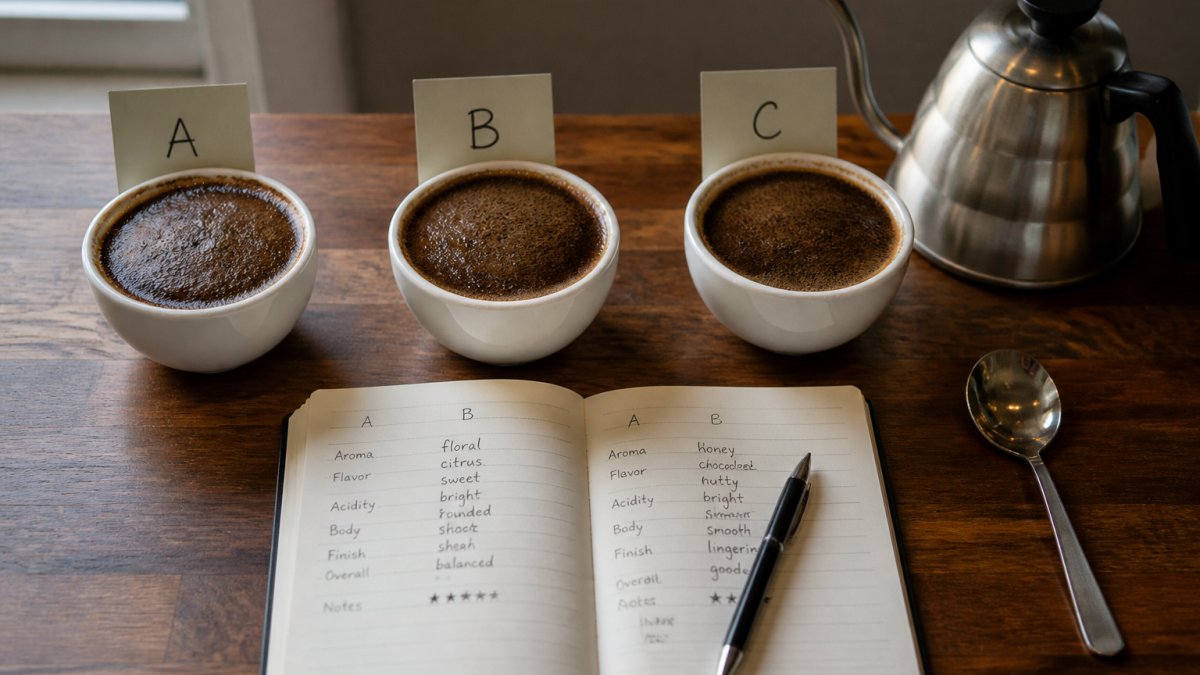
Here is the setup:
- Same dose: weigh each coffee to the same amount.
- Same grind: use one grind size for all cups.
- Same water: same temperature, same volume.
- Same time: start and stop each cup together.
- Label cups A, B, C: hide the bags until you finish.
Our Single Origin Favorites Sample Pack makes this easy. Six 2 oz pouches from six regions, roasted to order, so you can cup them back to back without buying six full bags.
Coffee Tasting Notes for Beginners: Build Your Vocabulary
Coffee tasting notes for beginners usually fail because the words feel fake. "Bergamot"? "Stone fruit"? The fix is not a bigger vocabulary. It is calibration: matching a word to a sensation you can already recognize.
Start with families, not fancy terms. Then anchor each family to a reference food you can buy at any grocery store.
| Note family | What it tastes like | Reference to calibrate against | Common in |
|---|---|---|---|
| Fruity, citrus | Lemon, orange, grapefruit | A squeeze of fresh lemon vs. orange zest | Ethiopia, Kenya, washed light roasts |
| Fruity, berry | Blueberry, strawberry, raspberry | A ripe blueberry; a spoon of raspberry jam | Ethiopia naturals, Tanzania |
| Fruity, stone fruit | Peach, apricot, plum | A slice of fresh peach; dried apricot | Colombia, Guatemala, Costa Rica |
| Floral | Jasmine, honeysuckle, rose | A jasmine tea bag; a rose petal | Light roasts, high altitude |
| Nutty | Almond, hazelnut, peanut | Raw almond vs. toasted almond | Colombia, Brazil, medium roasts |
| Chocolate | Cocoa, milk chocolate, dark chocolate | Unsweetened cocoa powder vs. a square of milk chocolate | Medium and dark roasts |
| Caramel / brown sugar | Toffee, molasses, maple | A caramel candy; a spoon of brown sugar | Medium roasts, honey process |
| Earthy / spicy | Wood, cedar, tobacco, clove | A cedar cigar box; a clove | Natural process, dark roasts, Sumatra |
Pick the family first, then get specific. "Fruity, maybe berry" is a real note. It beats a wrong guess at "blackcurrant."
Calibrate Before You Cup
A simple exercise makes the vocabulary stick. Before you taste coffee, taste the references. Put a pinch of unsweetened cocoa powder, a raw almond, a dried apricot, and a lemon peel on a plate. Taste each one, say the word out loud, and write it down. Ten minutes of this does more for your palate than a month of reading descriptors.
Then, when a coffee reminds you of one of those references, you have a real match instead of a guess. Most practitioners find that three or four calibrated references cover the majority of single-origin notes they encounter.
Separate Tasting Notes From Added Flavoring
A tasting note describes a sensory resemblance, not an ingredient. When a bag says "blueberry," it does not mean blueberries were added. It means the coffee's acids and aromatics remind trained tasters of blueberry. This is why the same coffee can read as "blueberry" to one drinker and "dark cherry" to another, both are honest descriptions of the same sensation.
Flavored coffee is different. It tastes like the syrup someone added, and the flavor usually sits on top of the cup rather than inside it. A useful test: if the flavor vanishes or turns flat as the cup cools, suspect added flavoring. A true single-origin note tends to shift and deepen as the coffee cools, not disappear.
Use a Coffee Tasting Wheel Without Getting Lost in It
A coffee tasting wheel is a map, not a test. Start at the center with broad categories like fruity or nutty, then work outward to narrower terms. Stop as soon as a word feels right.
Do not chase the outer ring. Most drinkers never need to name a specific cultivar-level flavor, and that is fine. The wheel helps you describe what you taste, not prove how refined your palate is.
Single Origin Favorites Sample Pack →
A Timed Tasting Worksheet
The wheel only works if you record what you find. Use the same short worksheet every time so your notes become comparable across coffees.
Coffee: ________ Origin / Process / Roast: ________ Dry aroma (before water): ________ Wet aroma (after water): ________ Hot, first sip (around 160°F): ________ Warm, 5 minutes in (around 140°F): ________ Cool, 10 minutes in (around 120°F): ________ Body / mouthfeel: ________ Finish / aftertaste: ________ Wheel path (center → outer): ________ Would I buy it again? ________
That last line matters most. The buy-again answer tells you more than any adjective.
Taste It as It Cools
Most drinkers taste coffee too hot, when heat masks acidity and sweetness. A timed cooling exercise fixes that. Slurp the same cup at roughly 160°F, then again at 140°F, then again at 120°F. Note what changes.
A common pattern: the hot cup reads mostly roast and body, the warm cup reveals sweetness and fruit, and the cool cup shows acidity and floral detail most clearly. If a note only appears when the coffee is cool, that is not a flaw, it is information. Write it down.
Keep the Comparison Controlled
A wheel cannot tell you whether a note comes from origin or from your brewing. To isolate origin, hold every other variable constant: same water, same dose, same grind, same temperature, same brew method, same cup. Change one coffee at a time. If you switch brewers between cups, you are tasting the brewer as much as the bean.
Our Single Origin Favorites Sample Pack is built for this: six 2 oz pouches from six regions, roasted to order, so you can run the same worksheet across all six with one controlled setup.
Do not confuse added flavoring with real tasting notes. A flavored coffee tastes like the syrup someone added. A single origin tastes like the bean. If the flavor vanishes as the cup cools, suspect flavoring, not origin.
What Changes the Flavor: Roast, Processing, Altitude, and Brew
Roast, processing, altitude, and brew method all reshape the flavor profile. Origin sets the range. These four decide where inside that range you land.
- Roast level: light roasts keep bright acidity and fruit. Dark roasts push chocolate and smoke forward.
- Processing method: washed process gives a clean, bright cup. Natural process adds fruity, wine-like depth. Honey process sits between them.
- Altitude: higher-grown beans ripen slower and often carry more acidity and complexity.
- Brew method and grind: a fine grind and long contact pull out more body and bitterness. A coarse grind keeps things clean.
Our Ethiopia Single Origin Coffee shows this well. It is a light-medium natural from high elevations, and it drinks floral and tea-like. Brew it as a pour-over and those jasmine notes come through clearly. Push it dark and you would lose them.

Write It Down: A Tasting Note Template That Works
A tasting note only counts if you record it. Use the same short template every time so your notes become comparable.
Coffee: ________ Origin / Roast: ________ Aroma: ________ First sip: ________ Body / mouthfeel: ________ Finish / aftertaste: ________ As it cooled: ________ Would I buy it again? ________
That last line matters most. "As it cooled" catches flavors that hide behind heat, and the buy-again answer tells you more than any adjective.
The best tasting note is a short, honest one you actually write down. Three consistent words beat ten poetic ones you never repeat.
Frequently Asked Questions
Do coffee tasting notes mean flavors were added?
No. Tasting notes on a bag of single origin coffee describe what the roasted bean naturally tastes like, not ingredients that were added. A washed Ethiopian coffee listed as jasmine and bergamot contains nothing but coffee. Flavored coffees are labeled separately and usually name the added flavoring outright. If a bag says 'natural process' or 'washed process' and lists fruit or floral notes, those come from the bean's variety, growing region, processing, and roast, not from syrup or oil.
How do you taste single origin coffee properly?
Grind fresh, brew at a consistent coffee-to-water ratio, and let the cup cool for a few minutes before judging. Slurp a small amount so it spreads across your palate, hold it briefly, then swallow and note the finish. Compare two origins side by side using the same brew method and grind size so the only variable is the bean. Write down three words before you read the bag again, then check how close you were.
How does a coffee's origin affect its flavor?
Origin sets a starting point, not a guarantee. East African high-grown coffees often show citrus, berry, and floral notes, while Central and South American coffees lean toward caramel, cocoa, and stone fruit. Altitude, coffee variety, processing method, and roast level all shift the result, which is why two Colombian lots can taste quite different. Use origin as a hint and let the cup confirm it.
How can beginners improve their coffee-tasting skills?
Taste deliberately and often. Try the Single Origin Favorites Sample Pack ($24.99) to compare six regions in one sitting, using the same brew method for each so the differences stand out. Keep a written log of three descriptors per cup, revisit the coffee as it cools, and use a coffee tasting wheel to find words when yours run out. Repeat comparisons build vocabulary faster than reading descriptions ever will.
Tasting single origin coffee well takes practice, not expensive gear. The challenge is finding fresh, traceable beans worth the effort. LGBrewTeaQ roasts to order and ships single origins straight to your door, so every cup arrives at peak flavor and aroma. Start with the Colombia Single Origin Coffee for a balanced, caramel-sweet baseline, or grab a sample pack and cup six regions side by side. Shop Coffee and taste the difference for yourself.
