

Perfect Espresso Crema: Fresh Beans, Fine Grind, Steady Shots
Quick Summary
Perfect espresso crema comes from fresh beans roasted within the last few weeks, a fine and consistent grind, and a weighed dose of about 18 grams pulled to about 36 grams in 25 to 35 seconds. Adjust one variable at a time, since crema forms when high-pressure extraction pushes gas into coffee oils.
- Look for a roast date and use beans roasted within the last few weeks.
- Grind close to powdered sugar texture, fine and consistent in size.
- Aim for a shot that runs roughly 25 to 35 seconds.
- Use a 2:1 ratio: about 18 grams of coffee yields about 36 grams of espresso.
- Change one variable at a time and record each shot's dose, yield and time.
Table of Contents
- What Espresso Crema Is and How It Forms
- Why Is There No Crema on My Espresso?
- Start With Fresh Beans and Roast Date
- Dial In Grind Size and Extraction Time
- Dose, Tamp and the 2:1 Espresso Ratio
- Water Temperature, Pressure and Machine Care
- A Step-by-Step Troubleshooting Workflow for Thicker Crema
- Pulling Your Next Shot With Confidence
- Frequently Asked Questions
What Espresso Crema Is and How It Forms
Last Updated: October 31, 2026
Perfect espresso crema starts with understanding what it actually is.
Crema forms when hot water is forced through finely ground coffee at high pressure.
Here is the part most guides skip. Crema is a useful sign, but it is not a perfect measure of quality.
So treat crema as a clue, not a score.
Why Is There No Crema on My Espresso?
If your shot has little or no crema, the most common causes are stale beans, a grind that is too coarse, or a shot that runs too fast. If your shots come out thin or sour, learn how to fix sour espresso shots at home to diagnose the problem.
Stale beans are usually the first suspect. Coffee loses carbon dioxide over time, so older beans produce thin or patchy foam.
Watch out: a coarse grind can make a shot look fine on top while tasting sour and thin underneath.
- Beans roasted weeks ago with little gas left
- Grind size too coarse for pressure to build
- Shot pulled too fast, under 20 seconds
Start With Fresh Beans and Roast Date
Fresh beans are the foundation of good crema. Look for a roast date on the bag, and aim for beans roasted within the last few weeks when you brew espresso.
Once beans are opened, store them airtight, away from heat and light. A quick sniff and a look at the surface can also help.
If you want a deeper guide, read our article on How to Identify High-Quality Espresso Beans. For a quick check on whether beans are still fresh, see How to Tell If Coffee Beans Are Fresh.
Dial In Grind Size and Extraction Time
Grind size controls how fast water passes through the coffee. For espresso, the grind should be fine, close to powdered sugar in texture, and consistent in size.
A fine, even grind builds enough pressure for crema to form. Grind too coarse and water rushes through.
Extraction time is your check on the grind. A typical espresso shot runs for roughly 25 to 35 seconds. Use this as a starting point, then adjust:
- Shot runs under 20 seconds: grind finer
- Shot runs over 35 seconds: grind coarser
- Shot is sour and thin: grind finer or raise the dose
Change one variable at a time so you know what made the difference.
The article's grind and timing guidance can be summarised as a quick troubleshooting reference:
| Shot symptom | What it means | Adjustment |
|---|---|---|
| Runs under 20 seconds | Grind too coarse | Grind finer |
| Runs over 35 seconds | Grind too fine | Grind coarser |
| Sour and thin | Under-extracted | Grind finer or raise dose |
| Bitter and harsh | Over-extracted | Grind coarser or shorten shot |
Dose, Tamp and the 2:1 Espresso Ratio
Dose, tamp and yield work together. The dose is the amount of ground coffee in the basket. The yield is the amount of liquid espresso that comes out.
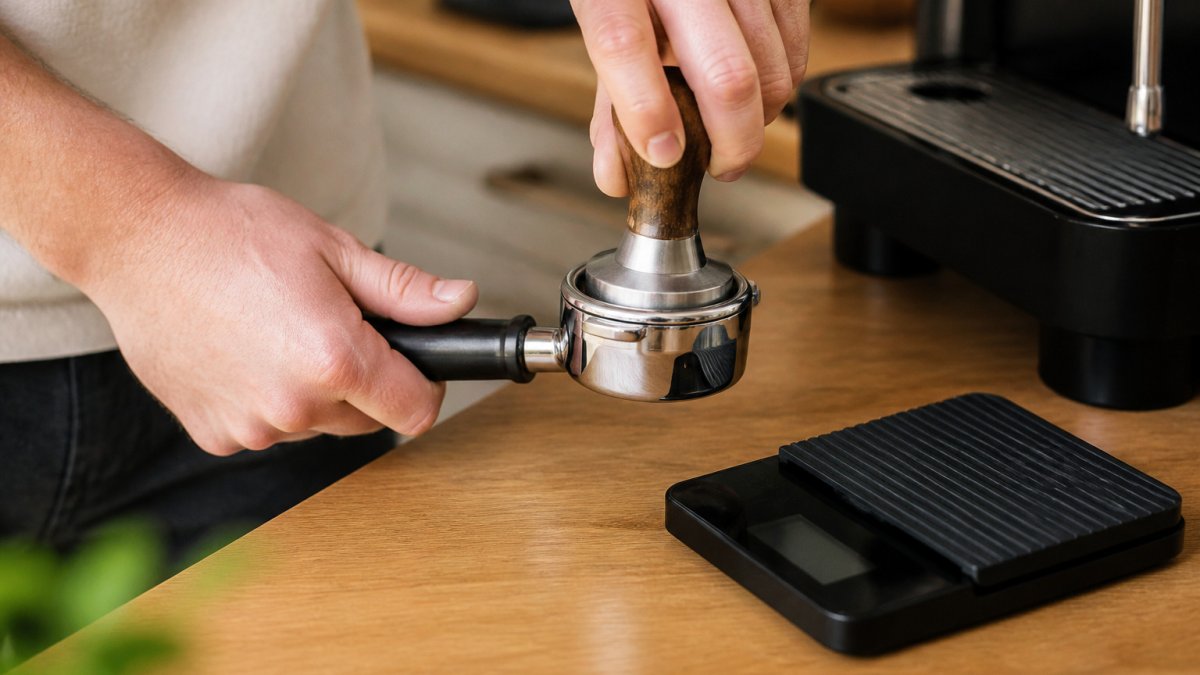
Consistent dosing matters. Use a scale so you can weigh the grounds and the output. Level the grounds in the basket before tamping, then press firmly and evenly so the puck is flat.
Here is a simple setup:
!Close-up of hands leveling and tamping freshly ground coffee in a portafilter on a kitchen counter with a digital scale nearby
- Dose: about 18 grams of ground coffee
- Yield: about 36 grams of espresso
- Time: roughly 25 to 35 seconds
Setting Your Shot Yield and Timing
Yield and time tell you whether the extraction is balanced. If you hit 36 grams in 30 seconds, you are in a solid range.
Weigh your output in a cup on a scale and start the timer when the shot begins. Write down your dose, yield and time so you can repeat a good shot.
Water Temperature, Pressure and Machine Care
Crema is a pressure-and-gas phenomenon, so anything that disturbs pressure or temperature stability shows up in the cup before it shows up anywhere else. This section covers the three machine-side variables most guides gloss over: water quality, temperature stability, and maintenance.
Water Quality Affects Extraction, Not Just Taste
Water makes up most of an espresso, so the water itself is part of the recipe. Two things matter most: mineral content and scale.
- Too soft or distilled water can taste flat and extract poorly, because there are few minerals to help carry flavor compounds out of the grounds.
- Very hard water leaves scale in the boiler, group head, and shower screen. Scale insulates the brew path, destabilizes temperature, and can partially block flow, all of which degrade crema over time.
A practical middle ground is filtered water with moderate mineral content. Test your water once so you know whether it is too soft or too hard rather than guessing.
Temperature Stability Beats a Single Temperature Number
Brew temperature matters, but stability matters more. A machine that swings several degrees between the start and end of a shot will produce inconsistent extraction even if its average temperature looks correct.
If your machine has a PID controller, use it to hold a steady brew temperature rather than relying on a thermostat with a wide dead band.
Pressure: What the Gauge Is Really Telling You
Espresso extraction depends on the pump building pressure against a properly prepared puck. A gauge reading in the normal brew range tells you the pump is working, but it does not tell you the puck is resisting evenly.
This is why puck preparation and basket condition matter as much as pump pressure.
Maintenance That Protects Crema
A short, regular maintenance routine prevents most crema problems that are not caused by beans or grind:
- Daily: flush the group head before and after your session, and wipe the shower screen.
- Weekly: remove and rinse the shower screen and basket, and backflush if your machine supports it.
- Regularly: descale according to your water hardness and the machine manufacturer's instructions, and inspect the group gasket for wear.
Clean, stable, properly mineralized water and a well-maintained brew path give the puck the conditions it needs. Technique gets the credit, but the machine sets the ceiling.
A Step-by-Step Troubleshooting Workflow for Thicker Crema
Most crema advice is a list of tips. A list does not tell you which tip to try first, so you end up changing three things at once and learning nothing. What you need is a controlled diagnostic sequence: change one variable, pull a shot, record the result, then decide the next move.
Before You Touch Anything: Establish a Baseline
Pull one shot with your current setup and record four numbers: dose in grams, yield in grams, shot time in seconds, and a crema note (thick, thin, patchy, absent). Write them down. Every later shot is compared against this baseline, not against a vague memory of a good shot.
Step 1: Rule Out the Beans
Beans are the most common cause of thin crema, and they are the cheapest thing to check. Confirm the roast date on the bag.
If the beans are old, stop here. No grind or tamp adjustment will fix a bag that has degassed. Replace the beans, pull a baseline shot, and only then continue.
Step 2: Fix the Dose, Then Hold It Constant
Weigh your dose on a scale. A common starting point for a double basket is about 18 grams, but the right number is whatever your basket is designed to hold without the puck touching the shower screen. Once you pick a dose, keep it fixed for the rest of the workflow. Changing dose and grind together is the fastest way to lose track of what worked.
Step 3: Use Shot Time to Set the Grind
With dose fixed, grind is your main lever. Aim for a shot that reaches your target yield in roughly 25 to 35 seconds.
- Shot finishes well under 20 seconds: grind finer.
- Shot runs past 35 seconds or chokes: grind coarser.
- Shot time is in range but crema is still thin: move to Step 4.
Change the grind in small increments and pull a shot after each change. If your beans are fresh and you are ready to upgrade for thicker crema, you can shop the African Espresso.

Step 4: Check the Puck, Not Just the Numbers
A shot can hit its time and yield and still produce poor crema if the puck is channeling. After a shot, knock out the puck and look at it. A puck with cracks, holes, or wet craters on top suggests water found a fast path through the coffee instead of flowing evenly.
Step 5: Confirm the Yield
Weigh the output. If you are dosing 18 grams and pulling 36 grams in 30 seconds, you are in a solid starting range. If the shot hits 36 grams much faster or slower than that, return to Step 3. If the shot tastes sour and thin even at the right time and yield, try a slightly finer grind or a small dose increase; if it tastes bitter and harsh, go slightly coarser or shorten the yield.
Step 6: Rule Out the Machine
If beans are fresh, dose and yield are on target, the puck looks even, and crema is still weak, the problem is likely upstream of the puck. Clean the group head, shower screen, and basket, and check that the machine reaches and holds its brew temperature. A clogged screen or an unstable temperature will produce dull crema regardless of technique.
Record What Worked
Keep a simple log: date, bean and roast date, dose, grind setting, yield, time, and a one-word crema note. After a few sessions, patterns appear, and you stop guessing. The log is also what lets you repeat a great shot when you switch beans, because you can see which variable moved when the result changed.
Pulling Your Next Shot With Confidence
Perfect crema comes from fresh beans, a fine and consistent grind, accurate dosing and steady timing. Treat crema as a helpful sign, but judge each shot by how it tastes.
Start with a weighed dose, aim for a 2:1 ratio, and adjust one variable at a time. For more ideas on your home setup, explore our Max Caf Blend or our 6 Bean Blend, both available for $23.99.


Frequently Asked Questions
Why does my espresso have so much crema?
Heavy crema usually comes from fresh beans, a fine grind and a well-pressurized extraction. Crema is a foam of CO2 gas and oils released during brewing, so beans roasted within the last few weeks tend to produce more of it. A dark roast can also foam more readily, but very thick crema is not proof of a better shot. Taste, sweetness and balance matter more than foam alone, so judge the cup as well as the crema.
What is the 2:1 rule for espresso?
The 2:1 rule is a starting ratio of liquid espresso out to dry coffee in the basket. For an 18-gram dose, aim for about 36 grams of espresso in the cup, typically pulled in roughly 25 to 35 seconds. Treat these numbers as a starting point and adjust grind size until your shot matches your taste.
How fresh should coffee beans be for espresso crema?
Most espresso drinkers find beans best from about one to three weeks after the roast date, once some CO2 has escaped but before flavor fades. Very fresh beans, just a few days off roast, can foam heavily but may taste sharp and gassy. Buy whole beans with a clear roast date, store them airtight away from heat and light, and grind just before brewing for the most consistent crema.
Why is there no crema on my espresso?
A missing or thin crema often points to stale beans, a grind that is too coarse, a shot that runs too fast, or a dose that is too small for the basket. Check that your beans are fresh, grind finer, and confirm your machine reaches proper brewing pressure. Uneven tamping and channeling can also reduce crema, so level the grounds and tamp evenly before you pull the shot.
