

What Coffee Bloom Means and Why It Matters for Your Brew
Last Updated: November 13, 2026
Quick Summary
Coffee bloom is the rush of carbon dioxide that escapes freshly ground coffee when hot water hits it, making the bed of grounds swell and bubble. The gas was trapped inside the beans during roasting, and grinding releases it fast. Blooming pre-wets the grounds so water can soak them evenly instead of being blocked by gas.
- Most brews need a coffee bloom time of 30 to 45 seconds before the main pour.
- Pour roughly twice the weight of your coffee dose in hot water to bloom.
- For a 20-gram dose, that means about 40 grams of bloom water.
- A weak bloom is a clue about freshness, not a verdict, since roast level and storage also matter.
- In a French press, wait 30 seconds after the bloom, then add the rest of your water.
Table of Contents
- What Coffee Bloom Means in Plain Terms
- Why Freshly Roasted Beans Release Carbon Dioxide
- Coffee Bloom Time: How Long to Wait Before the Main Pour
- How Does Bloom Time Affect Coffee Flavor and Extraction?
- How to Bloom Coffee in a Drip Coffee Maker
- Coffee Bloom in a French Press: A Slower, Fuller Method
- Troubleshooting Weak, Flat, and Uneven Blooms
- Pick Beans With a Recent Roast Date and Start Blooming
- Frequently Asked Questions
What Coffee Bloom Means in Plain Terms
Coffee bloom is the rush of carbon dioxide that escapes freshly ground coffee when hot water hits it, making the bed of grounds swell and bubble (To bloom or not to bloom? (Part 1)). The gas was trapped inside the beans during roasting, and grinding releases it fast.
That puff of gas matters because it pushes water away. If you pour all your water at once, the trapped gas can block the grounds from soaking evenly. That leads to dry pockets and a thin cup.
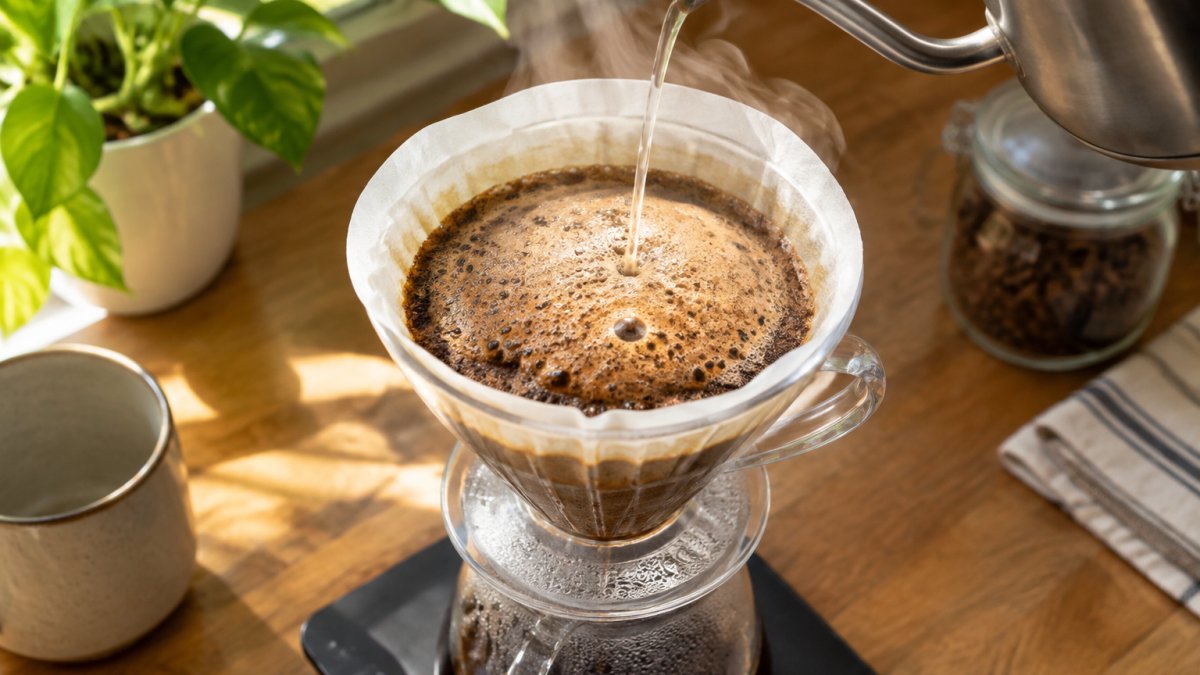
A simple coffee bloom definition: it is the pre-wetting step where a small amount of hot water meets fresh grounds, gas escapes, and the coffee bed expands before the main pour. The bloom phase takes seconds to start and usually under a minute to finish.
Many brewers treat the bloom as optional. We think that is a mistake for fresh beans, and a waste of time for stale ones. Here is how to tell the difference.
Why Freshly Roasted Beans Release Carbon Dioxide
Roasting builds up carbon dioxide inside each bean. Over the days after roasting, that gas leaks out slowly, which is why roast date matters so much. Grind the beans and the gas has nowhere to hide.
Research from NP's Coffee Science on blooming and dissolved CO2 looked at how blooming affects dissolved carbon dioxide in the brew. The work supports what home brewers notice: the bloom changes the gas balance in the cup, not just the look of the bed.
Fresher beans hold more gas, so they bloom harder. Beans that sat on a shelf for months may barely move. That is one reason a weak bloom is a clue, not a verdict.
If you want to know how long beans should rest before brewing, our guide on how long coffee beans should rest after roasting walks through the timing.
Coffee Bloom Time: How Long to Wait Before the Main Pour
Most brews need a coffee bloom time of 30 to 45 seconds. Pour roughly twice the weight of your coffee dose in hot water, wait for the bubbling to slow, then start the main pour. For a 20-gram dose, that means about 40 grams of bloom water.
Here is a simple bloom workflow you can follow:
- Weigh your coffee dose on a scale
- Grind fresh, right before brewing
- Place the dripper and filter on the scale, then tare
- Pour bloom water at about twice the coffee weight
- Swirl gently so all grounds get wet
- Wait 30 to 45 seconds
- Start the main pour in slow circles
Water temperature matters here too. If your water is too cool, the bloom is sluggish and extraction suffers. Our guide to the best water temperature for brewing coffee covers the range to aim for.
How Does Bloom Time Affect Coffee Flavor and Extraction?
Bloom time affects flavor by letting gas escape before the main pour, so water can reach the grounds evenly. Bloom too long and the bed cools, which can dull the cup.
The bloom is not magic on its own, though. Grind size and pour speed still do most of the work.
If you want more control over the finished cup, our roundup of ways to improve coffee extraction at home pairs well with a solid bloom routine.
How to Bloom Coffee in a Drip Coffee Maker
A standard drip machine can bloom coffee, but you have to control the first 30 to 45 seconds by hand. The goal is the same as pour-over: wet the entire bed with a small amount of hot water, let the carbon dioxide escape, then let the machine finish the brew.
Start with a ratio you can scale. Use about twice the weight of your coffee dose in bloom water. For a 30-gram dose in a batch brewer, that is roughly 60 grams of water. For a 60-gram dose, use about 120 grams. If you do not weigh your coffee, a common starting point is one ounce of bloom water per tablespoon of grounds, but a scale gives you repeatable results.
Here is a measurable workflow for a pause-capable drip machine:
- Add a paper filter and rinse it with hot water, then discard the rinse water.
- Weigh your dose into the filter and shake the bed level.
- Start the brew cycle and let it run just until the bed is saturated, usually 5 to 10 seconds.
- Pause the cycle immediately. If your machine has a pause-and-serve feature, use it; otherwise switch the machine off at the wall.
- Check that no dry patches remain. If the center is wet but the edges are dry, use a spoon to push the dry grounds into the wet center.
- Start a timer and wait 30 to 45 seconds. The bed should swell and bubble, then begin to settle.
- Resume the cycle and let the machine finish.
Watch out: if you pause too late, the machine may have already released most of its water, and the bloom step becomes a stall that cools the bed and slows extraction.
Not every drip maker lets you pause mid-cycle. If yours does not, pour a small splash of hot water over the grounds before you switch the machine on. Use about the same bloom ratio, then start the cycle after 30 seconds. It is not perfect, but it beats nothing.
Water temperature matters here too. If you are pre-wetting by hand, let boiling water cool for about 30 seconds first. Pouring boiling water straight from the kettle can scorch light roasts and flatten the flavor.
Our Colombia Single Origin Coffee brings dark chocolate depth with mango and peach, and it works well for both pour-over and standard drip.

Coffee Bloom in a French Press: A Slower, Fuller Method
French press blooming looks different. Add your grounds, pour in about twice their weight in hot water, and stir gently. You will see a thick crust of foam rise, then settle.
Wait 30 seconds, then add the rest of your water. The coffee bloom French press step gives you a fuller body because the grounds stay in contact with water the whole time.
A few things to keep in mind:
- Stir once after the bloom to break the crust
- Keep the total steep time around four minutes
- Use a coarse grind so the press is easy to plunge
Our Ethiopia Single Origin Coffee offers floral notes and ripe berry, though its listed brew methods are pour-over, iced pour-over or cold brew, and AeroPress.

Troubleshooting Weak, Flat, and Uneven Blooms
Bloom size is an imperfect freshness indicator: roast level, processing method, storage, grind size, and time since roasting all affect visible bubbling. Use the bloom as one clue among several, not a verdict.
Uneven blooms are a wetting problem. Dry pockets form when you dump water in one spot. Fix it by pouring in slow circles and giving the dripper a gentle swirl.
Channeling is the sneaky one. Water finds a fast path through the bed and leaves the rest dry. A gentle swirl during the bloom helps prevent it.
Here is a quick troubleshooting table:
| Problem | Likely Cause | Fix |
|---|---|---|
| Weak bloom | Stale beans | Buy a recent roast date |
| Flat bloom | Old or over-dried beans | Grind finer, use fresher beans |
| Uneven wetting | Water poured in one spot | Pour in circles, swirl gently |
| Domed bed, water down sides | Grind too fine or pour too fast | Coarsen grind, slow the pour |
| Sour cup | Skipped bloom, under-extraction | Bloom 30-45 seconds |
| Bitter cup | Over-extraction, water too hot | Cool water, shorten brew time |
Pick Beans With a Recent Roast Date and Start Blooming
The bloom is only as good as the beans behind it. Look for a roast date, not just a best-by date, and buy from a roaster who prints one clearly. Our guide on how to read coffee roast date labels helps you decode what is on the bag.
Once you have fresh beans, store them well. Our article on how to keep coffee beans fresh at home covers the basics: airtight container, cool spot, away from light.
If you are not sure where to start, our Single Origin Favorites Sample Pack gives you six regions to compare, so you can taste how bloom and roast level change the cup.

A visible bloom is not required for a good brew, as a coffee bloom explainer notes points out. But when your beans are fresh, the bloom is a useful check that things are working.
Our coffees are roasted to order, and our single-origin coffees are sourced from trusted farms. Shipping is fast and reliable.
Fresh beans and a 30-second bloom will do more for your morning cup than any gadget. LGBrewTeaQ roasts to order, sources carefully, and delivers fast, so your coffee arrives ready to bloom. Start with a single origin and see the difference in the first pour. Get started with LGBrewTeaQ and taste what a proper bloom does for your brew.
Frequently Asked Questions
What is the point of a coffee bloom?
Blooming releases trapped carbon dioxide from freshly ground coffee so water can reach the grounds evenly. When hot water hits the coffee bed, gas escapes as bubbles and the bed expands. If that gas stays in the way, water can channel through gaps and leave parts of the grounds under-extracted. A short pre-wet of roughly twice the coffee's weight in water lets the gas out first, which sets up a more even extraction and a more balanced cup.
How long should you let coffee bloom for?
Most pour-over recipes call for 30 to 45 seconds of bloom time before the main pour. Very fresh beans, meaning a roast date within the past week or two, may still be releasing gas after 45 seconds, so you can stretch it to about a minute. Watch the bed rather than the clock: once the bubbles slow and the crust stops rising, the bloom has done its job.
Can you bloom coffee in a drip coffee maker?
Yes, with a small manual step. Add your ground coffee to the filter basket, then pour about twice the coffee's weight in hot water, and wait 30 to 45 seconds. Then start the machine.
What happens if you don't let coffee bloom?
Nothing breaks, but the cup can taste flatter or sharper than it should. Trapped carbon dioxide pushes water away from parts of the coffee bed, so some grounds give up their flavor compounds while others barely get wet. The result can be uneven extraction. A visible bloom is not strictly required for a good brew, so if your coffee barely bubbles, that alone does not mean the cup will be bad.
