

How Do You Make Iced Tea With Loose Leaf Tea Leaves?
Last Updated: October 24, 2026
Quick Summary
Make loose leaf iced tea by brewing at double strength: use 2 teaspoons of loose leaf per 8 oz of water instead of the standard 1 teaspoon, then pour the concentrated hot tea over ice. The melting ice dilutes the brew to the right strength so it never tastes watery.
- For a large batch, use 8 teaspoons of loose leaf per quart of water.
- Cold brew uses about 2 tablespoons of loose leaf per 32 oz of cold water, steeped 8 to 12 hours.
- Flash chilling hot tea over ice prevents cloudiness better than slow refrigerator cooling.
- Sweeten with simple syrup while the tea is hot, using 2 tablespoons per 8 oz of finished tea.
- Keep iced tea covered in the fridge and drink it within 3 to 4 days.
Table of Contents
- Start With the Right Loose Leaf Iced Tea Ratio
- Loose Leaf Tea Steeping Times and Water Temperature
- Cold Brew Loose Leaf Tea Ratio for Smooth, Low-Bitterness Tea
- The Best Loose Leaf Tea for Iced Tea
- Iced Tea Brewing Equipment You Actually Need
- Flash Chill vs. Refrigerator Cooling: Which Prevents Cloudiness
- Sweetening, Garnishing, and Storing Your Iced Tea
- Pick Your Loose Leaf Blend and Brew a Glass Today
- Frequently Asked Questions
Start With the Right Loose Leaf Iced Tea Ratio
The best loose leaf iced tea starts with a simple rule: use double the tea you would for a hot cup.
Here is the core problem most people hit. Iced tea gets watery fast because melting ice dilutes the brew. According to USDA food and beverage guidance, water quality affects the taste of any brewed drink, so filtered water is a smart base.
A standard hot cup calls for 1 teaspoon of loose leaf per 8 oz of water. For iced tea, double it:
- Standard strength: 2 teaspoons per 8 oz of water
- Fruit and herbal blends: 2 to 3 teaspoons per 8 oz
- Large batch: 8 teaspoons per quart of water
Double-Strength Brewing for Ice Dilution
Double-strength brewing is the fix for watery iced tea. You brew a concentrated batch, then pour it over ice.
Think of it as banking flavor upfront. Brew 4 oz of hot tea at double strength, pour it over a full glass of ice, and you get roughly 8 oz of finished iced tea.
Watch out: if you brew at normal strength and chill it, the ice will water it down. Always brew concentrated when ice is involved.
Loose Leaf Tea Steeping Times and Water Temperature
Steeping time and water temperature decide whether your tea tastes sweet or bitter. Black and oolong teas want water near boiling. Green and white teas want it cooler. Herbal blends need the hottest water and the longest steep.
Here are the working numbers:
| Tea Type | Water Temperature | Steep Time |
|---|---|---|
| Black | 208°F to 212°F | 3 to 5 minutes |
| Oolong | 195°F to 205°F | 3 to 5 minutes |
| Green | 160°F to 180°F | 2 to 3 minutes |
| White | 170°F to 185°F | 4 to 5 minutes |
| Herbal and fruit | 212°F | 5 to 7 minutes |
For a deeper breakdown, our guide to steeping loose leaf tea properly covers each leaf type in detail.
Adjusting Steeping Times by Leaf Type
Whole leaf teas need more time than broken leaves. Big, intact leaves unfurl slowly, so they release flavor gradually. Fine leaves give up their flavor fast and turn bitter if you push them.
A common mistake is over-steeping black tea for iced batches. Past five minutes, the tannins take over and the tea turns harsh. Pull the leaves early and let the ice finish the job.
Cold Brew Loose Leaf Tea Ratio for Smooth, Low-Bitterness Tea
Cold brew loose leaf tea ratio is simple: use about 2 tablespoons of loose leaf per 32 oz of cold filtered water. Steep it in the fridge for 8 to 12 hours, then strain. The result is smooth, low in bitterness, and naturally sweet.
Cold water pulls flavor slowly. That slow extraction leaves most of the tannins behind, which is why cold brew tastes gentler than hot-brewed tea. It also cuts the astringency that turns some people off black tea.
A few practical tips:
- Use filtered water for a cleaner taste
- Keep the pitcher covered while it steeps
- Strain through a fine-mesh sieve before serving
Cold brew works well for fruit and herbal blends. Our Mango Treat and Hibiscus Berry blends both cold brew beautifully, and the fruit notes stay bright after hours in the fridge.
The Best Loose Leaf Tea for Iced Tea
The best loose leaf tea for iced tea is a bold black blend or a fruit-forward herbal. Black tea holds its flavor when chilled and stands up to ice. Herbal and fruit blends bring natural sweetness without any added sugar.
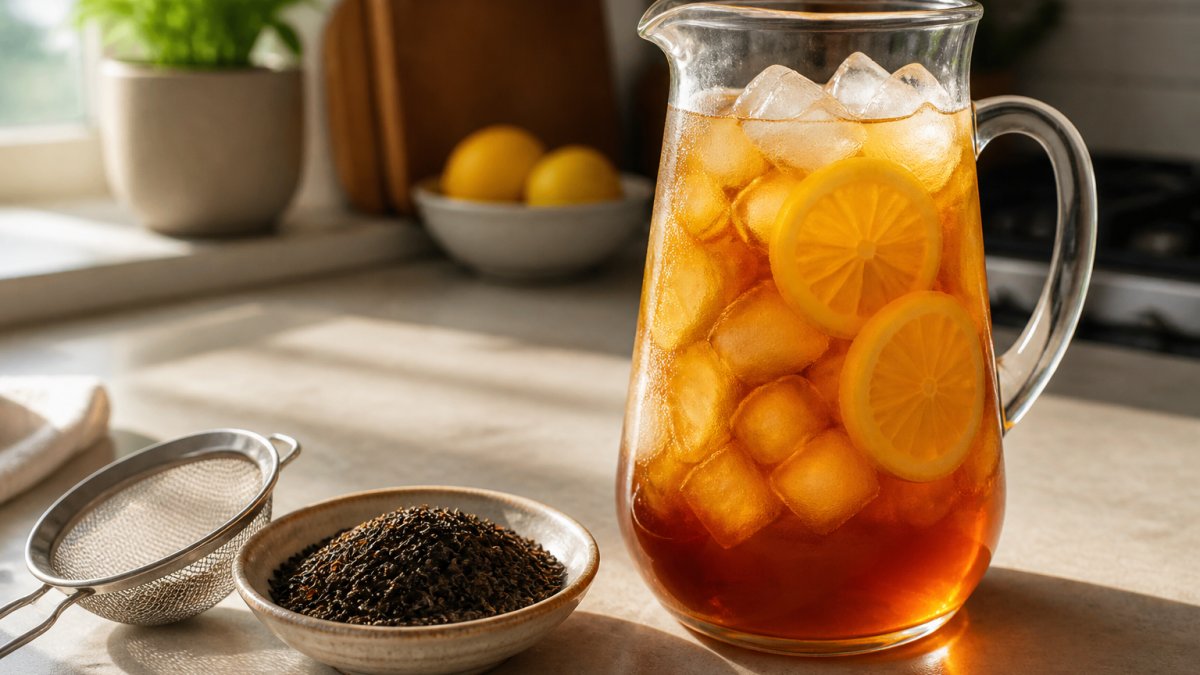
Here is how we would pick, based on what you want from the glass:
- Classic and brisk: English Breakfast, a whole-leaf black blend with malty depth
- Fruity and caffeine-free: Peach Paradise, with peach, cranberry, and rose petals
- Tropical and bright: Mango Treat, with mango, peach, and citrus blossom
Black tea brings caffeine and a full body. Herbal blends bring color and natural sweetness. Neither needs much help to taste good over ice.

Iced Tea Brewing Equipment You Actually Need
You need four things to brew iced tea: a brewing vessel, a fine-mesh strainer or infuser, a pitcher, and ice. That is the floor. But the gear you choose changes extraction, clarity, and how fast your tea dilutes, so it is worth picking each piece with a purpose.
Brewing vessel. A heat-safe glass measuring cup, a ceramic teapot, or a French press all work.
Strainer or infuser. Mesh size matters more than brand. Our roundup of the best tea infusers for fine leaf tea covers the options worth buying, and our guide to brewing equipment for home beginners covers starter gear more broadly.
Mango Treat (Loose Leaf Tea) →
Pitcher. A 1-quart glass pitcher is the workhorse size for a two-person batch. Glass shows off the color and does not hold odors the way plastic can.
Ice. Bigger cubes melt slower and dilute less. Standard 1-inch cubes are fine for a single glass; for a pitcher, use 2-inch cubes or a single large block so the melt rate stays low.
A few extras earn their counter space:
- Long-handled spoon: stirs leaves for even extraction and lets you fish out a basket without burning your fingers
- Kitchen scale: a 0.1-gram resolution scale makes the double-strength ratio repeatable batch after batch
- Fine-mesh skimmer: lifts floating leaves off the surface of a cold brew without disturbing the sediment
None of this is expensive. A heat-safe measuring cup, a fine-mesh strainer, a quart pitcher, and an ice tray will brew excellent iced tea for years. The scale and thermometer are the two upgrades that most improve consistency once you start brewing weekly.
Flash Chill vs. Refrigerator Cooling: Which Prevents Cloudiness
Flash chilling prevents cloudiness better than slow refrigerator cooling. Flash chilling means pouring hot, concentrated tea directly over a tall glass of ice.
Slow cooling in the fridge can turn black tea cloudy. The change comes from tannins binding together as the tea cools gradually.
Here is the trade-off:
- Flash chill: clear tea, fast results, best for single glasses
- Fridge cooling: convenient for batches, but can cloud black tea
For a full pitcher, cold brew is the better path. It never gets hot, so cloudiness is not an issue.
Sweetening, Garnishing, and Storing Your Iced Tea
Sweeten iced tea while it is still hot. Sugar dissolves poorly in cold liquid, so stir it into the concentrated brew before you pour over ice.
Honey and agave need the same treatment, dissolve them in a little hot water first, or they will sink and clump.
Garnishes do real work here. A citrus wheel adds brightness and a little acid, which rounds out black tea's malt.
Water Quality: The Variable Most Guides Skip
The water you brew with is roughly 99% of the finished glass, and its mineral content changes how tannins extract. Hard water, high in calcium and magnesium, pulls more tannin and can make black tea taste flat or chalky. According to USDA food and beverage guidance, water quality affects the taste of any brewed drink, so this is the cheapest upgrade in the whole process.
Leaf-Specific Adjustments for Iced Brewing
Iced tea is not just hot tea with ice. The double-strength ratio holds across leaf types, but the steep time and temperature should shift by leaf:
- Black: 208°F to 212°F for 3 to 4 minutes at double strength. Pull early, past five minutes the tannins turn harsh, and the ice will not mellow them.
- Oolong: 195°F to 205°F for 3 to 4 minutes. Ball-rolled oolongs need an extra 30 seconds to unfurl; strip-style oolongs are ready sooner.
- Green: 160°F to 180°F for 2 to 3 minutes. Green tea turns bitter fast at double strength, so err on the short side and let the ice finish the dilution.
Whole leaf teas need more time than broken leaves because intact leaves unfurl slowly. Fine leaves give up flavor fast and turn bitter if you push them. That is why a whole-leaf English Breakfast can take four minutes at double strength while a broken-leaf blend is done in two and a half.
Storing Iced Tea
- Keep iced tea covered in the fridge and drink it within 3 to 4 days; after that, oxidation and any introduced bacteria make it taste stale
- Add ice fresh in the glass, not in the storage pitcher, ice in the pitcher dilutes the whole batch as it melts
- Store in glass rather than plastic; glass does not hold odors and does not stain
That last storage point matters more than it looks. A pitcher of iced tea that sits out all afternoon is a bacterial growth medium, not a refreshment. Cool it fast, cover it, and keep it cold.
Pick Your Loose Leaf Blend and Brew a Glass Today
You now have the full method: double the leaf, mind the temperature, and chill fast. A fruity, caffeine-free option like Peach Paradise is a friendly place to start, and it cold brews into a smooth, sweet glass.

At LGBrewTeaQ, we roast and pack to order and ship straight to your door. Our teas are sourced from trusted farms, and every order is built around freshness.
Get started with LGBrewTeaQ and brew a glass of loose leaf iced tea that tastes as good as it looks.
Frequently Asked Questions
What is the best ratio of loose leaf tea to water for iced tea?
For hot-brewed iced tea, use 2 teaspoons of loose leaf tea per 4 ounces of boiling water, then pour over ice. That double-strength approach accounts for the ice melting into the glass. For cold brew, use 2 tablespoons of loose leaf tea per 32 ounces of cold filtered water and steep in the refrigerator for 8 to 12 hours. Both methods give you a full-flavored loose leaf iced tea without watering it down.
How long should I steep loose leaf tea for the best iced flavor?
Steeping times depend on the leaf. Black tea like English Breakfast needs 3 to 5 minutes in boiling water, while herbal blends such as Mango Treat or Peach Paradise want 5 to 7 minutes. Green and white teas do better with cooler water around 175°F to 185°F for 2 to 3 minutes so the tannins stay gentle. Cold brew skips heat entirely and steeps 8 to 12 hours in the fridge.
How do I prevent my loose leaf iced tea from becoming bitter?
Bitterness comes from over-steeping and water that is too hot for delicate leaves. Pull the tea leaves out as soon as the timer ends, and use cooler water for green and white teas. Flash chilling, pouring the concentrated brew straight over a glass packed with ice, stops extraction fast and keeps the flavor bright. If your tap water tastes strongly of minerals, brew with filtered water instead.
Can I use any type of loose leaf tea to make iced tea?
Yes, but each style behaves differently. Black teas hold up well over ice and keep their malt backbone. Caffeine-free herbals like Hibiscus Berry Tea and Peach Paradise stay smooth and low in astringency when chilled. Green and white teas work too if you steep them cooler and shorter. Avoid blends with very fine dust, since they turn bitter quickly and cloud the glass.
The gap between flat, watery iced tea and a glass worth refilling comes down to ratio, temperature, and chill speed. LGBrewTeaQ makes the tea side easy with freshly packed loose leaf blends, simple ordering, and fast delivery. Shop our tea collection and find your next favorite glass.
