

How to Use a Vietnamese Phin Filter: Step-by-Step
Last Updated: October 23, 2026
Quick Summary
To use a Vietnamese phin filter, add 2 tablespoons of finely ground coffee, pour a splash of hot water and wait 30 seconds to bloom, then press the insert lightly and add the rest of the water. The brew drips steadily, one drop at a time, and finishes in about four minutes.
- Heat water to roughly 195°F to 200°F and rinse the empty phin before brewing.
- Use a ratio of 2 tablespoons of coffee to 4 to 6 ounces of water, about 1:8 by volume.
- Press the gravity insert just enough to level the bed, since hard pressing stalls the drip.
- If the brew finishes under two minutes, grind one notch finer; if still dripping at six, go coarser.
- Rinse the metal parts under warm water right after brewing and skip the dishwasher.
Table of Contents
- What You Need Before You Brew
- Step-by-Step: How to Use a Vietnamese Phin Filter
- The Vietnamese Phin Coffee Ratio That Works Every Time
- Vietnamese Coffee Grind Size for Phin Brewing
- How Long to Brew Vietnamese Coffee in a Phin
- Phin Filter Troubleshooting: Fix Drips, Clogs, and Weak Cups
- Serving, Iced Coffee, and Cleaning Your Phin
- Frequently Asked Questions
What You Need Before You Brew
A Vietnamese phin filter is a small metal drip brewer that sits on top of your cup and makes one strong serving of coffee in about four minutes. Learning how to use a Vietnamese phin filter takes less time than reading this article. At LGBrewTeaQ, we keep the setup simple because the gear list is short.
You need five things:
- A phin filter (4 to 8 ounce size makes one strong cup, according to Boquete Coffee Traders' phin guide)
- Finely ground coffee, about 2 tablespoons per brew
- Hot water, roughly 195°F to 200°F
- A small cup or glass
- A kettle for pouring
Skip the paper filters for now. The metal phin has its own screen.
One note on grind: a blade grinder will fight you here. If you need a better grind, see our guide to manual coffee grinders for travel and camping before your first brew.
Step-by-Step: How to Use a Vietnamese Phin Filter
Here is the whole process in four minutes. Read it once, then brew.
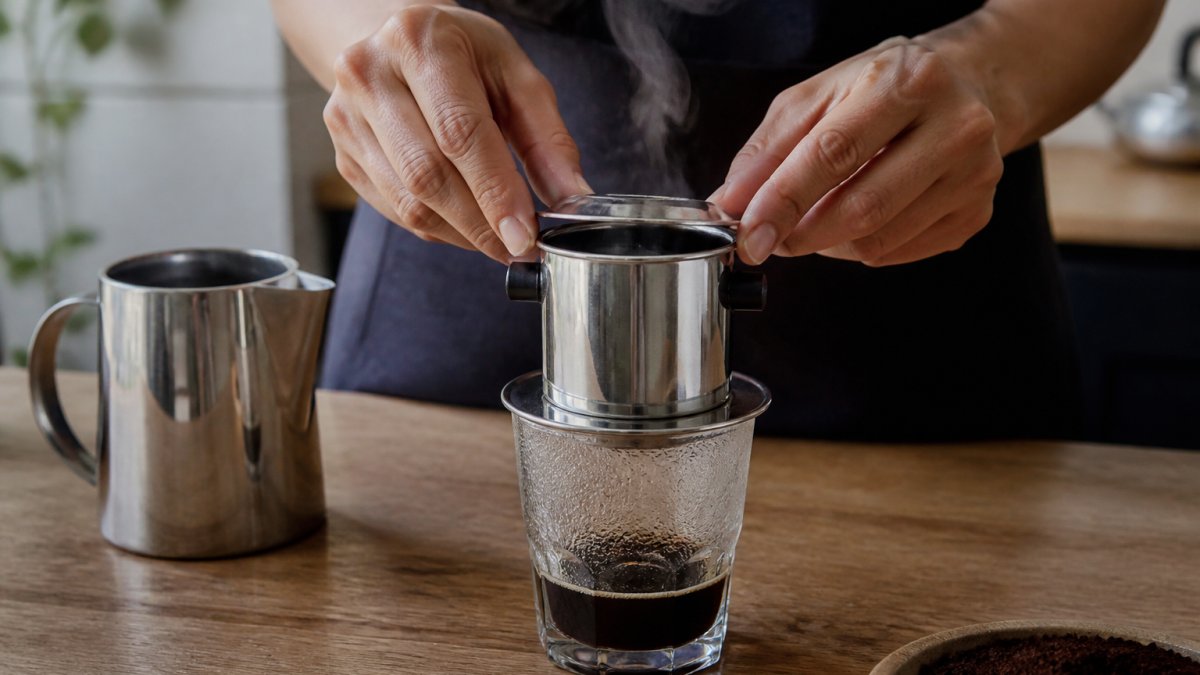
Step 1: Heat the Water and Rinse the Phin
Heat your water to just below boiling. Pour a splash through the empty phin to warm the metal and rinse out dust.
Set the phin over your cup. Dump the rinse water.
Step 2: Add Coffee and Level the Bed
Add 2 tablespoons of finely ground coffee. Shake the phin gently to level the bed.
Do not press hard yet. Loose grounds let water move through evenly.
Step 3: Bloom, Press, and Pour
Pour a small splash of hot water over the grounds. Wait 30 seconds. This bloom lets trapped gas escape.
Now set the gravity insert on top and press lightly. Add the rest of your water, cover with the lid, and wait.
Expected result: coffee drips steadily, one drop at a time, and finishes in about four minutes.
The Vietnamese Phin Coffee Ratio That Works Every Time
The working ratio is 2 tablespoons of coffee to 4 to 6 ounces of water. That is roughly 1:8 by volume, much stronger than drip coffee, because the phin is built for small, intense servings.
Scale it up:
| Servings | Coffee | Water | Cup Size |
|---|---|---|---|
| 1 | 2 tbsp | 4-6 oz | Small glass |
| 2 | 4 tbsp | 8-12 oz | Two glasses |
| 4 | 8 tbsp | 16-24 oz | Four glasses |
For the beans, a medium roast with body holds up well against the strength. Our Colombia Single Origin Coffee brings dark chocolate and stone fruit that stays readable even in a small, concentrated cup.

Vietnamese Coffee Grind Size for Phin Brewing
The phin is a gravity brewer with a fixed metal screen, so grind is the only variable you control for flow rate. The right grind is fine, close to espresso, with a texture like fine sand, but "fine" is a range, and the phin is less forgiving than a drip machine. Too coarse and water races through in under two minutes, leaving a thin, sour cup.
Why grind controls the phin
Water passes through the coffee bed by gravity alone. The metal screen has fixed holes, so the resistance comes almost entirely from the grounds. A finer grind packs more surface area into the same volume, slowing the flow and increasing extraction. A coarser grind does the opposite. That is why the same 2 tablespoons can brew in three minutes one day and six the next, the grind shifted, not the recipe.
Colombia Single Origin Coffee →
How to verify your grind without a setting chart
Grinder settings are not comparable across brands, so verify by behavior instead:
- The pinch test. Rub a pinch between your fingers. It should feel like powder with slight grit, not slick like flour, not sandy like table salt.
- The bed test. After brewing, the spent grounds should form a flat, even puck that holds its shape when you lift the insert. A crater or channel means water found a path; a sludgy, sunken bed means the grind was too fine.
- The drip test. A correct grind drips steadily, one drop at a time, and finishes in about four minutes. If it finishes under two minutes, go one notch finer. If it is still dripping at six minutes, go one notch coarser.
- The cup test. Grit in the glass means the grind was fine enough to pass the screen, coarsen one notch. A watery, sour cup means the water moved too fast, grind finer.
Choosing beans for a phin
Because the phin makes a small, concentrated cup, the bean has to hold up. A medium roast with body, chocolate, nut, or stone-fruit notes, stays readable at a 1:8 ratio. Very light roasts can taste sharp and underdeveloped in a phin, and very dark roasts can turn ashy when the brew runs long.
If your grinder cannot reach a fine enough setting, see our guide to manual coffee grinders for travel and camping before your first brew.
How Long to Brew Vietnamese Coffee in a Phin
A full phin brew takes about four minutes from first pour to last drop. The bloom adds 30 seconds at the start.
Use this timeline:
- 0:00 Bloom pour, 30 seconds
- 0:30 Press insert, add remaining water
- 1:00 Steady drip begins
- 3:30 to 4:30 Drip finishes
If it finishes in under two minutes, your grind is too coarse. If it is still dripping at six minutes, it is too fine or you pressed too hard.
Phin Filter Troubleshooting: Fix Drips, Clogs, and Weak Cups
Most phin problems trace back to two variables: grind and pressure. The table below maps symptoms to causes, but the faster path is to diagnose in order, check the drip rate first, then the bed, then the cup. That sequence tells you whether the problem is in the grind, the tamp, or the water.
Diagnose in order
- Watch the drip rate. Steady, one-drop-at-a-time flow that finishes in about four minutes is correct. Fast flow points to a coarse grind; a stall points to a fine grind or a hard press.
- Look at the spent bed. A flat, even puck means the water moved evenly. A crater or channel means the water found a path, usually a coarse grind or an uneven bed. A sludgy, sunken bed means the grind was too fine.
- Taste the cup. Sour and thin means under-extraction (too fast, too coarse). Bitter and harsh means over-extraction (too slow, too fine, or water too hot). Grit means the grind passed the screen.
Symptom, cause, and fix
| Symptom | Likely Cause | Fix |
|---|---|---|
| Water won't drip | Grind too fine or insert pressed hard | Coarsen grind one notch, press lightly |
| Drains in seconds | Grind too coarse | Grind finer, tamp gently |
| Weak, watery cup | Too much water or too little coffee | Use the 1:8 ratio; weigh the dose |
| Bitter, harsh cup | Water too hot or over-extracted | Cool water slightly, shorten brew |
| Grit in the cup | Grind too fine | Coarsen one notch |
| Uneven extraction | Bed not leveled or channeling | Shake to level before pressing |
| Sour, sharp cup | Under-extracted (too fast) | Grind finer or slow the pour |
Staged fixes
Start with the least destructive change and work outward:
- First, adjust pressure. Press the insert just enough to level the bed. Hard pressing is the most common cause of a stalled drip and over-extraction.
- Second, adjust grind by one notch. Change one variable at a time so you can tell what worked.
- Third, adjust water temperature. Water just below boiling (roughly 195°F to 200°F) is the target; cooler water slows extraction and can leave the cup sour.
- Fourth, check the dose. Two tablespoons can swing between 10 and 14 grams; a scale keeps the ratio stable.
For weak or uneven cups, our guide to improving coffee extraction at home covers the broader techniques. If your cup tastes sharp or bitter, read why coffee tastes bitter and how to fix it before you blame the phin.
Serving, Iced Coffee, and Cleaning Your Phin
Serve the coffee straight from the phin over a small glass. Sweetened condensed milk goes in the cup first if you want the classic version, and the hot coffee goes on top.
For iced coffee, fill a glass with ice and brew directly over it. The phin sits on the rim.
Cleaning takes a minute:
- Rinse the parts under warm water right after brewing.
- Skip the dishwasher for the metal parts.
- Dry fully before storing to avoid mineral buildup.
If you are weighing filter options, our piece on alternatives to paper coffee filters explains what changes in the cup. The metal phin screen is already one of them.
Frequently Asked Questions
How much coffee and water should I use in a Vietnamese phin filter?
Most 4- to 8-ounce phins hold about 2 tablespoons (roughly 10 to 14 grams) of finely ground coffee and take 3 to 4 fluid ounces of hot water. A common starting point is a 1:5 coffee-to-water ratio by weight, which makes a concentrated cup meant to be poured over ice or sweetened condensed milk. If you want a larger serving, size up to a bigger phin rather than overfilling a small one, since an overloaded basket slows the drip and turns the cup bitter.
What grind size works best for a Vietnamese phin filter?
Use a grind close to espresso-fine, just slightly coarser than powder. The phin's metal filter plate has wide holes, so too-coarse grounds let water rush through and leave a thin, sour cup. Too fine and the filter clogs, stretching the brew past 6 minutes. If you buy pre-ground coffee, look for a Vietnamese-style or espresso grind. Freshly roasted beans ground right before brewing give the best aroma, and a medium or medium-dark roast holds up well against the sweetened condensed milk many people add.
Why is my phin coffee dripping too slowly?
Slow drips usually come from a grind that is too fine, too much coffee packed into the basket, or pressing the insert down too hard. Try loosening the grind by one setting, using 2 level tablespoons instead of a heaping scoop, and setting the insert gently rather than tamping it. Water temperature matters too: water at about 200°F flows better than lukewarm water. If the filter still stalls, lift the insert slightly and add a splash of hot water to restart the flow.
Can you use a Vietnamese phin filter to make iced coffee?
Yes, and it is the standard way to make iced Vietnamese coffee. Set the phin over a glass with 1 to 2 tablespoons of sweetened condensed milk (or a dairy-free alternative), brew the coffee hot, and stir well so the milk dissolves. Fill the glass with ice and stir again. The concentrated 1:5 ratio means the ice will not water down the flavor. For a lighter drink, pour the brewed coffee over a taller glass of ice and add milk to taste.
Brewing a phin is a small ritual with a short learning curve, and the payoff is a cup with real depth. The two variables that matter most are grind and restraint: fine grounds, light pressure, steady drip. LGBrewTeaQ roasts single-origin coffee to order so the beans arrive fresh enough to hold up in a concentrated phin cup, with careful sourcing and fast delivery behind every order. Get started with LGBrewTeaQ and brew your first phin cup this week.
